Every business wants more visibility, more enquiries, more customers, and stronger online growth. But when companies start researching Digital Marketing Services, they often encounter a long list of options: SEO, Google Ads, social media marketing, content marketing, email marketing, website development, conversion optimization, influencer marketing, analytics, AI marketing, and more.
The real challenge isn’t finding a digital marketing service. It is deciding which services actually deserve your budget.
A small local business may need a completely different digital strategy from a B2B company, e-commerce brand, healthcare provider, real-estate company, or education business. Investing in every available marketing channel can spread a budget too thin and make performance difficult to measure.
The better approach is to start with business objectives, customer behavior, sales cycles, competition, existing digital assets, and measurable outcomes.
This guide explains the major Digital Marketing Services, what each service does, when a business should consider investing in it, and how to build a practical digital marketing strategy without wasting budget.
What Are Digital Marketing Services?
Digital Marketing Services are professional marketing activities designed to help businesses attract, engage, convert, and retain customers through digital channels.
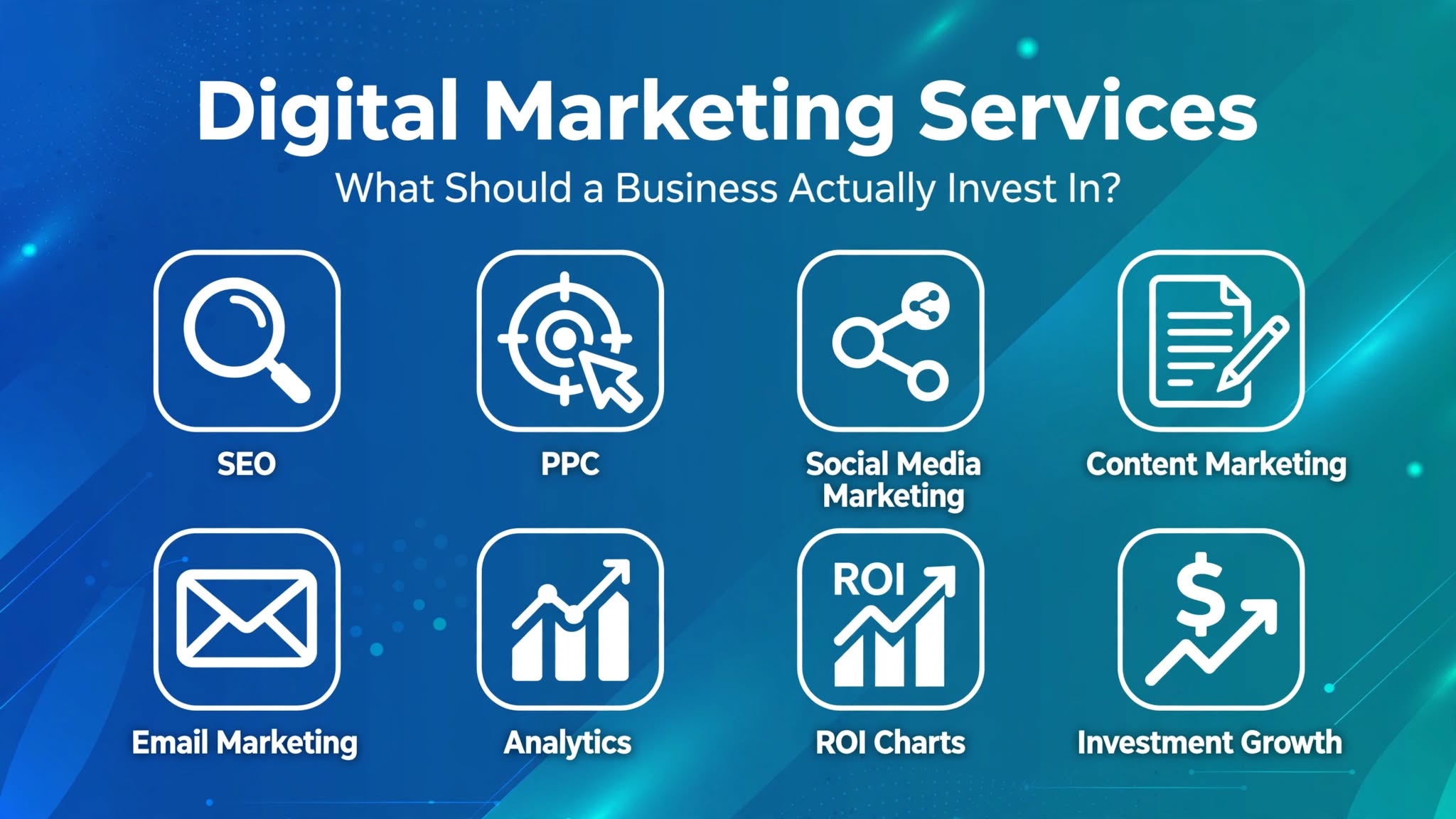
These services can include:
- Search Engine Optimization (SEO)
- Search Engine Marketing and Google Ads
- Social media marketing
- Content marketing
- Local SEO
- Website optimization
- Conversion rate optimization
- Email marketing
- Online reputation management
- Marketing analytics
- AI-assisted marketing
- Video marketing
- Performance marketing
- Lead generation
- E-commerce marketing
SEO is designed to improve organic visibility and discoverability. Paid search is designed to generate visibility through advertising. Social media can support awareness, engagement, community building, and paid acquisition. Conversion optimization focuses on improving what happens after users reach the website.
A business therefore shouldn’t ask:
“Which digital marketing service is the best?”
A more useful question is:
“Which marketing activities are most closely connected to our current business objective?”
Google’s Search Essentials recommends creating helpful, reliable, people-first content and making websites accessible to search engines. Google also emphasizes that SEO should support useful content rather than content created primarily to manipulate rankings. [Reference Source: Google Search Central]
The Core Digital Marketing Services Businesses Should Consider
1. SEO: Build Sustainable Organic Visibility
SEO is one of the foundational Digital Marketing Services for businesses that want to attract people through search engines without paying for every individual click.
SEO can involve:
- Keyword research
- Search-intent analysis
- Technical SEO
- On-page SEO
- Content optimization
- Internal linking
- Structured data
- Local SEO
- Digital PR and link acquisition
- Content strategy
- Search performance analysis
Google describes SEO as helping search engines understand your content and helping users find your site through search. It also notes that there are no secret techniques that automatically guarantee first position. [Reference Source: Google Search Central]
When should a business invest in SEO?
SEO can be particularly relevant when:
- Customers actively search for your products or services.
- Competitors are receiving organic search traffic.
- Your website has useful content but limited visibility.
- You want to build a long-term acquisition channel.
- You operate in a local market and need local search visibility.
- Your sales cycle involves research before contacting your business.
What should SEO investment include?
A professional SEO program should go beyond publishing blogs.
A practical SEO strategy can include:
Technical foundation → Keyword research → Search-intent mapping → Landing pages → Content → Internal linking → Authority building → Measurement → Continuous improvement
Search Console can provide data including clicks, impressions, CTR, average position, queries, pages, countries, devices, and search appearances. This information can help SEO teams identify which areas require improvement.
2. Google Ads and PPC: Capture Existing Demand
SEO helps businesses earn organic visibility, while Google Ads can provide paid visibility when users are actively searching.
For businesses with strong commercial search demand, PPC can be an important part of the marketing mix.
Google Ads can be used for objectives such as:
- Lead generation
- Sales
- Phone calls
- Online purchases
- Local enquiries
- Brand visibility
- Remarketing
However, paid advertising should not begin with:
“How much should we spend?”
It should begin with:
“What business outcome are we buying?”
For example, a B2B company may care about qualified leads rather than total form submissions.
An e-commerce company may care about revenue and conversion value.
A local service business may care primarily about phone calls and qualified enquiries.
AI and Google Ads
Google’s Smart Bidding uses AI to optimize bids for conversions or conversion value at auction time. Available strategies include Target CPA, Target ROAS, Maximize Conversions, and Maximize Conversion Value.
But automation does not eliminate the need for strategy.
Campaign structure, conversion tracking, landing-page quality, targeting, creative assets, offers, budgets, and business goals still matter.
Google specifically recommends accurate conversion data when setting up Smart Bidding.
Therefore, before increasing an advertising budget, businesses should verify that they are measuring the right conversions.
3. Local SEO: Essential for Location-Based Businesses
If customers search for services by location, Local SEO can be one of the most valuable Digital Marketing Services.
Examples include searches such as:
- Digital marketing agency near me
- Dentist in Noida
- Best salon in Gurgaon
- Real estate company in Greater Noida
- Restaurant near me
- Digital Marketing Services in Noida
A local SEO strategy may include:
- Google Business Profile optimization
- Accurate business information
- Local landing pages
- Reviews and reputation management
- Local keyword research
- Location-specific content
- Local citations where appropriate
- Website optimization
- Local business structured data where applicable
- Search performance monitoring
Digital Marketing Services in Noida
For a company targeting Noida, Greater Noida, Delhi NCR, or nearby business markets, local SEO can be integrated with broader SEO and lead-generation campaigns.
Instead of creating dozens of nearly identical location pages, businesses should create genuinely useful pages that explain:
- Services offered
- Areas served
- Customer problems addressed
- Relevant industries
- Local experience
- Frequently asked questions
- Contact options
- Supporting resources
The goal should be to help a potential customer make a decision—not simply insert a city name repeatedly.
4. Content Marketing: Turn Expertise Into Searchable Assets
Content marketing is often treated as “writing blogs.”
That is too narrow.
A strong content strategy can include:
- Blog articles
- Service pages
- Industry pages
- Case studies
- Research reports
- Guides
- FAQs
- Videos
- Infographics
- Social content
- Email content
- Downloadable resources
The purpose of content should be connected to the customer journey.
Top-of-funnel content
People are researching a problem.
Examples:
- What is digital marketing?
- How does SEO work?
- How much does Google Ads cost?
- How can a business generate online leads?
Middle-of-funnel content
People are comparing solutions.
Examples:
- SEO vs PPC
- In-house vs agency marketing
- Google Ads vs Meta Ads
- Digital marketing agency vs freelancer
Bottom-of-funnel content
People are close to taking action.
Examples:
- Digital marketing services
- SEO services
- Google Ads management
- Digital Marketing Services in Noida
- Request a digital marketing consultation
Google’s people-first content guidance emphasizes original information, comprehensive coverage, expertise, and content that provides meaningful value beyond simply rewriting other sources.
That makes content quality more important than simply meeting a particular word count.
5. Social Media Marketing: Build Visibility and Engagement
Social media marketing can help businesses distribute content, communicate with customers, strengthen brand recognition, and support paid campaigns.
Depending on the audience and industry, businesses may use:
- YouTube
- X
- Other relevant social platforms
But businesses shouldn’t automatically maintain every social account.
The better approach is to identify where the target audience actually spends time and what type of content works on that platform.
Organic vs Paid Social
Organic social media can support:
- Brand communication
- Community engagement
- Educational content
- Product updates
- Employer branding
- Customer relationships
Paid social can support:
- Lead generation
- Sales
- Retargeting
- Audience acquisition
- Promotional campaigns
- Content distribution
The two approaches can complement each other, but they should have clearly defined objectives.
6. Website and Conversion Rate Optimization
Driving traffic to a poor website can waste marketing investment.
Imagine spending money on Google Ads and SEO but sending visitors to:
- A slow website
- Confusing navigation
- Weak service pages
- Unclear contact options
- Poor mobile experience
- Complicated enquiry forms
- Generic messaging
The problem isn’t necessarily the traffic.
The problem may be what happens after the click.
Conversion optimization examines how effectively a website turns relevant visitors into meaningful actions.
These actions can include:
- Contact form submissions
- Phone calls
- WhatsApp enquiries
- Product purchases
- Demo requests
- Appointment bookings
- Newsletter registrations
A conversion-focused website should make three things clear:
What do you offer?
Why should the customer consider you?
What should they do next?
7. Analytics and Measurement: Know What Your Marketing Is Actually Doing
A marketing strategy without measurement is difficult to improve.
Businesses should establish a measurement framework before scaling campaigns.
Useful metrics can include:
SEO
- Organic clicks
- Impressions
- CTR
- Search queries
- Landing pages
- Rankings and visibility trends
- Organic conversions
Paid Advertising
- Spend
- Clicks
- CTR
- CPC
- Leads
- Cost per lead
- Conversion rate
- Conversion value
- ROAS where appropriate
Website
- Users
- Engagement
- Landing-page performance
- Form submissions
- Key events
- Conversion paths
Google Analytics uses key events to identify user actions that are particularly important to a business. These can include meaningful actions such as lead-form submissions. Key events can then help marketers understand user behavior and marketing performance.
Google also explains that Search Console and Google Analytics provide complementary information: Search Console focuses on how people discover and interact with a site through Google Search, while Analytics provides information about what happens after users reach the website.
This distinction is extremely useful.
Search Console answers:
“What are people searching for and how is my site appearing?”
Analytics answers:
“What are users doing after they arrive?”
Together, they provide a more useful view of the customer journey.
How Much Should a Business Invest in Digital Marketing Services?
There is no universal percentage or fixed amount that is appropriate for every company.
A practical budget should be determined by factors such as:
- Business revenue
- Gross margin
- Customer lifetime value
- Average order value
- Lead-to-customer rate
- Customer acquisition cost
- Sales cycle
- Competition
- Geographic market
- Existing website performance
- Marketing maturity
- Available internal resources
A simple budgeting framework
Instead of dividing the budget equally across every channel, consider a three-stage model.
Stage 1: Foundation
Invest in:
- Website quality
- Technical SEO
- Analytics
- Conversion tracking
- Core service pages
- Google Business Profile where relevant
Stage 2: Demand Generation
Invest in channels that match customer behavior:
- SEO
- Google Ads
- Social media
- Content marketing
- Local SEO
Stage 3: Optimization and Scale
Once sufficient performance data exists:
- Improve conversion rates
- Expand successful campaigns
- Build additional content clusters
- Refine audiences
- Improve landing pages
- Test new channels
- Automate repetitive processes
- Increase investment where business economics support it
This approach helps prevent businesses from spending heavily before the foundation is ready.
Which Digital Marketing Services Should Different Businesses Consider?
There is no single package that fits every organization.
| Business Type | Services to Consider |
|---|---|
| Local service business | Local SEO, Google Ads, website optimization, reviews, content |
| B2B company | SEO, content marketing, LinkedIn, Google Ads, lead generation |
| E-commerce | SEO, shopping/PPC, paid social, CRO, analytics, remarketing |
| Real estate | Local SEO, Google Ads, Meta Ads, landing pages, content |
| Healthcare | SEO, local SEO, informative content, reputation management |
| Education | SEO, content, Google Ads, Meta Ads, landing pages, lead tracking |
| Startup | SEO foundation, content, paid testing, analytics, conversion optimization |
| Professional services | SEO, local SEO, thought leadership, Google Ads, website optimization |
These are starting frameworks rather than fixed packages.
The correct combination depends on customer behavior and commercial objectives.
A Practical Digital Marketing Investment Framework
Before purchasing any Digital Marketing Services, answer these ten questions:
1. What is the primary business goal?
Is it:
- Leads?
- Sales?
- Revenue?
- Brand awareness?
- Website traffic?
- Market expansion?
2. Who is the target customer?
Define:
- Location
- Industry
- Age or professional profile where relevant
- Needs
- Search behavior
- Purchase intent
3. What does the customer search for?
Identify commercial, informational, branded, and local search opportunities.
4. What happens after the customer clicks?
Review landing pages and conversion paths.
5. Which channels already work?
Use historical data wherever available.
6. What can be measured?
Set up meaningful key events and advertising conversions.
7. What is the sales value of a lead?
A ₹1,000 lead and a ₹50,000 lead should not necessarily be evaluated using the same acquisition target.
8. How long is the sales cycle?
SEO and content may support longer journeys, while paid search can capture immediate demand.
9. What can the internal team handle?
An organization with an experienced marketing department may need specialized support rather than full-service execution.
10. What should happen next?
Every marketing campaign should have a clear optimization process.
Real-World Example: A Business Looking for Digital Marketing Services in Noida
Consider a hypothetical B2B company serving customers in Noida and Delhi NCR.
Its website receives traffic, but enquiries are inconsistent.
Instead of immediately launching campaigns across every platform, the company could follow a structured process.
Month 1: Audit and Foundation
- Technical SEO audit
- Keyword research
- Competitor analysis
- Analytics review
- Conversion tracking
- Website and landing-page review
- Google Business Profile review
Month 2: Build Demand
- Optimize important service pages
- Create commercial content
- Launch targeted Google Ads
- Improve local search visibility
- Develop supporting educational content
Month 3: Analyze and Optimize
Review:
- Search queries
- Landing pages
- Lead quality
- Advertising costs
- Conversion rates
- Organic visibility
- Customer acquisition data
The team can then allocate additional resources based on evidence rather than assumptions.
For example, if paid search produces enquiries but the leads are poorly qualified, the answer may not simply be “increase the budget.” The business may need better keyword targeting, landing-page messaging, conversion definitions, qualification questions, or sales follow-up.
Common Mistakes When Buying Digital Marketing Services
Mistake 1: Choosing a Package Instead of a Strategy
A list of services doesn’t automatically create a marketing strategy.
Solution: Start with business objectives and customer journeys.
Mistake 2: Focusing Only on Traffic
More traffic isn’t necessarily more business.
Solution: Measure qualified leads, sales, revenue, and meaningful website actions.
Mistake 3: Expecting Immediate SEO Results
SEO generally requires ongoing optimization and measurement.
Solution: Establish realistic milestones and monitor trends over time.
Mistake 4: Running Ads Without Conversion Tracking
If meaningful conversions aren’t measured correctly, optimization becomes much harder.
Solution: Configure analytics and advertising conversions before scaling campaigns.
Mistake 5: Publishing Content Only for Keywords
Keyword insertion isn’t a substitute for useful information.
Solution: Build content around customer questions, search intent, expertise, evidence, and genuine usefulness. Google’s guidance specifically recommends people-first content rather than search-engine-first publishing.
Mistake 6: Trying Every Platform
Being active everywhere can consume resources without producing meaningful results.
Solution: Prioritize channels according to audience and business objectives.
How to Choose a Digital Marketing Agency
If you decide to work with an agency, evaluate its process rather than only its service list.
Look for an agency that can explain:
- How it will understand your business
- How it will identify the target audience
- How it will conduct keyword research
- How campaigns will be measured
- Which KPIs will be reported
- How frequently optimization will happen
- How content will be reviewed
- How paid campaigns will be managed
- How lead quality will be evaluated
- How strategy will change based on performance data
Ask for examples of relevant work where appropriate, but also ask how success was measured.
A professional agency should be able to distinguish between activity metrics and business outcomes.
For example:
“We published 20 blogs.”
is an activity metric.
Whereas:
“These pages generated qualified organic enquiries and contributed to the sales pipeline.”
is closer to a business outcome.
The Future of Digital Marketing Services
Digital marketing is becoming increasingly data-driven and AI-assisted.
AI can support:
- Research
- Content workflows
- Audience analysis
- Advertising optimization
- Reporting
- Personalization
- Customer service
- Marketing automation
Google Ads already uses AI within Smart Bidding to optimize bids using conversion and contextual signals.
At the same time, search continues to evolve, making high-quality content, technical accessibility, structured information, and strong brand signals increasingly important.
The future is therefore unlikely to be about choosing AI instead of marketers.
It is more likely to involve marketers using AI and automation to handle repetitive work while spending more time on strategy, creativity, analysis, customer understanding, and decision-making.
Conclusion: Invest in the Right Digital Marketing Services, Not Every Service
The right Digital Marketing Services investment depends on your business model, audience, competition, sales cycle, existing digital presence, and objectives.
For some businesses, SEO and content may form the foundation. For others, paid search and lead generation may be more immediately relevant. Local businesses may need Local SEO and Google Business Profile optimization, while e-commerce companies may prioritize paid acquisition, SEO, conversion optimization, and analytics.
The most effective approach is to build a connected system:
Strategy → Website → SEO → Content → Paid Marketing → Conversion Optimization → Analytics → Continuous Improvement
If your business operates in Noida or Delhi NCR and needs a structured approach to SEO, paid advertising, content marketing, local search, lead generation, and performance measurement, exploring Digital Marketing Services in Noida can be a practical starting point.