Businesses in India are increasingly using paid digital advertising to generate leads, increase sales, attract website visitors, and build brand awareness. Two of the most widely used advertising platforms are Google Ads and Meta Ads. Both provide opportunities to reach potential customers, but they work differently and serve different marketing objectives.
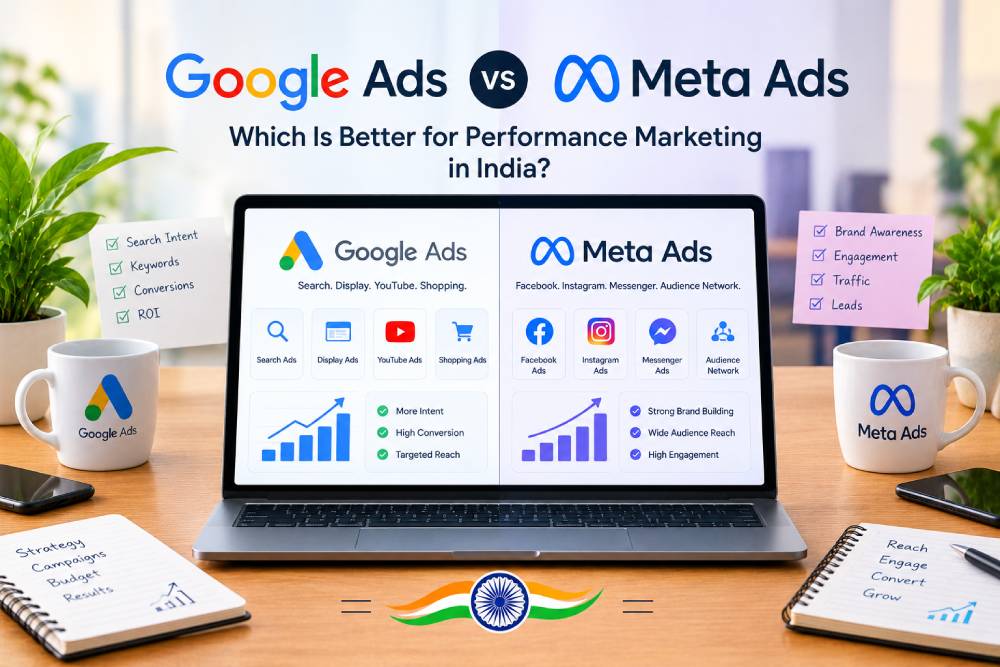
When comparing Google Ads vs Meta Ads for performance marketing in India, the right choice depends on the business model, target audience, customer buying journey, campaign objectives, and available budget. Google Ads can help businesses reach people actively searching for products or services, while Meta Ads can help businesses discover and engage audiences through platforms such as Facebook and Instagram.
Neither platform is universally better. A campaign that performs well for an ecommerce brand may not deliver the same results for a local service provider or a B2B company. Understanding how each platform works can help businesses make more informed advertising decisions.
This guide explains the differences between Google Ads and Meta Ads, their advantages, costs, targeting options, performance metrics, and practical use cases to help Indian businesses choose the right strategy.
What Is Performance Marketing?
Performance marketing is a digital marketing approach in which campaigns are planned, tracked, and optimized around measurable objectives. These objectives may include website purchases, qualified leads, app installs, registrations, phone calls, or other valuable customer actions.
Instead of judging a campaign only by impressions or clicks, performance marketers examine how advertising contributes to business outcomes.
Common performance marketing metrics include:
- Click-through rate (CTR): The percentage of impressions that result in clicks.
- Cost per click (CPC): The average cost paid for a click under the applicable advertising model.
- Cost per lead (CPL): The advertising cost associated with generating a lead.
- Conversion rate: The proportion of relevant interactions that result in a defined conversion.
- Cost per acquisition (CPA): The cost associated with acquiring a customer or completing a specified action.
- Return on ad spend (ROAS): The revenue attributed to advertising divided by the advertising spend, using a consistent attribution method.
These metrics help businesses understand campaign efficiency. However, a low cost per lead does not automatically mean a campaign is profitable. Lead quality, sales conversion rates, margins, and customer lifetime value also matter.
What Are Google Ads?
Google Ads is Google’s advertising platform. It allows advertisers to promote products and services across eligible placements, including Google Search, YouTube, and other participating properties.
One of the main strengths of Google Ads is its ability to reach people based on their searches and other relevant signals. For example, someone searching for “best website development company in Noida” may be actively comparing providers.
A business offering website development services can use relevant search campaigns to reach potential customers at that moment.
Major Google Ads Campaign Types
1. Search Ads
Search campaigns can display text ads for relevant search queries. They are particularly useful when customers already know what they need and are looking for a solution.
Examples include searches for a service provider, a specific product, or a local business.
2. Shopping Ads
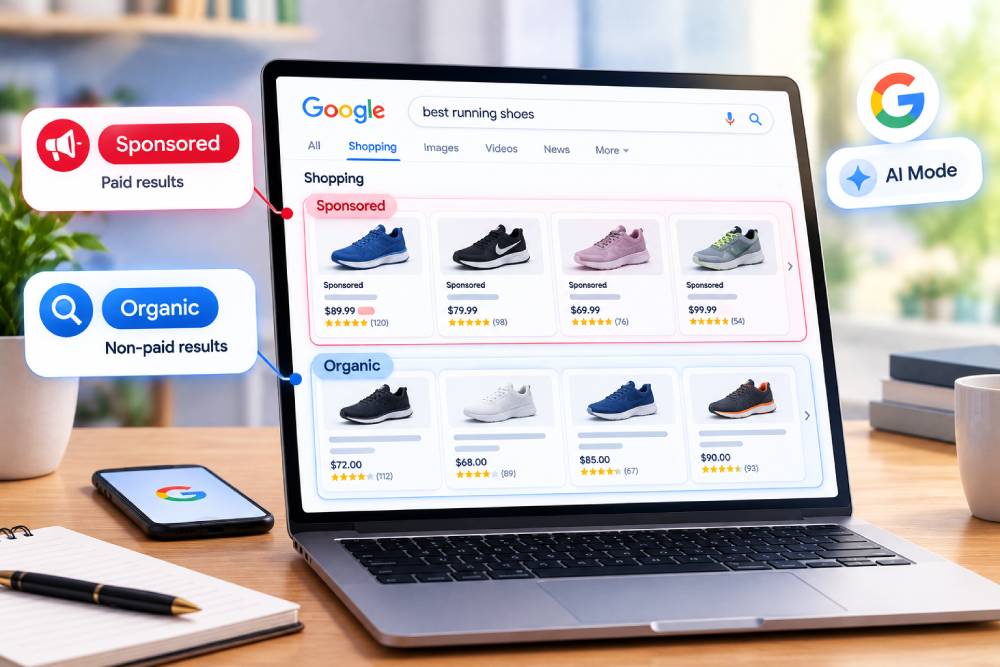
Eligible ecommerce businesses can use Shopping ads to showcase products with information such as product images, titles, and prices. Accurate product data and compliance with Google’s Merchant Center policies are important.
3. Display Ads
Display campaigns can reach audiences through eligible websites and apps. They may be useful for awareness, remarketing, or other campaign objectives, depending on the strategy.
4. YouTube Ads
YouTube advertising can help businesses reach audiences through video placements. It can support brand awareness, product demonstrations, consideration, and certain conversion objectives.
5. Performance Max Campaigns
Performance Max uses Google’s automated campaign technology to access multiple eligible Google advertising channels from a single campaign. Results depend on campaign settings, conversion data, creative assets, product or service relevance, and other factors.
Benefits of Google Ads for Indian Businesses
Google Ads can be valuable when there is clear search demand for a product or service. Its benefits may include:
- Reaching users searching for relevant solutions.
- Targeting selected locations and languages where available.
- Testing different keyword themes and ad messages.
- Promoting time-sensitive offers.
- Measuring conversions when tracking is configured correctly.
- Adjusting campaign budgets and targeting based on performance.
However, search advertising can be competitive. Popular commercial keywords may attract multiple advertisers, and clicks can become expensive relative to the value of the resulting leads or sales. Keyword research, negative keywords, landing-page relevance, and conversion tracking are therefore important.
What Are Meta Ads?
Meta Ads is the advertising platform used to create campaigns across eligible Meta placements, including Facebook and Instagram. Depending on campaign settings and eligibility, ads may also appear across other Meta placements.
Google Search often captures existing demand, while Meta Ads can help businesses introduce products, offers, or ideas to audiences who may not be actively searching for them.
For example, an Indian skincare brand can use visually engaging Instagram ads to introduce a product to relevant audiences and encourage them to explore the brand’s website.
Common Meta Ads Formats
1. Image Ads
Image ads use a single visual to communicate an offer, product benefit, or message. Clear imagery and concise copy can help users understand the advertisement quickly.
2. Video Ads and Reels
Short videos can demonstrate product features, show how a service works, or communicate a brand’s value. The opening seconds, creative relevance, and mobile-friendly presentation can influence how people engage with the ad.
3. Carousel Ads
Carousel formats allow advertisers to present multiple images or videos in one ad. They can be useful for showcasing product collections, explaining a process, or highlighting several service features.
4. Lead Ads
Lead generation campaigns can help businesses collect enquiries through eligible platform forms or direct users to a website landing page. Businesses should consider lead quality, consent, follow-up speed, and how enquiries are transferred to their sales process.
5. Sales and Retargeting Campaigns
Eligible campaigns can help businesses promote products and reconnect with relevant audiences who have interacted with their content or website. Implementation depends on platform policies, tracking setup, audience eligibility, and applicable privacy requirements.
Benefits of Meta Ads in India
Meta Ads can be useful for businesses that depend on visual presentation, audience discovery, repeated exposure, and social engagement.
Potential benefits include:
- Promoting products through image, video, and carousel formats.
- Reaching relevant audiences using available targeting options.
- Supporting lead generation and ecommerce sales.
- Testing different creative concepts and messages.
- Building brand awareness among audiences who may not be actively searching.
- Supporting remarketing where permitted and appropriately configured.
Meta Ads also has limitations. Users may not be actively looking to purchase when they encounter an ad, and results can vary with creative quality, audience relevance, offer strength, competition, and the purchase journey.
Google Ads vs Meta Ads: Key Differences
The following table summarizes how the platforms commonly differ. Actual campaign capabilities and results depend on the selected campaign type, settings, market, and business model.
| Factor | Google Ads | Meta Ads |
|---|---|---|
| Main opportunity | Reach people through search intent and other Google advertising placements | Reach and engage audiences across Meta placements |
| Typical strength | Capturing existing demand | Generating interest and discovering potential customers |
| Common formats | Search text ads, Shopping ads, Display, YouTube, automated campaigns | Image, video, Reels, carousel, lead and sales ads |
| Audience signals | Search queries, keywords where applicable, location, audiences, and other campaign signals | Available audience targeting, engagement signals, and campaign optimization signals |
| Creative requirements | Search campaigns emphasize relevant text; other formats may require images or video | Visual and video creative often plays a major role |
| Common use cases | High-intent services, product searches, local enquiries, ecommerce | Product discovery, visual brands, social engagement, lead generation |
| Important metrics | CPC, conversion rate, CPA, qualified leads, ROAS | CPC, CTR, cost per lead, conversion rate, CPA, ROAS |
| Main challenges | Competitive search terms, irrelevant queries, expensive clicks | Creative fatigue, variable lead quality, uncertain purchase intent |
| Best choice | When reaching active demand is a priority | When audience discovery and creative-led promotion are priorities |
The distinction is not absolute. Google Ads can generate demand through video and display campaigns, while Meta Ads can drive direct purchases from people who are ready to buy. The most suitable platform depends on how customers discover, evaluate, and purchase the product or service.
Google Ads vs Meta Ads: Which Is Better for Different Businesses in India?
1. Local Service Businesses
Businesses such as plumbers, clinics, consultants, repair providers, and website development companies may benefit from Google Search campaigns when customers actively search for their services.
For example, a local service provider may target relevant searches within its service area and send users to a page with clear service details, contact information, and an enquiry option.
Meta Ads can complement this approach by promoting offers, introducing the business to local audiences, or generating enquiries through suitable campaigns.
Practical starting point: If customers regularly search for the service by name or location, test Google Search first. Consider Meta Ads if visual promotion, local awareness, or additional lead generation is also important.
2. Ecommerce Businesses
Ecommerce brands may use Google Ads to reach shoppers searching for specific products or to promote eligible product listings. Meta Ads can showcase product benefits, lifestyle imagery, demonstrations, and product collections.
For example, a home decor store may use Google advertising to reach people searching for a particular product category and Meta video ads to demonstrate how the products look in real settings.
The most suitable approach depends on product demand, profit margins, inventory, creative resources, and the store’s conversion rate.
Practical starting point: Test the platform that best matches the product discovery journey, then compare performance using tracked purchases, contribution margins, and consistent attribution.
3. B2B Companies
B2B companies often have longer buying cycles, multiple decision-makers, and higher-value enquiries.
Google Search can help capture demand from people searching for a specific business solution. Meta Ads may support awareness, content distribution, and selected lead generation activities, depending on audience fit.
For B2B campaigns, measuring qualified opportunities and sales pipeline value is often more useful than counting every form submission as an equally valuable lead.
Practical starting point: Use high-intent search campaigns where relevant demand exists, and evaluate Meta campaigns through lead quality and downstream sales outcomes rather than lead volume alone.
4. Education and Training Businesses
Training institutes and educational businesses can use Google Ads to reach people searching for courses, certifications, or local classes. Meta Ads can promote course highlights, student resources, event registrations, and enquiry forms.
Advertising claims about placements, salaries, accreditation, and course outcomes should be accurate and verifiable.
Practical starting point: Choose campaigns according to the audience’s decision stage, course demand, admission deadlines, and ability to follow up with prospective students.
5. New Brands and Startups
New businesses may have limited brand recognition and little historical conversion data.
Meta Ads can help test creative messages and introduce products to relevant audiences. Google Ads can help capture demand when people already search for the category or problem the business solves.
A startup should avoid spreading a small budget across too many campaigns before understanding which audience and offer are most promising.
Practical starting point: Begin with a clear objective, a focused audience or keyword set, a relevant landing page, and reliable tracking. Expand only after reviewing meaningful results.
Google Ads vs Meta Ads: Which Platform Is More Affordable?
There is no universal rule that Google Ads is more expensive or Meta Ads is cheaper. Advertising costs vary by industry, audience, geography, competition, campaign objective, ad quality, bidding strategy, and time period.
A platform may generate inexpensive clicks but few customers. Another may produce more expensive clicks but attract people who are more likely to purchase.
For this reason, businesses should compare outcomes rather than CPC alone.
Understand the Difference Between CPC, CPL, CPA, and ROAS
Consider a hypothetical example in which a business spends ₹10,000 on each platform.
- Google Ads generates 20 leads.
- Meta Ads generates 40 leads.
The cost per lead would be ₹500 for Google Ads and ₹250 for Meta Ads. On the surface, Meta appears more efficient.
However, suppose only 5 Google leads and 4 Meta leads become customers. If each customer has the same value, Google may produce more customers despite generating fewer leads.
This example is illustrative, not a benchmark or a prediction of actual results. In a real campaign, businesses should also account for sales revenue, profit margins, lead quality, refunds where relevant, and the time required to convert leads.
Budget Planning for Indian Businesses
Before deciding how much to spend, consider:
- The value of a new customer.
- The profit margin on each sale.
- The conversion rate from lead to customer.
- The acceptable cost per acquisition.
- The likely cost of reaching relevant audiences.
- The budget required to collect useful campaign data.
Set a test budget that your business can afford to lose while learning. Establish clear stopping or adjustment criteria, and avoid scaling a campaign simply because it produces many clicks or leads.
How to Choose Between Google Ads and Meta Ads
A practical decision process can help you choose the platform that fits your current objectives.
Step 1: Define Your Campaign Objective
Decide whether you want purchases, qualified leads, phone calls, registrations, website traffic, or brand awareness. Your objective influences campaign selection and measurement.
Step 2: Understand How Customers Find Your Business
Ask whether customers actively search for your product or service, discover it through social content, or use a combination of both.
If high-intent searches are common, Google Search may be a useful starting point. If customers respond to demonstrations, lifestyle imagery, or product discovery, Meta may be a strong candidate.
Step 3: Evaluate Your Creative and Landing Pages
Google Search campaigns require relevant ad copy and useful landing pages. Meta campaigns often need a steady supply of suitable image or video creative.
Both platforms benefit from clear messaging, a relevant offer, fast and mobile-friendly pages, and a straightforward next step.
Step 4: Configure Conversion Tracking
Track the actions that matter to the business. Depending on the setup, this may include purchases, qualified enquiries, phone calls, or booked appointments.
Make sure that conversions are defined consistently and that the implementation respects applicable consent and privacy requirements. Inaccurate tracking can lead to misleading conclusions.
Step 5: Test and Compare Results
Run a structured test with a defined budget, audience or keyword strategy, and evaluation period. Avoid changing too many variables at once.
Compare cost per qualified lead, customer acquisition cost, conversion rate, revenue, and profitability where data is available. Use a consistent attribution approach when comparing platforms.
Step 6: Optimize Based on Business Outcomes
Review search terms, audience relevance, creative performance, landing-page experience, lead quality, and sales feedback. Pause ineffective activity, test improvements, and gradually increase investment where the evidence supports it.
Can Businesses Use Google Ads and Meta Ads Together?
Yes. Using both platforms can be effective when each has a defined role in the marketing strategy.
A business might use Google Search to reach people actively looking for a solution and Meta Ads to introduce its offer to new audiences. Meta may also support eligible remarketing activity, while Google campaigns can cover additional search demand.
A coordinated approach can include:
- Google Search: Reach relevant users searching for specific products or services.
- Meta Ads: Test creative messages and introduce the business to suitable audiences.
- Content marketing: Answer customer questions and support product or service evaluation.
- Landing pages: Provide relevant information and encourage the desired action.
- Analytics and CRM: Track enquiries, sales progress, and customer outcomes where available.
When both platforms are active, avoid treating every conversion as a completely independent result. The same customer may interact with multiple ads before converting, and each platform may use different attribution settings. Compare reports carefully and use business-level sales data where possible.
Common Mistakes to Avoid in Performance Marketing
Businesses can waste advertising budgets when they focus on platform settings without addressing the underlying customer journey.
Choosing a platform based only on CPC: Lower click costs do not guarantee better business results.
Using the same creative everywhere: Each platform and placement has different user behaviour and format requirements. Adapt messaging and assets to the audience and placement.
Sending all traffic to the homepage: A relevant service or product landing page may provide a clearer path to conversion.
Ignoring lead quality: A high number of form submissions is not useful if the leads are irrelevant or cannot be converted into customers.
Failing to track sales: Businesses that stop measuring at the form submission stage may miss important differences in downstream conversion rates.
Changing campaigns too frequently: Constant changes can make it difficult to understand what is driving performance. Use structured tests and allow sufficient time and data for evaluation.
Expecting guaranteed results: Neither platform can guarantee a specific number of leads, sales, or return on advertising spend.
Frequently Asked Questions
1. Is Google Ads better than Meta Ads in India?
Google Ads may be better when customers actively search for a product or service. Meta Ads may be more suitable for visual promotion, audience discovery, and social engagement. The right choice depends on the business objective, customer journey, and campaign economics.
2. Which platform is better for lead generation?
Both platforms can generate leads. Google Search can reach people with clear search intent, while Meta lead campaigns can help businesses collect enquiries from relevant audiences. Compare the quality and conversion rate of leads, not only the number generated.
3. Which is better for ecommerce: Google Ads or Meta Ads?
Google Ads can help capture product search demand and promote eligible product listings. Meta Ads can help showcase products through visual creative and reach potential buyers. Many ecommerce businesses test both and allocate budget according to profitable sales, margins, and customer acquisition costs.
4. Can I start performance marketing with a small budget?
Yes, but the appropriate budget depends on your market, conversion goal, competition, and expected customer value. Begin with a focused campaign and reliable tracking rather than splitting a limited budget across many campaigns.
5. Do I need an agency to run Google Ads and Meta Ads?
Not necessarily. Businesses can manage campaigns internally if they have the required skills, time, and tracking setup. An agency may be helpful when a business needs specialist expertise, structured optimization, creative support, or reporting. Evaluate providers on their process, transparency, and relevance to your goals.
6. How long does it take to see results from paid advertising?
Campaigns may start generating clicks after they become eligible to serve, but reliable performance evaluation usually requires sufficient conversion data. The timeline depends on budget, traffic volume, sales cycle, tracking quality, and campaign complexity. Early activity should not be treated as proof of profitability.
Conclusion
When comparing Google Ads vs Meta Ads for performance marketing in India, the better platform is the one that aligns with your customers’ behaviour and your business goals.
Google Ads can be particularly useful for capturing existing demand through relevant searches and other Google placements. Meta Ads can help businesses introduce products, engage audiences, and generate enquiries through creative-led campaigns. Both can support performance marketing, provided that targeting, messaging, landing pages, conversion tracking, and optimization are handled carefully.
For some businesses, starting with one platform makes it easier to understand campaign economics. Others may benefit from using both channels with clearly defined roles. The decision should be based on qualified leads, customer acquisition costs, sales, and profitability—not assumptions about which platform is always cheaper or better.
A structured testing process, accurate measurement, and continuous improvement can help Indian businesses make more informed advertising decisions and build a performance marketing strategy around measurable business outcomes.