Google answers with 10 blue links. Meta AI answers with one direct answer. And it chooses who to cite.
brand visibility is no longer just about ranking. It’s about reference rate – how often AI models like Meta AI, ChatGPT, and Perplexity cite your brand as the trusted source. For digital marketing agencies, this is the biggest shift since mobile-first indexing. It’s called Generative Engine Optimization (GEO) or Answer Engine Optimization (AEO).
If your clients aren’t optimized for Meta AI Search, they are invisible where discovery is actually happening – inside Instagram, Facebook, Threads, and WhatsApp search.
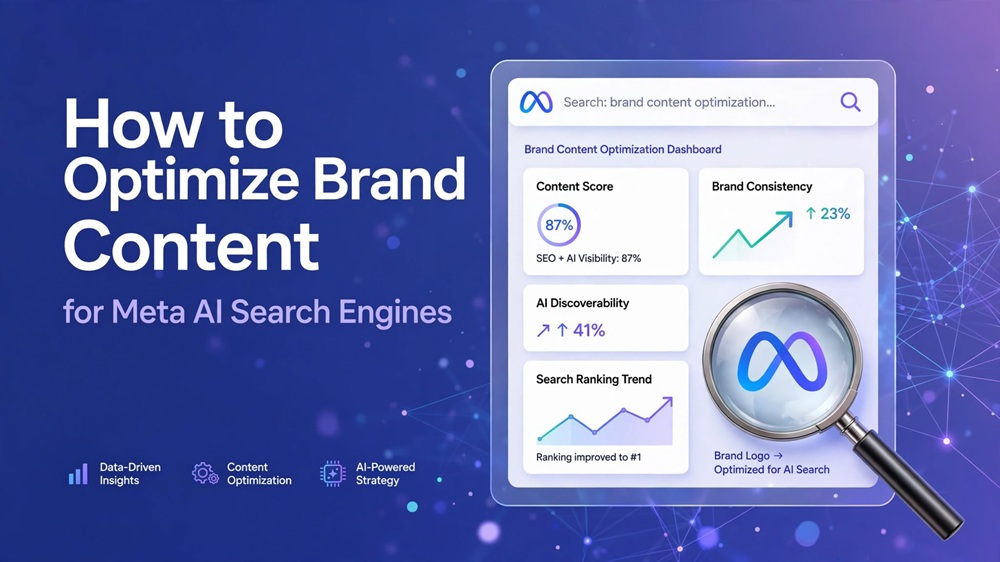
Here is how to optimize brand content for Meta AI Search Engines, and how to turn it into a service your agency can sell.
1. What is Meta AI Search and How Does It Work?
Meta AI Search doesn’t crawl for keywords. It uses Retrieval-Augmented Generation (RAG). It retrieves the most structured, trustworthy, and fresh content from across the web and Meta’s own ecosystem, then generates a conversational answer.
It rewards:
Clean structure over keyword stuffing
Entity authority over backlinks alone
Conversational answers over long-form fluff
2. Google SEO vs. Meta AI SEO: What’s Different?
| Google SEO | Meta AI Search Optimization |
|---|---|
| Focuses on keywords and ranking | Focuses on entities and citation |
| Rewards backlinks | Rewards factual density, sources, and E-E-A-T |
| 10 results on a page | 1-3 cited sources in the answer |
| User clicks to your site | User gets the answer from you inside Meta AI |
Your job as an agency is to move clients from ranking to being referenced.
3. The 9-Step Framework to Optimize Brand Content for Meta AI
1. Build Your Entity, Not Just Keywords
Meta AI needs to understand WHO the brand is. Implement robust structured data.
- Use JSON-LD Schema:
Organization,Brand,Product,FAQPage,Article, andAuthorschema are non-negotiable - Connect your brand’s Knowledge Graph: Same Facebook Page, Instagram handle, Threads profile, website, and Wikipedia/Wikidata entry everywhere. Consistency is trust.
2. Write in 40-60 Word Answer Blocks
AI doesn’t read like humans. It extracts.
Under every H2/H3, write a self-contained, direct answer block of 40-60 words that fully answers the query. This structure makes your content highly extractable for RAG.
Example: Instead of “Our face cream is good,” write: “What is Hydra Cream? Hydra Cream is a hyaluronic acid-based moisturizer for Indian humid climates, clinically tested to increase skin hydration by 42% in 7 days.” [Brand]
3. Optimize for Conversational Intent
People ask Meta AI like they talk to a friend.
- Shift from “best running shoes” to “what are the best running shoes for flat feet under 5000 in India?”
- Create content clusters around questions: Who, What, Why, How, vs, price, alternatives.
- Add a dedicated FAQ section with conversational Q&A and
FAQPageschema.
4. Prove E-E-A-T With Dated Facts and Citations
AI hallucinates less when you give it facts. OtterlyAI’s 2026 experiments show AI engines prefer content with factual density and named sources.
- Back every claim with a stat, date, and source: “As per Statista, June 2026…”
- Show Experience: Add author bios, first-hand testing, UGC, reviews.
- Never publish AI content without human fact-checking and sourcing.
5. Make Your Site 100% Crawlable for AI Bots
Many brands block AI crawlers by accident.
- Check your
robots.txt– AllowMeta-ExternalAgent,GPTBot,ClaudeBot,PerplexityBot - Don’t hide key content behind JavaScript only. Use server-side rendering or pre-rendering.
- Keep load speed <2s and keep key info high up on the page
6. Optimize Your Meta Ecosystem
This is where you beat generic SEO agencies. Meta AI prioritizes content from its own platforms.
- Post native explainers on Instagram, Reels with transcripts, and Threads discussions answering client FAQs
- Use consistent brand handles and link back to your pillar pages
- Encourage and repurpose UGC – AI sees community validation as authority
7. Don’t Ignore Multimedia
AI still struggles to “watch” a video. Help it.
- Add alt text, video transcripts, captions, and descriptive metadata to every image, Reel, and video
- Use AI tools to auto-generate accurate transcripts for all brand videos.
8. Freshness is a Ranking Factor
AI search measures “last updated” timestamps and actual content changes.
- Build a content refresh calendar. Update top 20% pages every 30-45 days with new data, FAQs, or examples.
- Show “Last Updated: September 18, 2026” visibly.
9. Track What Actually Matters: AI Visibility
Stop reporting only Google rankings. Start reporting AI Share of Voice.
- Ask Meta AI: “What is the best [your client’s category] brand in?” Does your client get cited?[city]
- Tools to track: Otterly.ai, Peec AI, Scrunch AI, Authoritas AI Visibility.
- Audit: Are AI engines citing your content at all? Can they read your structured data?
How Your Agency Can Package This as a Service
Don’t just write blogs. Sell a Meta AI Readiness Audit.
Your Agency Offer:
- Phase 1: AI Visibility Audit – Where does the brand stand in Meta AI / ChatGPT / Perplexity today?
- Phase 2: Entity & Technical Fix – Schema, robots.txt, site speed, and Meta ecosystem cleanup
- Phase 3: Answer Engine Content – Rewriting top pages into answer blocks, FAQ clusters, and cross-platform posts
- Phase 4: Authority Building – Digital PR, expert quotes, and UGC to increase citation likelihood
This is a retainer, not a one-time project. As Gartner predicted, traditional search volume has already dropped ∼25% by 2026. Brands that move first win.
Final Takeaway:
In the Google era, we optimized for clicks. In the Meta AI era, we optimize to be the answer itself. Clean HTML, clear entities, conversational structure, and provable authority – that’s the new SEO.