Digital marketing has always relied on human effort – someone writes the ad, someone monitors the campaign, someone decides when to increase the budget. Agentic AI changes this entirely. It builds systems that think, plan, decide, and act on their own – without waiting for a human to click a button.
This is not the AI that suggests a keyword or autocompletes a sentence. Agentic AI executes complete marketing workflows, adapts to new data in real time, and coordinates across channels simultaneously. It does what a skilled marketing team does – only faster, at greater scale, and without stopping.
Understanding agentic AI is no longer optional for marketers. It reshapes how campaigns run, how content gets created, how budgets get allocated, and how brands compete for attention in search and on social platforms.
What Is Agentic AI?
Agentic AI refers to artificial intelligence systems that operate as autonomous agents. These agents pursue defined goals by planning a sequence of actions, executing those actions, evaluating the results, and adjusting their approach – all without requiring step-by-step human instructions.
The word “agentic” comes from agency – the capacity to act independently and make decisions. An agentic AI system does not just respond to prompts. It takes initiative, uses tools, accesses external data, and keeps working toward its objective until it completes the task or achieves the goal.
| 🔍 Simple Definition Agentic AI is an AI system that acts like an employee – you give it a goal, and it figures out the steps, executes them, checks the results, and improves its approach on its own. You supervise the outcome, not every action. |
How Agentic AI Differs from Standard AI Tools
| Standard AI Tool | Agentic AI System |
| Responds to a single prompt | Pursues a multi-step goal autonomously |
| Needs human to trigger each action | Plans and executes actions independently |
| Produces one output at a time | Coordinates multiple tasks simultaneously |
| Has no memory of past actions | Maintains context across an entire workflow |
| Example: ChatGPT answering a question | Example: AI agent that monitors, optimises, and reports a PPC campaign |
How Agentic AI Works in Practice
An agentic AI system typically consists of four core components working together:
1. A Goal or Objective
You define what you want the agent to achieve – for example, “increase organic traffic to our blog by 30% over the next quarter” or “reduce cost per lead on our Google Ads campaigns by 20%.” The agent takes this objective and builds a plan to achieve it.
2. A Planning Engine
The agent breaks the objective into a sequence of tasks. It decides what order to tackle them in, what tools to use, and what information it needs to gather first. This planning happens automatically and adapts as new data becomes available.
3. Tool Access
Agentic AI agents connect to the tools they need to act – search APIs, advertising platforms, content management systems, analytics dashboards, email platforms, and social media scheduling tools. The agent uses these tools to execute its plan, not just to research it.
4. A Feedback and Adaptation Loop
After each action, the agent evaluates the result. Did the ad perform as expected? Did the keyword ranking improve? Did the email open rate increase? Based on this feedback, the agent adjusts its next action. This loop continues until the agent reaches the goal or identifies that a different strategy is needed.
| ⚡ Real-World Example An agentic AI system assigned to improve SEO might: (1) audit the website for technical errors, (2) identify high-opportunity keywords, (3) generate and publish optimised content drafts, (4) build internal links between related pages, (5) monitor ranking changes weekly, and (6) iterate based on what improves. A human reviews outcomes – the agent handles execution. |
Why Agentic AI Matters in Digital Marketing
Digital marketing involves thousands of small decisions made every single day – which keywords to bid on, what subject line to test, when to post on social media, how to respond to a drop in rankings, which pages need fresh content. Human teams manage these decisions with limited time and limited bandwidth.
Agentic AI handles this decision-making load autonomously, at a scale that no human team can match. This creates several fundamental changes to how digital marketing works:
Marketing Campaigns Run Continuously Without Pausing
Human-managed campaigns pause when the team logs off, waits for approval, or misses a signal. Agentic AI monitors and adjusts campaigns around the clock. It catches a budget overspend at 2am, pauses a poorly-performing ad group, and reallocates that budget to higher-performing ads – all before the marketing team arrives at the office.
Personalisation Scales to Millions of Users
Traditional personalisation requires significant manual segmentation. Agentic AI analyses user behaviour in real time and personalises content, ads, email sequences, and landing pages for each individual visitor – not each segment. A retail brand can serve a unique homepage experience to each of its million monthly visitors without any human configuring those experiences manually.
Cross-Channel Coordination Becomes Automatic
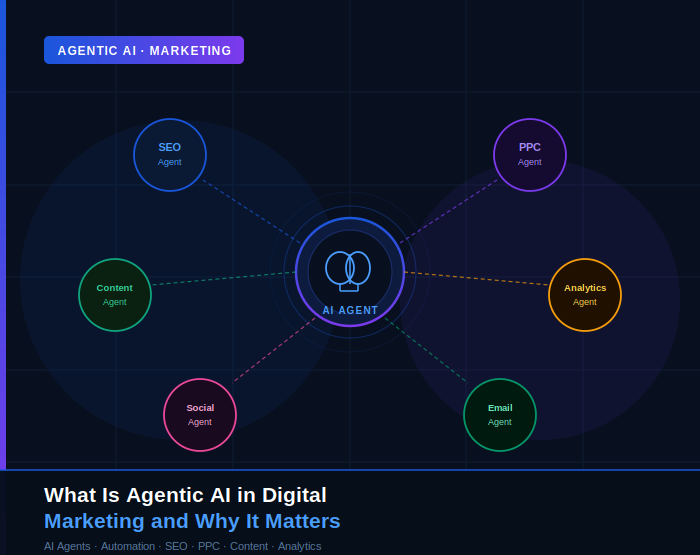
Most marketing teams struggle to keep SEO, PPC, social, email, and content strategies aligned. Each channel operates in its own silo. Agentic AI coordinates across all channels simultaneously, sharing data between agents, identifying opportunities that span channels, and ensuring consistent messaging without manual project management.
Speed from Insight to Action Collapses
When a human analyst identifies an opportunity – a trending keyword, a competitor pausing their ads, a surge in demand for a product – the insight travels through a briefing, a planning session, a content creation process, and an approval chain before any action happens. Agentic AI compresses this to near-zero. It identifies the insight and acts on it immediately.
| 🇮🇳 Why This Matters for Indian Businesses Indian markets move fast. Festival season campaigns, regional demand spikes, competitor activity, and price-sensitive buying behaviour all require rapid response. Agentic AI gives Indian businesses the ability to react at market speed – without needing to scale headcount every time they scale campaigns. |
Agentic AI Across Every Digital Marketing Channel
| Marketing Channel | What Agentic AI Does Autonomously |
| SEO | Audits the site, identifies keyword gaps, creates optimised content, builds internal links, monitors rankings, and adjusts strategy based on results. |
| PPC / Google Ads | Manages bids in real time, pauses underperforming ads, reallocates budgets, tests new ad copy, and reports on ROAS automatically. |
| Content Marketing | Identifies trending topics, briefs and drafts content, publishes on schedule, tracks performance, and refreshes older posts that lose rankings. |
| Email Marketing | Segments lists based on behaviour, personalises subject lines and body copy, tests send times, and re-engages inactive subscribers. |
| Social Media | Schedules posts at peak engagement times, monitors brand mentions, responds to comments, identifies trending hashtags, and reports on reach. |
| Analytics & Reporting | Consolidates data from all channels, identifies anomalies, flags opportunities, and generates performance reports without manual data pulls. |
Agentic AI and AI Search: The Connection Marketers Need to Understand
Agentic AI connects directly to how modern search engines work. Google’s AI Overviews, ChatGPT’s web browsing, and Perplexity’s real-time research all use AI agents to find, evaluate, and synthesise information from across the web.
This means the same AI agent principles that drive marketing automation also drive how your brand gets found – or doesn’t get found – in AI search results. Brands that structure their content in ways that AI agents can read, evaluate, and cite will appear in AI-generated answers. Brands that don’t will become invisible.
Agentic AI in your marketing stack therefore serves two purposes: it automates your campaigns, and it optimises your content for the AI agents that decide what appears in search results.
What Agentic AI Cannot Replace
Agentic AI handles execution at scale. It does not replace human judgement on what a brand stands for, how it should communicate in a crisis, what creative direction aligns with its values, or how to build genuine long-term relationships with customers. These require human insight, empathy, and strategic thinking.
The most effective digital marketing operations combine agentic AI for execution with human expertise for strategy and brand direction. Marketers who understand both – and know when to trust the agent and when to override it – will consistently outperform those who either ignore AI entirely or outsource their strategic thinking to it.
Frequently Asked Questions
Is agentic AI the same as marketing automation?
No. Traditional marketing automation executes pre-defined rules – for example, “send this email when a user clicks this button.” Agentic AI plans its own sequence of actions based on a goal, adapts its approach based on results, and makes decisions that the human never explicitly programmed. It is far more flexible and capable than rule-based automation.
Do I need a large budget to use agentic AI in my marketing?
No. A growing number of agentic AI tools operate as SaaS products accessible to small and medium businesses. The barrier to entry decreases every month. The more relevant question is whether your team has the knowledge to configure, supervise, and optimise these systems – which requires understanding what they can and cannot do.
Will agentic AI replace digital marketing jobs?
Agentic AI automates the repetitive, execution-heavy parts of digital marketing – bid management, reporting, content scheduling, A/B testing. It does not automate strategy, brand positioning, creative direction, or relationship management. Marketers who focus their careers on these higher-order skills will remain valuable and will use agentic AI as a force multiplier.
How does agentic AI improve Google and AI search rankings?
Agentic AI improves search performance by executing SEO tasks consistently and at scale – publishing optimised content regularly, fixing technical issues quickly, building internal link structures systematically, and monitoring competitor changes continuously. It also enables you to implement AEO and GEO strategies at the pace these fast-moving channels demand.
Where does agentic AI fit in a digital marketing strategy for an Indian business?
Agentic AI works particularly well in Indian markets for managing multi-language content, running festival-season campaign surges, monitoring competitive pricing in e-commerce, and handling the high volume of localised search queries across Tier 1 and Tier 2 cities. It allows smaller Indian teams to execute at a scale previously reserved for much larger organisations.