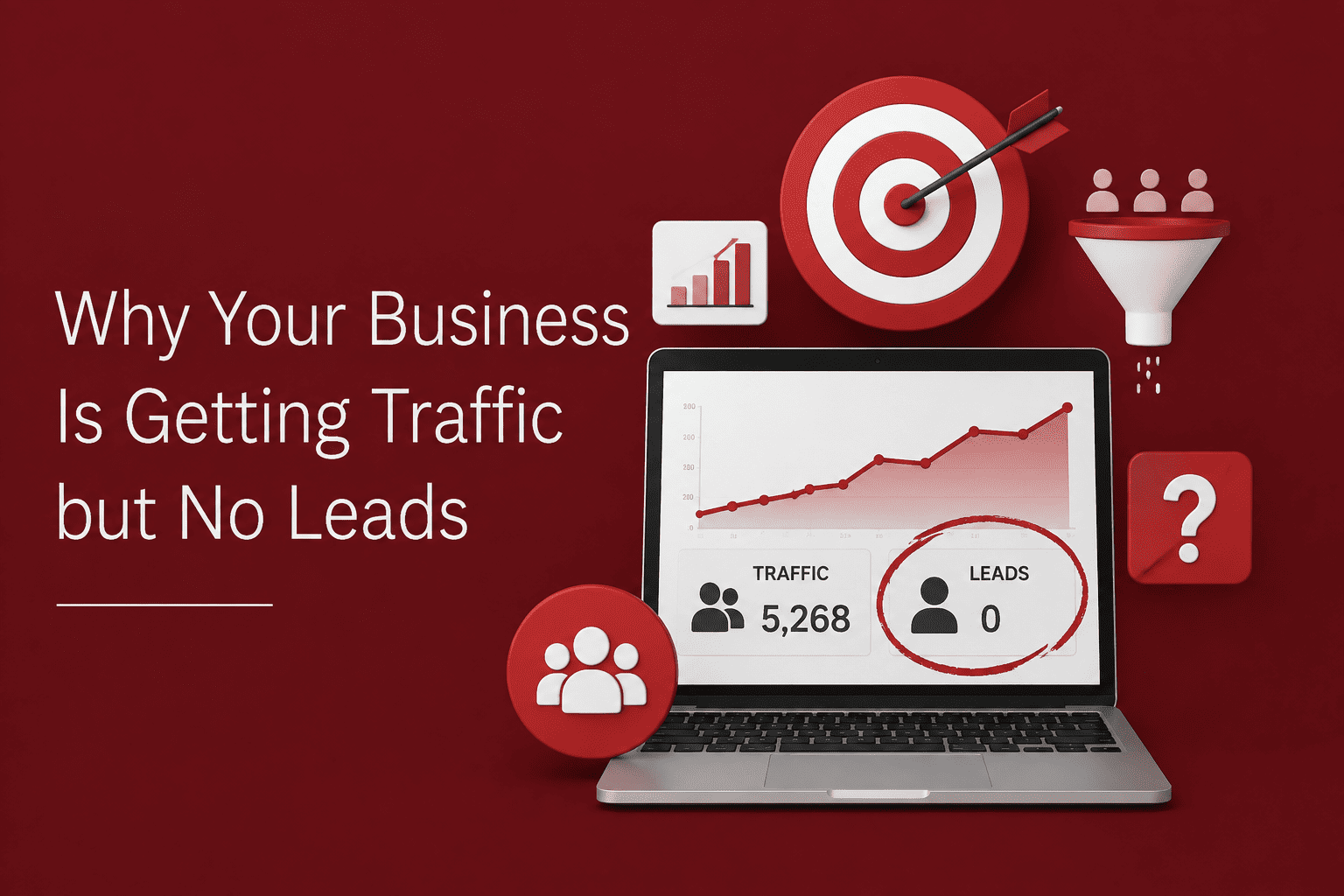
You open Google Analytics and the numbers look encouraging — sessions are climbing, organic traffic is up, maybe your ad campaigns are performing well too. And yet the contact form isn’t filling up, the phone isn’t ringing, and the inbox stays quiet. This is one of the most common and most misleading problems in digital marketing: traffic is not the same thing as demand, and more visitors will never fix a conversion problem on their own. At Conceptial Media, this is one of the most frequent audits we run for clients, and it almost always comes down to a handful of fixable issues rather than a fundamentally broken business. Here’s what’s usually going on, and what to do about it.
1. You’re attracting the wrong kind of traffic
Not all traffic carries the same intent. Someone searching “what is SEO” is in research mode, while someone searching “SEO agency for ecommerce” is close to making a decision. Many websites unintentionally optimize for high-volume informational keywords because they look impressive in a traffic report, while ignoring lower-volume, higher-intent commercial searches that actually convert. If your blog is full of broad educational content but your service pages aren’t ranking for the specific terms your buyers search, you’ll keep collecting visitors who were never going to become leads in the first place.
2. Your value proposition isn’t clear within seconds
Visitors typically decide whether to stay or leave within the first few seconds of landing on a page. If your homepage or landing page doesn’t immediately answer “what do you do, who is it for, and why should I care” in plain language, most visitors will bounce before they ever reach your offer. Vague taglines and generic stock imagery might look polished, but they rarely tell a visitor anything concrete about the problem you solve.
3. Your calls-to-action are weak, buried, or missing
A call-to-action is the bridge between interest and action, and when it’s vague, invisible, or placed too far down the page, that bridge simply doesn’t get crossed. Eye-tracking research consistently shows that calls-to-action placed above the fold get dramatically more clicks than ones buried lower on the page. “Learn more” or “submit” rarely performs as well as a specific action tied to a clear outcome, such as “get your free audit” or “book a 15-minute call.”
4. Your forms and contact process create friction
Every additional field on a contact form is another reason for a visitor to abandon it. Long forms asking for information that isn’t immediately necessary — company size, budget range, multiple dropdowns — filter out people before they’ve even had a conversation with you. Cutting a form down to the essentials, and making phone numbers clickable on mobile, removes friction that’s silently costing you leads every day.
5. Your site is too slow, especially on mobile
Page speed has a direct, measurable effect on conversions — research shows that even a one-second delay in load time can meaningfully reduce conversion rates, and pages that load in under roughly two and a half seconds convert notably better than slower ones. With mobile now accounting for the majority of web traffic, a slow mobile experience isn’t a minor technical detail; it’s an active leak in your lead pipeline, especially since mobile visitors already tend to convert at lower rates than desktop visitors.
6. There aren’t enough trust signals on the page
Most consumers read reviews before engaging with a business, and a page with no testimonials, case studies, certifications or recognizable client logos gives a visitor no reason to believe you can deliver. Trust signals don’t need to be elaborate — a handful of specific, credible testimonials placed near your call-to-action often does more for conversions than a lengthy “About Us” page.
7. Leads go cold before you ever respond
Even when a visitor does convert, response time matters enormously. Research from Harvard Business Review has found that leads contacted within the first hour are dramatically more likely to qualify than those contacted a day later, yet many businesses take far longer than that to follow up — and some never respond at all. A form that generates a lead but sits unanswered for two days might as well not have converted in the first place.
How Conceptial Media approaches this problem
Rather than treating traffic and conversion as separate projects, Conceptial Media runs a combined audit that looks at search intent alignment, on-page messaging, page speed, form friction and trust signals together — because fixing one in isolation rarely solves the underlying gap. The goal isn’t just to explain why leads aren’t coming through, but to prioritize the two or three highest-impact fixes first, since page speed, CTA visibility and form length changes often show measurable results within one to two weeks, well before a full site overhaul is needed.
Quick wins to try first
- Rewrite your homepage headline to state exactly what you do and who it’s for, in one sentence.
- Move your primary call-to-action above the fold on every key landing page.
- Cut your contact form down to name, email and one qualifying question — nothing more.
- Run your site through a page speed tool and fix anything scoring below 70 on mobile.
- Add two or three specific, credible testimonials near your main call-to-action.
Final thoughts
Traffic without leads is rarely a traffic problem — it’s a conversion problem, and conversion problems are almost always fixable without spending another rupee on acquisition. Before investing in more SEO, more ads or more social content, it’s worth auditing what’s actually happening once visitors arrive. That’s the exact gap Conceptial Media specializes in closing, turning existing traffic into a working lead pipeline rather than chasing bigger numbers that never quite convert.