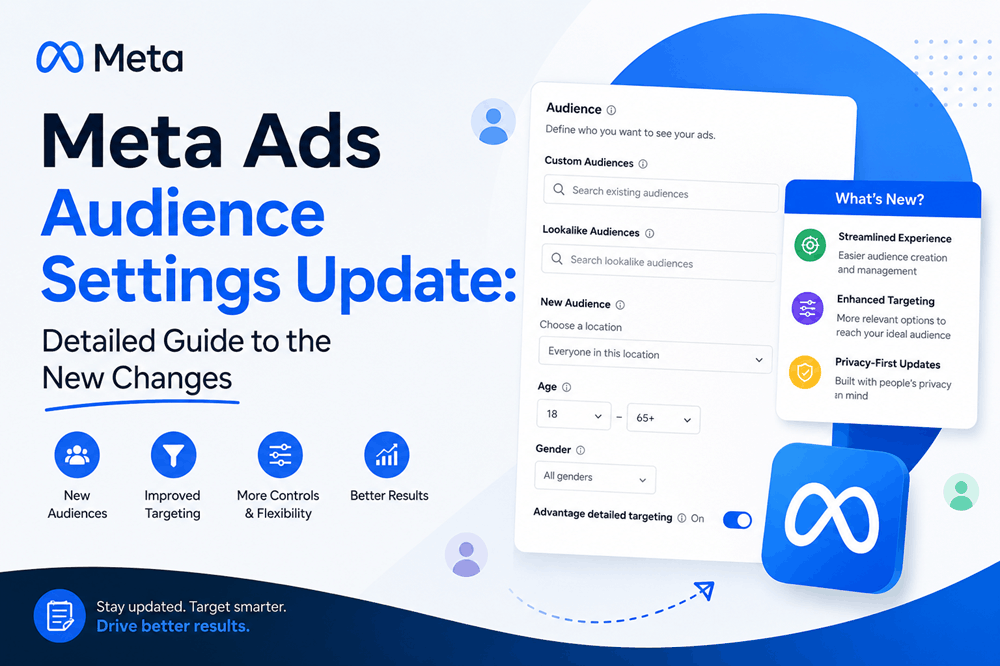
Meta Ads continues to evolve as Meta introduces more automation, AI-powered tools, and changes to audience targeting. These updates are changing how advertisers create audiences, control targeting, and optimize Facebook and Instagram campaigns.
For businesses running Meta Ads for leads, sales, website traffic, or brand awareness, understanding the latest audience settings is important for building campaigns that align with their marketing goals.
In this guide, we explain the key changes in Meta Ads audience settings, how automated targeting works, what advertisers should review, and how to approach audience setup in the latest Meta Ads Manager environment.
What Are Meta Ads Audience Settings?
Meta Ads audience settings determine who can potentially see your advertisements across Meta platforms such as Facebook and Instagram.
Depending on your campaign objective and setup, advertisers can work with:
- Custom Audiences
- Lookalike Audiences
- Saved Audiences
- Detailed targeting
- Location targeting
- Age and gender
- Advantage+ audience
- Retargeting audiences
- Customer lists
- Website and app audiences
Meta has increasingly moved toward AI-assisted audience expansion and automated delivery, meaning advertisers may have fewer manual controls in some campaign setups than they previously had.
What Has Changed in Meta Ads Audience Settings?
One of the biggest developments is the increasing use of AI and automated audience optimization.
Instead of relying exclusively on manually selected interests, behaviors, and demographics, Meta can use its systems to identify people who are more likely to take the desired action.
The exact settings available can vary depending on the campaign objective, account, location, and Meta’s current Ads Manager interface.
1. Greater Use of Advantage+ Audience
Advantage+ audience allows advertisers to provide audience suggestions while giving Meta more flexibility to find additional people who may be likely to convert.
Instead of treating every selected interest as a strict limitation, Meta can use the provided information as guidance for delivery.
For advertisers, this means audience setup is increasingly becoming a combination of:
Advertiser Input + Meta AI + Conversion Data
This approach can be particularly relevant for campaigns where the primary goal is lead generation, purchases, or other measurable conversions.
2. Audience Suggestions Are Becoming More Important
With automated audience systems, advertisers can provide signals that help Meta understand the type of customer they want to reach.
These signals may include:
- Customer lists
- Website visitors
- Existing customers
- Lookalike audiences
- Demographic information
- Interests
- Previous engagement
- Conversion data
Rather than creating extremely narrow audiences, advertisers should focus on providing useful signals and allowing the platform’s optimization systems to work with sufficient data.
3. Detailed Targeting Is Changing
Detailed targeting has historically been one of the most commonly used Meta Ads features.
Advertisers could select interests, behaviors, demographics, and other characteristics to create specific audiences.
However, Meta has been moving toward more automated delivery.
As a result, advertisers should not assume that manually selecting a large number of interests will automatically produce better campaign performance.
The value of an interest depends on the campaign objective, available audience size, creative, offer, conversion tracking, and other factors.
4. Custom Audiences Remain Important
Custom Audiences continue to be an important part of Meta advertising because they allow businesses to reach people who have already interacted with their brand.
Depending on available data and Meta’s current features, advertisers can build audiences from sources such as:
- Website activity
- Customer lists
- App activity
- Facebook engagement
- Instagram engagement
- Video engagement
- Lead form interactions
These audiences can be useful for remarketing campaigns.
For example, an advertiser could create separate audiences for:
Website Visitors → Product Viewers → Leads → Existing Customers
This allows businesses to build different campaigns around different stages of the customer journey.
5. Lookalike Audiences and First-Party Data
Lookalike audiences have traditionally helped advertisers find new people who resemble an existing audience.
However, the broader shift toward AI-powered advertising makes high-quality first-party data increasingly valuable.
Businesses should focus on maintaining accurate customer information and creating meaningful source audiences.
Examples include:
- Previous purchasers
- Qualified leads
- High-value customers
- Repeat customers
- Website converters
- Engaged users
A high-quality source audience can provide stronger signals than simply creating a broad audience based on unrelated interests.
6. Location Targeting Still Needs Attention
Location targeting remains one of the most important settings for local and regional businesses.
Advertisers should carefully review:
- Countries
- States
- Cities
- Specific locations
- Radius targeting
- Multiple service areas
For example, a real estate company serving Noida and Greater Noida may want to structure its location strategy differently from an e-commerce business selling across India.
Similarly, a local service business should avoid unnecessarily broad geographic targeting when its services are available only in selected areas.
7. Age and Gender Settings
Age and gender settings can still be relevant depending on the product or service.
However, advertisers should avoid restricting the audience without a clear business reason.
For example, if a product can reasonably be purchased by a broad age range, excessive restrictions may reduce the available audience.
Instead, advertisers can test broader targeting and use campaign data to understand which segments generate meaningful results.
8. Audience Expansion and Meta AI
The broader direction of Meta Ads is toward greater use of machine learning and AI.
Meta’s systems can evaluate signals from campaign activity and attempt to identify users who are more likely to complete the desired action.
This makes conversion tracking and campaign signals increasingly important.
If Meta receives better-quality conversion data, its optimization systems have more useful information to work with.
For this reason, advertisers should pay attention not only to audience settings but also to:
- Pixel implementation
- Conversions API
- Event tracking
- Lead quality
- Purchase tracking
- Landing-page experience
- Creative performance
Should You Still Use Manual Audience Targeting?
Yes, but the role of manual targeting is changing.
Manual targeting can still be useful when you have a strong reason to define a specific audience, particularly for:
- Geographic campaigns
- Niche products
- Specific customer segments
- Remarketing
- B2B campaigns
- Audience testing
- New market testing
However, advertisers should avoid assuming that a highly detailed audience will always outperform a broader audience.
Testing is more useful than relying on assumptions.
Meta Ads Audience Settings for Lead Generation
For lead-generation campaigns, audience quality is particularly important.
A business can consider testing:
Campaign A: Broad Audience
Use relevant geographic and basic demographic settings while allowing Meta’s optimization systems more freedom.
Campaign B: Audience Signals
Provide relevant customer or engagement signals to help Meta identify potential prospects.
Campaign C: Remarketing
Target people who have previously:
- Visited the website
- Engaged with social media
- Watched videos
- Opened a lead form
- Interacted with the business
The results can then be compared using meaningful business metrics such as qualified leads and cost per qualified lead, rather than focusing only on impressions or clicks.
Meta Ads Audience Settings for E-commerce
For e-commerce businesses, audience strategy can be structured around the customer journey.
A typical framework could include:
New Customers
Broad or AI-assisted prospecting campaigns.
Product Visitors
People who have viewed relevant products.
Cart or Checkout Users
People who showed stronger purchase intent.
Existing Customers
Audiences based on previous purchases.
Different audience segments can receive different creative, offers, and messaging.
Common Meta Ads Audience Mistakes
1. Making Audiences Too Narrow
Extremely narrow audiences can restrict delivery and reduce the number of people Meta can evaluate.
2. Selecting Too Many Interests
Adding dozens of unrelated interests does not necessarily create a better audience.
3. Ignoring First-Party Data
Businesses with customer, website, or engagement data should consider how that information can contribute to their advertising strategy.
4. Focusing Only on CPC
A cheap click does not necessarily mean a successful campaign.
For lead generation, businesses should examine lead quality and conversion rates.
5. Not Testing Audience Strategies
Audience performance can vary by industry, offer, location, creative, and campaign objective.
Testing provides more useful information than assumptions.
Meta Ads Audience Settings Checklist
Before launching or updating a campaign, review the following:
- Campaign objective
- Location targeting
- Age range
- Gender settings
- Audience type
- Advantage+ audience settings
- Custom Audiences
- Retargeting audiences
- Customer lists
- Lookalike audiences, where applicable
- Detailed targeting
- Pixel implementation
- Conversions API
- Conversion events
- Exclusions where appropriate
- Landing page
- Creative
- Lead quality or purchase data
How Businesses Should Adapt to the New Meta Ads Audience Environment
The shift toward AI-assisted advertising does not mean audience strategy is no longer important.
Instead, advertisers need to think beyond simply selecting interests.
A modern Meta Ads strategy should combine:
Strong Audience Signals + Quality Creative + Accurate Tracking + Sufficient Conversion Data + Continuous Testing
Businesses should regularly review campaign results and adjust their strategy based on actual performance.
Frequently Asked Questions
What is the latest change in Meta Ads audience settings?
Meta has increasingly incorporated automated and AI-assisted audience delivery into its advertising systems. The available controls can vary by campaign objective, account, market, and current Ads Manager setup.
Is Advantage+ Audience mandatory?
Not every campaign uses the same audience controls. Availability and functionality can vary depending on the campaign setup and Meta’s current product configuration.
Are Meta interest-based audiences still useful?
They can still be useful in appropriate campaigns, but advertisers should test them against broader or AI-assisted approaches rather than assuming that more detailed targeting will always perform better.
Should I use broad targeting on Meta Ads?
Broad targeting can be worth testing, particularly when the campaign has sufficient conversion signals and a clearly defined offer. The appropriate approach depends on the business and campaign objective.
Are Custom Audiences still important?
Yes. Website visitors, customer lists, social engagement, and other first-party or platform-based audience sources can remain valuable for prospecting and remarketing strategies.
How often should Meta Ads audience settings be reviewed?
Advertisers should review audience settings whenever they create a new campaign and periodically review existing campaigns for changes in delivery, audience size, tracking, exclusions, and performance.
Final Thoughts
Meta Ads audience targeting is moving from a heavily manual approach toward a more automated, AI-assisted advertising environment.
The key change for advertisers is not simply learning where each setting is located. It is understanding how audience signals, conversion data, creative, and Meta’s optimization systems work together.
Businesses should regularly review their audience configuration, maintain accurate conversion tracking, test different targeting approaches, and measure results based on meaningful business outcomes.
As Meta continues to update Ads Manager, staying current with audience settings can help advertisers make better-informed campaign decisions and adapt their paid social strategy to the changing advertising environment.