
The way people discover information online is changing as search engines incorporate artificial intelligence into their results. Instead of relying exclusively on traditional blue links, users may now see AI-generated summaries that bring together information from multiple sources and provide links to relevant webpages.
Google AI Overviews is one of the most significant developments in this changing search landscape. It helps users explore certain questions by presenting an AI-generated overview alongside links to supporting web content. This experience can make it easier to understand complex topics, compare information, and discover additional resources.
For website owners, publishers, and digital marketers, this development raises important questions. How do Google AI Overviews work? Can websites appear as sources in these summaries? Will AI-generated answers reduce organic traffic? And what can businesses do to improve their visibility?
Understanding these questions is essential for developing a sustainable search engine optimization strategy. While AI Overviews introduce new ways for users to interact with search results, the fundamentals of SEO remain important: useful content, technical accessibility, clear information, and a website experience that serves the audience.
This guide explains how Google AI Overviews work, their potential impact on SEO, and practical ways businesses can prepare for AI-driven search experiences.
1. What Are Google AI Overviews?
Google AI Overviews are AI-generated summaries that may appear within Google Search results for certain queries. They provide an overview of information intended to help users understand a topic without having to visit several webpages immediately.
These summaries may combine information from multiple sources and include links to webpages that provide additional details or supporting information.
For example, someone searching for ways to improve website speed might receive an overview explaining common performance improvements, such as image compression, browser caching, and reducing unnecessary JavaScript. Links may direct the user to relevant sources for more detailed explanations.
AI Overviews can be useful for questions that involve several related concepts, comparisons, or multiple steps.
However, they do not appear for every search. Their availability and presentation can vary according to the query, language, location, device, and Google’s evolving search systems.
How Are AI Overviews Different from Traditional Search Results?
Traditional search results primarily present a list of webpages with titles, descriptions, and links. Users generally choose which pages to visit to find the information they need.
AI Overviews add a generated summary to this experience. Instead of beginning with a list of links alone, users may first encounter a synthesized explanation and then explore supporting sources.
This creates an additional way for websites to be discovered. A page may provide useful supporting information for a search query even when the user initially interacts with an AI-generated summary.
However, appearing in an AI Overview is not guaranteed, and website owners should not assume that every relevant page will be selected as a source.
2. How Do Google AI Overviews Work?
Google AI Overviews use Google’s AI systems to generate responses to certain search queries. These systems may draw on information from relevant webpages and other sources available to Google’s search systems.
The process is more complex than simply selecting one article and copying its content.
Understanding the Search Query
Google first needs to interpret what the user is looking for. A query may contain several related questions or require information from different subject areas.
For example, a search for “how to choose a laptop for video editing” may involve processor performance, memory, storage, display quality, and budget.
An AI-generated overview may organize these considerations into a single explanation that helps the user understand the decision.
Generating an Overview
Google’s AI systems generate a summary designed to address the query. Depending on the search, the overview may contain explanations, steps, comparisons, or other useful information.
AI-generated answers can still contain mistakes or omit important context. Users should consult the linked sources, especially when making decisions involving health, finance, legal matters, or other high-impact subjects.
Connecting Users with Supporting Sources
AI Overviews can include links to relevant webpages. These links give users opportunities to investigate a topic in greater depth and allow publishers to receive visits from people seeking additional information.
A useful webpage should therefore do more than repeat a basic definition. It should provide accurate explanations, practical details, original insights, or evidence that helps users understand the topic.
Importantly, the precise selection and presentation of sources are controlled by Google’s systems. No particular content format guarantees inclusion.
3. AI Overviews vs. AI Mode: Understanding the Difference
Google AI Overviews and Google AI Mode are related AI-powered search experiences, but they serve different purposes.
| Feature | AI Overviews | AI Mode |
|---|---|---|
| Primary purpose | Summarize information within Search results | Support a more conversational search experience |
| Typical interaction | Users see an overview and can explore linked sources | Users can ask follow-up questions and continue exploring a topic |
| Search experience | Appears as part of the broader search results page | Provides a dedicated AI-oriented experience |
| Best understood as | An AI-generated summary for a search query | An interactive way to investigate questions and follow-ups |
AI Overviews can help users understand a subject quickly. AI Mode is designed for more extended interactions in which users can ask additional questions and explore a subject through a conversational interface.
Both experiences reflect Google’s broader use of AI in search, but they should not be treated as identical features.
For SEO professionals, this distinction matters because visibility and user behaviour may differ across search experiences. Reporting should be based on the available data rather than assumptions about how often a website appears in either feature.
4. Why Google AI Overviews Matter for SEO
AI Overviews have introduced another consideration for businesses that depend on organic search traffic.
Previously, many SEO strategies concentrated on improving traditional search rankings, attracting clicks, and converting visitors into customers. Those goals remain relevant, but AI-generated summaries may influence how users discover information and decide which links to visit.
Changes in Search Visibility
A website may receive visibility through a link included in an AI Overview, creating an additional opportunity for discovery.
At the same time, a user may find enough information in the overview to satisfy a simple question without visiting another website.
The effect varies by query, subject, search-result layout, and user intent. It is therefore inaccurate to assume that AI Overviews always increase traffic or always reduce it.
Greater Importance of Useful Content
When an AI-generated summary answers a basic question, a generic article may provide little additional value to the reader.
Websites can differentiate themselves by offering detailed explanations, original research, genuine examples, expert commentary, practical tools, and information that helps users make decisions.
For example, an article about technical SEO can explain what indexing means. A more useful resource can also demonstrate how to investigate indexing problems, interpret Search Console reports, and prioritize fixes.
The second approach offers practical value beyond a basic definition.
Visibility Is Not the Same as Business Results
An appearance in an AI Overview does not automatically translate into website traffic, enquiries, or sales.
Businesses should evaluate how search visibility contributes to meaningful outcomes, including relevant visits, qualified leads, purchases, and customer engagement.
A sustainable SEO strategy should consider the entire customer journey rather than treating inclusion in an AI-generated answer as the final objective.
5. How to Optimize Content for Google AI Overviews
There is no guaranteed method for appearing in AI Overviews. However, businesses can improve the overall usefulness, accessibility, and clarity of their content by following established SEO principles. AI Search Optimization in India can help businesses strengthen their online visibility by creating helpful, relevant, and well-structured content that meets users’ search needs.
Google’s guidance for its AI search features emphasizes the importance of existing SEO fundamentals. Website owners do not need to create a separate collection of special AI files or adopt a particular word count simply to become eligible for AI search features.
Answer the Main Question Clearly
Readers should be able to understand the purpose of a page quickly.
Begin with a clear introduction that explains the topic and its importance. Then organize the article into sections that address related questions in a logical order.
For example, an article about local SEO can explain what local SEO is, why it matters, how business profiles work, and how performance can be measured.
Avoid unnecessarily long introductions that delay the answer to the main question.
Use Descriptive Headings
Clear headings help readers navigate content and understand the relationship between sections.
Use headings that accurately describe the information that follows. For a comprehensive guide, suitable sections might cover definitions, implementation steps, common mistakes, measurement, and FAQs.
Headings should be written for clarity rather than filled with repeated keywords.
Include Specific and Actionable Information
Content becomes more useful when it explains how to apply a concept.
Instead of saying only that technical SEO is important, explain how to inspect indexing status, identify broken links, review canonical tags, or investigate performance problems.
Where appropriate, provide examples, checklists, calculations, and clear explanations of limitations.
Specific details make content more useful to readers and help demonstrate the depth of the information being provided.
Cover Related Questions Naturally
A comprehensive article often addresses several questions that readers have about the same subject.
For example, a guide to AI Overviews may explain their purpose, their relationship with traditional search, their potential traffic impact, and how website owners can measure performance.
However, adding unrelated sections simply to make an article longer can reduce its usefulness. Each section should contribute to the reader’s understanding.
Avoid Keyword Stuffing
The primary keyword should appear naturally in the title, introduction, and relevant sections.
Related terminology can be used where it improves clarity, but repeating the exact phrase in every heading is unnecessary.
Google does not require a particular keyword density or a fixed number of keyword repetitions for AI Overviews.
Focus on answering the user’s question thoroughly and accurately.
6. Demonstrate Experience, Expertise, Authoritativeness, and Trustworthiness
E-E-A-T stands for Experience, Expertise, Authoritativeness, and Trustworthiness. These concepts are part of Google’s quality-evaluation framework, with trust being especially important.
E-E-A-T is not a single score that website owners can directly optimize, and adding an author biography or a few external links does not automatically establish quality.
Instead, businesses should demonstrate the qualities that make their information useful and reliable.
Experience: Include Genuine First-Hand Insights
Experience can be demonstrated through real observations, practical examples, original photographs, and documented processes.
For example, an SEO article may include a genuine example showing how a website owner investigated an indexing issue and what the inspection revealed.
Any case study should accurately describe the work performed and distinguish observed results from assumptions.
Do not invent personal experience, client outcomes, or testimonials.
Expertise: Explain the Subject Accurately
Expertise involves understanding the subject and communicating it correctly.
Technical articles should define unfamiliar terms, distinguish related concepts, and explain important limitations.
For AI Overviews, this means avoiding unsupported claims that a particular schema type, article length, keyword density, or AI-writing tool guarantees visibility.
Where technical details matter, consult authoritative documentation and update the article when guidance changes.
Authoritativeness: Build a Credible Reputation
A website can strengthen its reputation by publishing consistently useful material within its area of expertise.
Relevant industry references, credible editorial mentions, original research, and useful resources may help establish recognition.
However, authority should not be confused with a high backlink count or a collection of generic author biographies.
Focus on providing information that people have a legitimate reason to reference and trust.
Trustworthiness: Be Accurate and Transparent
Trustworthy content communicates information honestly, corrects errors, and avoids misleading claims.
Businesses should provide accurate contact details, disclose relevant commercial relationships, and explain limitations when necessary.
For topics involving AI search, distinguish confirmed product features from predictions about future developments. This is especially important because Google’s search experiences can change over time.
7. Technical SEO Requirements for AI Search Visibility
Useful content needs to be accessible before it can contribute to organic search visibility.
Google’s guidance for AI features builds on its established search requirements rather than introducing a universal technical shortcut for inclusion.
Ensure Important Pages Can Be Crawled
Googlebot must generally be able to access a page for Google to process its content normally.
Review robots.txt rules to ensure that important resources are not unintentionally blocked. Check that pages intended for indexing do not contain an unintended noindex directive.
Use Google Search Console to inspect URLs and investigate indexing issues.
Maintain a Logical Website Structure
Organize website content into clear categories and connect related pages with useful internal links.
For example, a website publishing digital marketing resources could link its AI search guide to relevant articles about technical SEO, content quality, keyword research, and Search Console.
Internal linking helps users discover related resources and gives search engines additional context about the website’s structure.
Improve Mobile Usability and Page Experience
Ensure that content works well on mobile devices, text remains readable, navigation is accessible, and important information is not hidden behind broken interactive elements.
Monitor loading performance and Core Web Vitals where appropriate.
Good page experience supports usability, although achieving a perfect performance score does not guarantee AI Overview inclusion or higher rankings.
Use Structured Data Correctly
Structured data can help Google understand supported information about a webpage or entity.
However, adding structured data does not guarantee that a page will appear in an AI Overview.
Use supported schema types only when they accurately describe the visible content and meet Google’s implementation guidelines. Do not add misleading or irrelevant structured data to pursue AI search visibility.
Do Not Rely on Special AI Files as a Ranking Shortcut
Website owners may encounter recommendations to create special files or use proprietary formatting to influence AI systems.
Such recommendations should be evaluated carefully. Google has not established a universal special file or mandatory content format that guarantees inclusion in AI Overviews.
Follow Google’s current Search Central documentation and prioritize accessible, useful content over unverified optimization shortcuts.
8. The Role of Original Research and Helpful Content
As AI-generated summaries become more common, original information can help a website provide value beyond a general overview.
Many articles on the same subject may repeat similar definitions and recommendations. Readers often need more than another summary of familiar information.
Businesses can differentiate their content through original research, practical demonstrations, detailed comparisons, and relevant examples.
Publish Original Data Where Possible
A business might analyze anonymized customer questions, conduct a survey, compare product specifications, or document the results of a carefully designed test.
The methodology should be explained clearly, and the conclusions should not extend beyond what the evidence supports.
Original data can make an article more informative and provide useful material for other publishers to reference.
Update Outdated Information
AI search features, SEO tools, and Google’s documentation can evolve over time.
Review important articles periodically to identify outdated screenshots, incorrect instructions, unsupported claims, and broken references.
When updating an article, make meaningful improvements rather than changing the publication date without improving the content.
Prioritize People Over Search Features
A useful article should remain valuable even if it never appears in an AI Overview.
Ask whether the content answers the intended question, provides sufficient context, and helps the reader take the next step.
This approach supports a more sustainable content strategy than creating pages solely to target a particular search feature.
9. How to Measure the Impact of Google AI Overviews
Measuring AI search performance can be challenging because not every appearance or interaction is reported as a separate, easily identifiable metric.
Website owners should avoid relying on estimates that cannot be verified through their available data.
Use Google Search Console
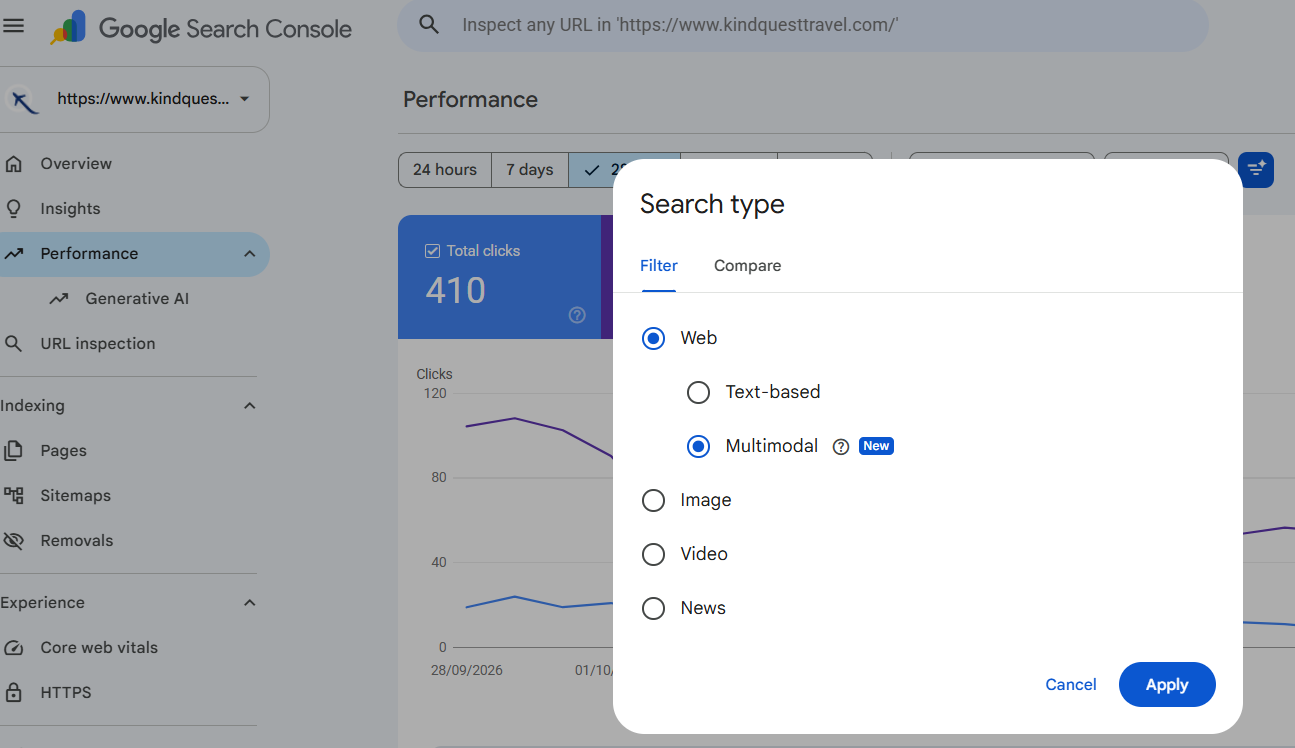
Google Search Console provides information about a website’s performance in Google Search, including clicks, impressions, click-through rate, and average position.
Google’s AI features documentation explains how relevant AI feature activity is represented in Search Console reporting. AI feature traffic may be included within the overall Web search performance data rather than presented as a fully separate, comprehensive AI Overviews report.
Consequently, businesses should not assume that Search Console provides a complete, standalone count of every AI Overview appearance or click.
Monitor Organic Traffic in Analytics
Google Analytics can help businesses evaluate what visitors do after reaching the website.
Useful measures may include engaged sessions, lead submissions, purchases, and other meaningful conversions from organic search.
Compare changes over time and consider other factors, such as seasonality, website updates, marketing campaigns, and shifts in search demand.
Evaluate Content Performance
Review which pages attract relevant search queries, receive organic clicks, and contribute to business outcomes.
If a page receives impressions but relatively few clicks, review whether its title and description accurately communicate its value. If a page attracts visitors but generates few conversions, investigate the usefulness of its content and the clarity of the next steps.
These improvements can strengthen the overall search experience without depending on an unverified AI-specific ranking tactic.
10. Common Myths About Google AI Overviews
Several misconceptions can lead website owners toward ineffective optimization practices.
Myth 1: Every Search Query Triggers an AI Overview
AI Overviews do not appear for every query. Their appearance depends on Google’s systems and the circumstances of the search.
Businesses should therefore avoid assuming that every target keyword will produce an AI-generated summary.
Myth 2: A Website Must Rank First to Appear as a Source
Traditional search rankings and AI Overview source selection are not identical processes. A high organic ranking does not guarantee inclusion, and website owners should not assume that one fixed ranking position determines eligibility.
The most practical approach is to create relevant, useful content and maintain strong technical SEO fundamentals.
Myth 3: Adding FAQ Schema Guarantees AI Visibility
Structured data can help search engines interpret supported content, but it does not guarantee inclusion in AI Overviews.
Adding FAQ sections may help readers when they address genuine questions. Their value should not depend on an expectation of guaranteed search-feature visibility.
Myth 4: AI-Generated Content Automatically Performs Poorly
The use of AI tools alone does not determine whether content is useful or eligible to appear in search results.
The important considerations include accuracy, originality, relevance, and whether the content provides value to users. Publishing large quantities of unhelpful content to manipulate rankings can violate Google’s spam policies, regardless of how the content was produced.
Myth 5: AI Overviews Make Traditional SEO Unnecessary
Traditional SEO remains important because AI search experiences rely on Google’s broader systems for discovering and understanding web content.
Technical accessibility, useful content, clear page structure, and accurate information remain relevant to a website’s search visibility.
11. A Practical 90-Day Strategy for Businesses
Businesses can prepare for AI-driven search experiences by improving the quality and accessibility of their existing content.
Days 1–30: Audit the Website
- Review important pages and their search performance.
- Check indexing and crawling issues in Google Search Console.
- Identify outdated, repetitive, or unhelpful content.
- Review the accuracy of important facts and claims.
- Identify the questions the target audience needs answered.
- Establish baseline organic traffic and conversion metrics.
Use the audit to identify the highest-priority improvements.
Days 31–60: Improve Content and Technical SEO
- Rewrite unclear introductions and headings.
- Add useful examples and practical explanations.
- Strengthen internal links between related pages.
- Correct important technical issues.
- Improve mobile usability and page performance.
- Verify structured data where relevant.
- Update outdated information and remove unsupported claims.
Focus on meaningful improvements rather than producing large quantities of new pages.
Days 61–90: Measure and Refine
- Review changes in organic clicks and impressions.
- Identify queries that generate relevant visibility.
- Evaluate engagement and conversions.
- Investigate pages with declining performance.
- Improve content that fails to meet user expectations.
- Plan additional resources based on genuine information gaps.
This process does not guarantee AI Overview inclusion. It helps establish a stronger website foundation that supports sustainable search visibility across evolving search experiences.
Frequently Asked Questions
1. What are Google AI Overviews?
Google AI Overviews are AI-generated summaries that may appear in Google Search for certain queries. They help users understand a topic and can provide links to webpages for further information.
2. How can my website appear in Google AI Overviews?
There is no guaranteed method. Focus on making your pages accessible to Google, publishing useful and accurate content, organizing information clearly, and following established SEO best practices.
3. Do AI Overviews affect organic traffic?
They can influence how users interact with search results. Some queries may receive fewer clicks to websites when an overview answers the user’s question, while other situations may create opportunities for additional discovery. The impact varies by query, topic, and search experience.
4. Is traditional SEO still important for AI Overviews?
Yes. Google recommends established SEO fundamentals for its AI search features. Crawling accessibility, indexable content, helpful information, and a good website experience remain important.
5. Does Google require special schema for AI Overviews?
There is no universal special schema type that guarantees inclusion in AI Overviews. Use structured data when it accurately describes supported content and follows Google’s guidelines.
6. Can AI-generated articles appear in AI Overviews?
Content created with AI tools is not automatically excluded. However, content should be accurate, useful, original in its contribution, and created to serve people rather than manipulate rankings.
7. How can I track AI Overview traffic?
Use Google Search Console and Google Analytics to monitor available search performance and website engagement data. Be aware that reporting may not provide a complete, separate count of every AI Overview appearance or interaction.
Conclusion
Google AI Overviews represent an important development in how users discover and explore information through search. By providing AI-generated summaries and links to supporting resources, they create another way for people to interact with information online.
For website owners and SEO professionals, the most effective response is not to chase unverified shortcuts or focus exclusively on AI-generated answers. Instead, businesses should strengthen the fundamentals that make their websites useful: accurate information, clear structure, technical accessibility, relevant content, and a reliable user experience.
Original research, genuine expertise, and practical explanations can further distinguish a website from generic content. At the same time, performance should be measured through available search data and meaningful business outcomes rather than assumptions about AI visibility.
As Google’s search experiences continue to evolve, a people-first strategy provides a practical foundation for adapting. By helping users find trustworthy answers and useful next steps, businesses can build a stronger digital presence across traditional and AI-powered search.