
The way people search on Google is changing rapidly. Traditional keyword-based searches are no longer the only way users discover information, products, services, and businesses online. Today, people can search by uploading photographs, capturing images through their smartphone cameras, or highlighting objects directly on their screens.
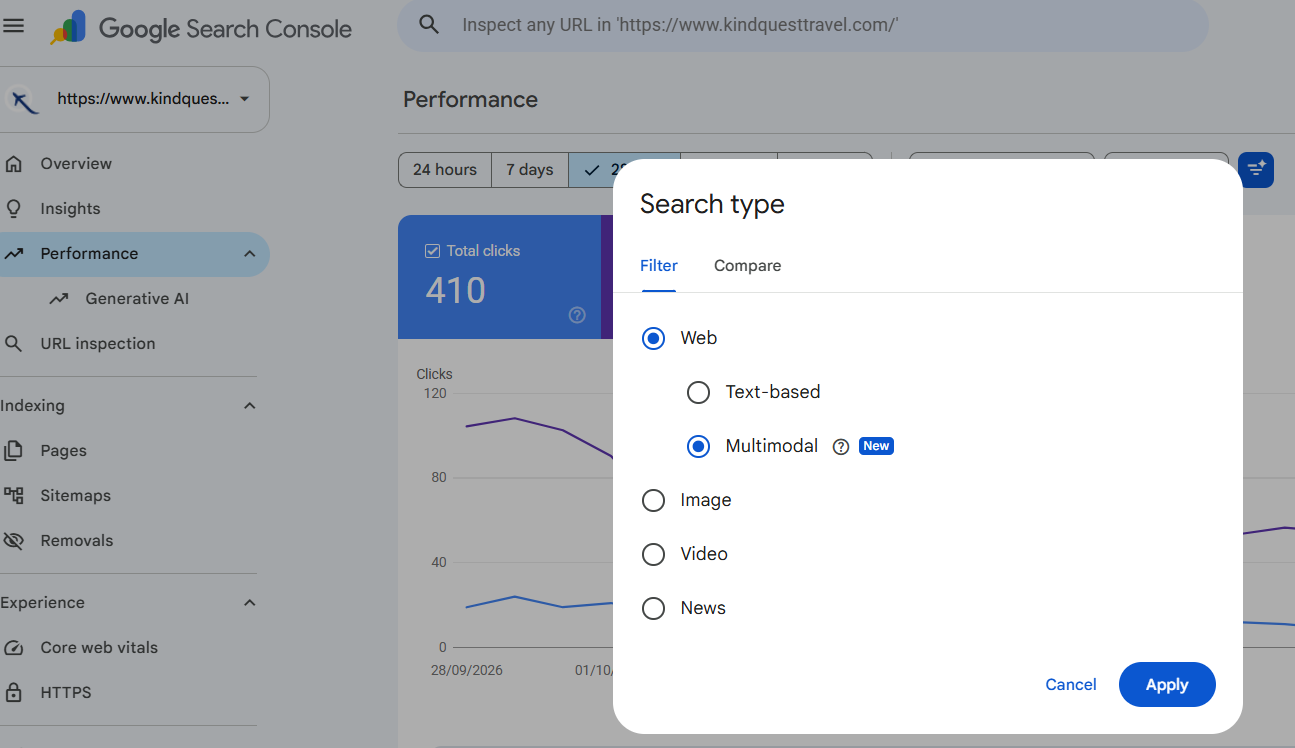
Recognizing this shift, Google introduced a new multimodal search filter in Google Search Console on September 24, 2026, giving website owners and SEO professionals greater visibility into how their content performs when users search with images.
This development represents an important advancement in search performance reporting, particularly for businesses that rely heavily on visual content.
For years, SEO professionals have optimized images using descriptive file names, alt text, structured data, and contextual content. However, understanding how these efforts contributed specifically to image-initiated web searches remained challenging.
Google’s latest Search Console update helps address this reporting gap.
The new filter provides insights into search activity originating from visual search experiences, including Google Lens, Circle to Search, image uploads, and Chrome’s image-search functionality.
But what exactly does this update mean for SEO? How can businesses use the new data? And what strategies should marketers adopt to improve visibility in multimodal search?
This comprehensive guide explains everything website owners, digital marketers, and SEO professionals need to know.
What Is the New Multimodal Filter in Google Search Console?
The Google Search Console Multimodal Filter is a reporting feature that allows website owners to analyze how their web pages perform when users conduct searches involving images.
Unlike traditional searches, where users enter text-based keywords, multimodal searches can begin with photographs, screenshots, or other visual inputs.
For example, imagine someone notices a stylish office chair in a photograph but does not know its brand or model.
Instead of typing a detailed description into Google, the person can use Google Lens to search using the image.
Google analyzes the visual information and displays relevant results, potentially including product pages, shopping guides, and related content.
With the new multimodal filter, website owners can identify whether their pages are receiving visibility and clicks from these types of searches.
What Types of Searches Does the Filter Cover?
According to Google’s September 2026 announcement, multimodal reporting includes searches initiated through several visual search experiences.
1. Google Lens
Google Lens enables users to search for information using photographs or their smartphone cameras.
Users can identify products, landmarks, plants, clothing, furniture, and other objects.
For e-commerce businesses, Google Lens creates opportunities to connect visually recognizable products with potential customers.
2. Circle to Search
Circle to Search allows users on supported Android devices to select an object or image displayed on their screens and search for related information.
For example, someone watching a travel video could circle a landmark to discover its location or find related travel information.
3. Image Uploads to Google Search
Users can upload existing images to search for visually related information.
This functionality is particularly useful when people want to identify products, find similar designs, or learn more about unfamiliar objects.
4. Chrome’s Search This Image Feature
Google Chrome allows users to search using images encountered while browsing websites.
This creates another pathway for visual discovery beyond traditional keyword searches.
Together, these search experiences demonstrate how Google’s ecosystem increasingly supports searches that combine visual information with user intent.
Why Google Introduced Multimodal Search Reporting
Search behavior has evolved significantly as smartphones, artificial intelligence, and computer vision technologies have become more sophisticated.
People no longer need to describe everything they want to find.
Sometimes, showing Google an image is faster and more accurate than entering a complicated search query.
Consider these examples:
- A shopper photographs a pair of shoes to find similar products online.
- A traveler uploads an image of a destination to identify its location.
- A homeowner searches using a photograph of a modular kitchen design.
- A student captures an image of an unfamiliar object to learn more about it.
- A customer uses a product screenshot to locate relevant shopping pages.
These examples highlight the importance of visual search in modern online discovery.
Previously, Search Console offered reporting for traditional web searches and Google Images, but it did not provide a dedicated way to isolate this newly reported category of image-initiated web searches.
The multimodal filter helps website owners understand an additional dimension of their organic search performance.
For SEO professionals, this means visual search can become a more measurable component of an overall organic search strategy.
How to Find the Multimodal Filter in Google Search Console
Accessing the new reporting feature is relatively straightforward.
Step 1: Open Google Search Console
Sign in to your Google Search Console account and select the verified website property you want to analyze.
Step 2: Navigate to Performance
Open the Performance → Search Results report.
This section displays important organic search metrics, including clicks, impressions, click-through rate, and average position.
Step 3: Select the Search Type Filter
Click the search type filter at the top of the performance report.
Within the Web search category, Google now distinguishes between text-based and multimodal search activity.
Step 4: Choose Multimodal
Select the multimodal option to examine performance associated with image-initiated web searches.
Step 5: Analyze Available Performance Data
Review the available reporting dimensions, particularly:
- Pages receiving multimodal search visibility.
- Countries generating visual search activity.
- Devices associated with multimodal search performance.
- Changes in clicks and impressions over time.
The Queries dimension is not available for multimodal reporting because these searches primarily use images rather than text.
Step 6: Export the Data
Google also allows users to export available performance data for further analysis.
SEO teams can combine exported Search Console data with website analytics and business performance metrics to evaluate whether visual search visitors are contributing to meaningful outcomes.
Important: Google began the global rollout on September 24, 2026. Multimodal metrics appear for properties receiving relevant search activity. The absence of visible data does not automatically indicate a technical SEO problem.
Multimodal Search vs Traditional Search vs Google Images
One of the most important aspects of this update is understanding how multimodal search differs from existing search categories.
Traditional Text-Based Search
Traditional search begins when someone enters keywords or questions into Google’s search interface.
For example:
“Best digital marketing agency in Delhi”
Google interprets the query and displays relevant results.
SEO strategies for traditional search generally emphasize search intent, content relevance, technical accessibility, website quality, and authoritative information.
Google Images Search
Google Images focuses on discovering images through Google’s image search interface.
For example, a user might search:
“Modern office interior design images”
Google displays image results associated with relevant web pages.
Image SEO helps search engines understand and discover visual content through descriptive text, image accessibility, and relevant page context.
Multimodal Web Search
Multimodal search begins when an image forms part of the search input.
Instead of typing “black leather office chair,” someone might upload a photograph of the chair.
Google processes the image and presents relevant search results.
The new Search Console filter specifically measures web search performance associated with these image-based interactions.
Key Difference
Google Images reporting and multimodal web search reporting are not interchangeable.
Google Images is a separate search category, while the new multimodal option identifies web searches involving visual inputs.
Understanding this distinction is essential when interpreting organic traffic reports.
What Data Does the Multimodal Search Report Provide?
The new reporting capability gives SEO professionals an additional way to evaluate how users discover their websites.
1. Search Impressions
Impressions help indicate how frequently a website’s content appears in eligible multimodal search results.
For example, a furniture website might discover that certain product pages receive impressions when users search using photographs of similar furniture.
This can help identify pages attracting visibility through visual search experiences.
However, impressions alone do not indicate whether users visited the website or completed a purchase.
2. Organic Clicks
Clicks indicate visits originating from eligible multimodal web search results.
This information can help businesses identify landing pages that attract users searching with visual inputs.
For example, an online fashion retailer might find that its footwear collection receives visits from image-based searches.
The business could then examine how those visitors interact with product pages.
3. Click-Through Rate
Where click and impression metrics are available, click-through rate can help marketers understand the proportion of reported impressions that generate clicks.
A low CTR may justify further investigation into page relevance, search-result presentation, and user intent.
However, CTR should not be interpreted as a direct measurement of image quality.
4. Landing Page Performance
The Pages report is particularly valuable because Google does not provide the original visual queries.
SEO teams can identify which pages receive multimodal visibility and compare those results with their broader organic performance.
This can help prioritize content improvements.
5. Geographic and Device Insights
Country and device dimensions can reveal where multimodal discovery is occurring.
For businesses targeting different markets, these insights may help inform localization and mobile optimization decisions.
What the Multimodal Filter Does Not Show
Although the update introduces useful reporting capabilities, it has several limitations.
First, Google does not provide the exact image used in a search.
Website owners cannot see the photograph, screenshot, or visual object that initiated an individual search.
Second, text query information is unavailable.
Because multimodal searches primarily use visual inputs, Google does not provide a standard Queries report for this search type.
Third, the report does not identify which image on a landing page caused that page to appear.
A product page receiving multimodal impressions does not prove that one particular product photograph generated those impressions.
Fourth, Search Console does not directly measure business conversions.
Businesses must use their analytics and conversion tracking systems to evaluate leads, purchases, bookings, or other outcomes.
These limitations matter because SEO teams should avoid drawing unsupported conclusions from the available data.
The report provides evidence of visual-search visibility, not a complete explanation of Google’s visual matching or ranking systems.
Why the Multimodal Filter Matters for SEO in 2026
The introduction of multimodal reporting has implications for several important areas of search engine optimization.
1. Visual Search Becomes More Measurable
Historically, many image optimization decisions relied on indirect indicators.
Marketers could monitor image search traffic, but identifying performance from camera-based and screenshot-based searches was more difficult.
The new filter introduces a dedicated reporting view for these experiences.
This helps SEO teams evaluate whether visual search deserves additional attention within their organic growth strategies.
2. Image Optimization Gains Greater Strategic Importance
High-quality, relevant images have long supported content usability and product discovery.
Multimodal reporting reinforces the value of treating images as meaningful website assets rather than decorative elements.
Businesses should consider whether their photographs clearly represent their products, services, destinations, and other subjects.
However, Google has not announced a new image-ranking factor as part of this reporting update.
3. E-Commerce Businesses Gain New Insights
Online stores are particularly well positioned to benefit from multimodal performance analysis.
Products such as clothing, footwear, furniture, accessories, and home décor are frequently identified through visual characteristics.
An e-commerce business can use the new reporting data to investigate which product categories attract image-led search visibility.
These insights may inform photography priorities, product descriptions, and landing page improvements.
4. Local Businesses Can Explore Visual Discovery
Restaurants, hotels, salons, travel companies, and interior design businesses often publish visually rich content.
For these organizations, multimodal reporting may reveal additional discovery opportunities.
A hotel, for example, could examine whether its accommodation pages attract visitors through image-based searches.
The business could then improve page information, image descriptions, and booking usability.
5. SEO Reporting Becomes More Comprehensive
Organic search performance increasingly spans multiple search experiences.
SEO professionals should therefore avoid relying exclusively on traditional keyword rankings when evaluating website visibility.
Multimodal reporting provides another perspective on how audiences discover content.
It complements rather than replaces conventional keyword research, technical SEO, and content optimization.
How to Optimize Your Website for Multimodal Search
The new filter is primarily a reporting feature, but businesses can use its insights alongside established image SEO practices.
The following strategies provide a practical framework.
1. Publish Original, High-Quality Images
Images should accurately represent the subject of the page.
For e-commerce websites, this may include:
- Clear product photographs.
- Multiple useful viewing angles.
- Close-up images showing important details.
- Contextual photographs demonstrating product usage.
- Accurate colors and product variations.
Original photography can improve the user experience and help differentiate a website’s content.
However, original images alone do not guarantee higher search rankings.
2. Write Descriptive Image Alt Text
Alternative text helps describe images for users who rely on assistive technologies.
It also provides search engines with useful information about image content.
For example:
Poor alt text: image123
Better alt text: Black leather office chair with adjustable armrests and a high backrest.
Effective alt text should describe the image naturally.
Avoid repeating keywords unnecessarily or inserting unrelated promotional phrases.
3. Use Meaningful Image File Names
Before uploading images, use descriptive file names where practical.
For example:
Poor file name: IMG_9821.jpg
Better file name: black-leather-office-chair.jpg
File names can provide additional context about an image.
However, they should be considered a supporting optimization rather than a major ranking factor.
4. Improve Image Loading Performance
Large image files can negatively affect page loading speed and user experience.
Website owners should consider:
- Using appropriately sized images.
- Applying efficient compression.
- Choosing suitable modern image formats.
- Implementing responsive images.
- Avoiding unnecessary loading of off-screen images.
- Monitoring Core Web Vitals.
The objective is to balance image clarity with efficient website performance.
5. Add Relevant Context Around Images
Google can use surrounding page content to better understand images.
A product photograph becomes more useful when supported by accurate information about the product.
For example, a page featuring a leather wallet should provide relevant details about its material, dimensions, features, and intended use.
Similarly, a travel destination image should appear alongside meaningful information about the location.
This contextual approach benefits both users and search engines.
6. Make Images Discoverable
Important images should be implemented in ways that Google can discover and process.
Website owners should ensure that:
- Image resources are accessible to crawlers.
- Important images use supported HTML image elements.
- Robots directives do not unintentionally block image resources.
- Relevant landing pages are indexable.
- Image URLs are stable where practical.
Google’s image SEO documentation provides additional technical guidance.
7. Implement Appropriate Structured Data
Structured data helps search engines understand certain types of website content.
Depending on the page, relevant structured data may include:
- Product.
- Recipe.
- Article.
- VideoObject.
- LocalBusiness.
Structured data should accurately reflect visible page content and follow Google’s supported feature requirements.
Adding structured data does not guarantee multimodal visibility.
However, valid structured data can support broader search understanding and eligibility for relevant search features.
8. Optimize for Mobile Users
Many visual search experiences occur on smartphones.
A website should therefore provide a smooth mobile browsing experience.
Important considerations include readable content, responsive layouts, accessible navigation, clear product details, and straightforward conversion paths.
For example, an online retailer receiving visual search traffic should make it easy for mobile visitors to view product variations and complete purchases.
9. Strengthen Content Quality and E-E-A-T Signals
Visual optimization should not come at the expense of content credibility.
Google’s E-E-A-T framework emphasizes Experience, Expertise, Authoritativeness, and Trustworthiness within its search quality evaluation guidelines.
For businesses, useful practices include publishing accurate information, identifying responsible authors, providing clear business details, and demonstrating relevant subject-matter knowledge.
Where appropriate, original photographs, product demonstrations, case studies, and firsthand observations can help make content more useful.
E-E-A-T is not a single measurable ranking score, and the new multimodal filter does not introduce an E-E-A-T metric.
The goal is to create reliable, people-first content that supports informed decisions.
Multimodal Search and the Future of AI-Powered SEO
Multimodal search reflects a broader change in how search engines interpret information.
Traditional search largely focused on matching text queries with relevant documents.
Modern search systems can process different forms of information, including images and language.
This creates opportunities for users to express search intent without relying entirely on written descriptions.
How Multimodal Search Connects With AEO
Answer Engine Optimization, or AEO, focuses on making content useful for systems that provide direct answers to user questions.
Businesses can support this goal by publishing clear explanations, accurate product information, well-organized headings, and relevant supporting visuals.
For example, a travel website could combine destination photography with concise information about location, transportation, attractions, and recommended visiting seasons.
This makes the page more useful across different discovery experiences.
How Multimodal Search Connects With GEO
Generative Engine Optimization, or GEO, refers to strategies intended to improve how content is discovered, interpreted, or referenced by AI-powered search experiences.
Google’s multimodal reporting announcement also included its Generative AI features performance report.
This makes the update relevant to marketers monitoring visibility across Google’s evolving AI search interfaces.
However, multimodal reporting should not be interpreted as a guarantee that optimized images will be cited in AI-generated answers.
The relationship between visual content, AI-generated responses, and website visibility remains dependent on the specific search experience.
Why SEO Strategies Must Become More Holistic
A comprehensive SEO strategy should now consider multiple forms of discoverability.
These include traditional web search, image search, video search, visual search experiences, and AI-powered search features.
Businesses should continue prioritizing helpful content, technical accessibility, and strong website experiences.
The new Search Console data simply provides another way to measure part of that broader ecosystem.
Practical SEO Strategy: How Businesses Can Use Multimodal Data
Consider a hypothetical online furniture retailer.
The business has optimized its website for traditional keywords such as “modern dining table” and “wooden office desk.”
After reviewing the new multimodal report, its SEO team notices that certain product pages receive substantially more image-based search impressions than others.
Rather than assuming that image quality alone explains the difference, the team investigates several factors.
First, it reviews whether the higher-performing pages feature clear product photography and detailed descriptions.
Next, it compares the page structure, image accessibility, mobile experience, and technical indexing conditions.
The team then identifies lower-performing pages that may benefit from better visual presentation and more complete product information.
After implementing improvements, it monitors multimodal impressions and clicks over subsequent weeks.
Finally, it evaluates whether visitors reaching these pages contribute to purchases or other business goals.
This approach demonstrates how the new reporting feature can support evidence-based SEO decisions.
Importantly, the business should account for seasonality, demand changes, and reporting limitations before attributing performance improvements to individual optimizations.
Common Mistakes to Avoid in Multimodal SEO
Businesses should avoid several common mistakes when working with visual search performance data.
Mistake 1: Treating Multimodal Search as Google Images
These are different reporting categories.
Combining them without understanding their definitions can lead to misleading conclusions.
Mistake 2: Assuming More Images Automatically Mean Better Rankings
Publishing additional images does not guarantee increased visibility.
Images should serve a clear purpose and contribute useful information.
Mistake 3: Ignoring Landing Page Quality
An excellent image cannot compensate for a confusing, inaccurate, or difficult-to-use landing page.
Users still need relevant information after reaching the website.
Mistake 4: Overoptimizing Alt Text
Keyword stuffing reduces the usefulness of alternative text.
Descriptions should remain natural, accurate, and accessible.
Mistake 5: Drawing Conclusions From Limited Data
A small number of impressions or clicks may not provide enough evidence to justify major strategic changes.
SEO teams should evaluate trends over meaningful periods.
Mistake 6: Assuming the Report Reveals Visual Search Queries
The multimodal filter does not show the actual photographs or screenshots users searched with.
Marketers should avoid presenting assumptions about those images as verified facts.
Who Will Benefit Most From Google’s Multimodal Search Update?
The update may be particularly valuable for businesses and publishers whose content has a strong visual component.
E-Commerce Websites: Retailers can analyze visual discovery of products, collections, and shopping-related landing pages.
Travel and Tourism Businesses: Travel websites can investigate how destination pages and visual travel guides perform in image-based searches.
Real Estate Companies: Property websites may gain insights into searches involving interior design, architecture, and property-related visuals.
Fashion and Beauty Brands: Businesses can evaluate how visually distinctive products and styles perform in image-led discovery.
Food and Recipe Publishers: Websites featuring recipes, dishes, and cooking-related photography can explore another source of organic visibility.
Educational Publishers: Websites featuring diagrams, objects, illustrations, and educational resources may identify relevant visual search activity.
Digital Marketing Agencies: Agencies can incorporate multimodal performance analysis into technical SEO audits, content planning, and organic search reporting.
The potential value depends on actual audience behavior and available data rather than business category alone.
Frequently Asked Questions About Google Search Console’s Multimodal Filter
1. What is the multimodal filter in Google Search Console?
The multimodal filter is a reporting feature that helps website owners analyze performance from web searches involving images, photographs, or screenshots.
It provides a separate view of eligible image-initiated search activity.
2. When did Google introduce multimodal search reporting?
Google announced the feature on September 24, 2026, with a global rollout beginning on the same date.
3. Does the multimodal filter include Google Lens traffic?
Yes. Google confirmed that the reporting includes eligible searches involving Google Lens.
4. Can I see the keywords used in multimodal searches?
No. Google does not currently provide the Queries dimension for multimodal search reporting because these searches primarily involve images rather than text.
5. Is multimodal search different from Google Images?
Yes. Google Images is a separate search category. The multimodal filter focuses on web search results associated with searches that use images as input.
6. Does the new filter improve website rankings?
No. The filter is a reporting enhancement, not a ranking update.
It helps website owners understand an additional source of search visibility.
7. How can I improve my website’s multimodal search performance?
Start with established image SEO practices, including relevant images, descriptive alt text, accessible image resources, useful surrounding content, and mobile-friendly pages.
Use Search Console data to identify opportunities, but avoid assuming any individual change guarantees improved visibility.
8. Why can’t I see multimodal data in Search Console?
Google indicates that multimodal metrics appear for websites receiving relevant search activity.
If no data is visible, your website may not have recorded eligible activity during the selected reporting period.
9. Does multimodal reporting include AI-powered search features?
Google announced multimodal reporting for both Search results and its Generative AI features performance report.
The available metrics differ between those reporting environments.
10. Is multimodal SEO important for small businesses?
It can be valuable for small businesses whose products, services, or locations are frequently discovered through visual content.
However, businesses should evaluate actual search demand and performance data before making substantial investments.
Final Thoughts: Multimodal Search Is Expanding How Businesses Understand Organic Visibility
Google’s introduction of the multimodal filter in Search Console marks an important development in search performance measurement.
As users increasingly interact with search engines through photographs, screenshots, and camera-based experiences, website owners need better ways to understand these discovery channels.
The new reporting feature provides additional visibility into how web pages perform when images are part of the search process.
For SEO professionals, this creates an opportunity to evaluate visual search using measurable performance data rather than relying entirely on assumptions.
However, the fundamentals of effective SEO remain unchanged.
Businesses should continue publishing helpful content, maintaining technically accessible websites, using accurate visual information, and creating positive user experiences.
The most effective approach is to combine traditional SEO with thoughtful image optimization, AI-search awareness, and ongoing performance analysis.
The future of search is not limited to what people type. It increasingly includes what they see, capture, and share.
Businesses that understand this shift will be better prepared to adapt their content strategies as visual and AI-powered search experiences continue to evolve.