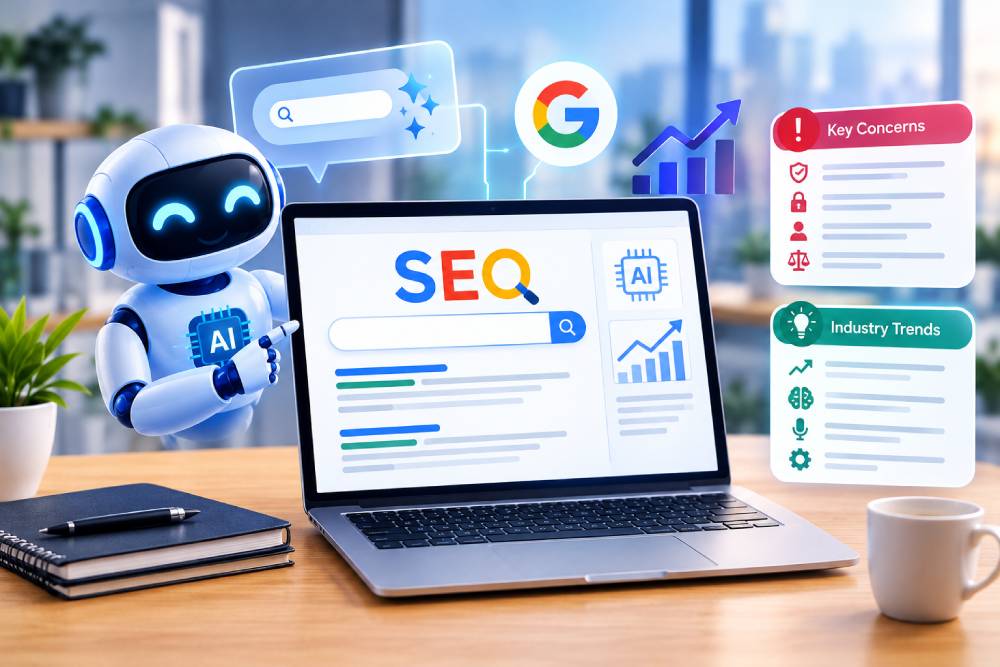
Artificial intelligence is transforming how people discover information, how search engines understand queries, and how businesses attract visitors through organic search. In 2026, search engine optimization (SEO) is no longer limited to ranking web pages on traditional search engine results pages. Businesses must also consider AI-generated answers, conversational search, content quality, user experience, and brand visibility across different discovery platforms.
AI-powered search experiences can summarize information, compare options, and provide direct answers to users. This creates new opportunities for businesses to become visible, but it also raises important questions about website traffic, content differentiation, measurement, and the future of SEO.
For SEO professionals, the challenge is not simply to use more AI tools. It is to understand how search behavior is evolving and adapt their strategies without abandoning the fundamentals that help search engines discover, understand, and evaluate useful content.
This guide explains how AI is changing SEO in 2026, the major concerns facing digital marketers, emerging industry trends, and practical strategies businesses can use to strengthen their search visibility.
1. How AI Is Changing SEO in 2026
Traditional SEO focuses on improving a website’s visibility in organic search results through relevant content, technical accessibility, keyword targeting, internal linking, and authoritative references.
AI is expanding this landscape by helping search systems interpret complex questions, connect related concepts, summarize information, and present responses in conversational formats.
For example, a user searching for a digital marketing agency may previously have reviewed several websites individually. An AI-powered search experience might summarize relevant services, compare providers, and direct the user toward selected sources.
This changes how businesses should approach visibility. Ranking remains important, but marketers also need to understand whether their content can provide useful, clearly structured information that search systems may reference.
Important changes include:
- More conversational queries: Users increasingly express detailed questions instead of entering only short keywords.
- AI-generated summaries: Some search experiences provide synthesized answers alongside or above traditional results.
- Greater emphasis on content usefulness: Generic information has less potential to differentiate a website.
- Changing user journeys: People may research a topic through several platforms before visiting a business website.
- More complex performance measurement: Traditional rankings alone may not explain the full impact of AI-assisted discovery.
AI does not eliminate SEO. Instead, it expands the range of search experiences and the ways businesses may need to measure visibility.
2. Why SEO Professionals Are Concerned About AI
AI offers opportunities to improve productivity and discover new audiences. However, it also introduces challenges that SEO teams must address.
2.1 Potential Decline in Organic Website Clicks
One major concern is that AI-generated answers may satisfy some users without requiring them to visit an external website.
For instance, someone searching for a basic definition or a simple explanation may find the information directly in a search interface. As a result, the user may not click through to the pages that contributed information.
This does not mean that every website will lose traffic. The impact depends on the search query, industry, search feature, and user intent.
Businesses that depend heavily on informational traffic should monitor changes in impressions, clicks, click-through rates, and conversions. They should also identify which pages provide unique information that encourages users to explore further.
2.2 Increased Competition for Visibility
As more businesses adopt AI-assisted content production, the volume of published material can increase substantially.
When multiple websites publish similar articles covering the same basic information, competing solely through content volume becomes less effective.
Search visibility increasingly requires meaningful differentiation. Businesses should provide original analysis, practical examples, expert explanations, first-hand observations where available, and information that genuinely helps readers make decisions.
Publishing more pages does not automatically create more authority or improve rankings.
2.3 Uncertainty About the Future of SEO
SEO professionals may also be concerned about how search interfaces, ranking systems, and user behavior will evolve.
AI features can change how information is displayed and how users interact with search results. Businesses therefore need strategies that can adapt to changes rather than depending entirely on a single traffic source or ranking position.
The most sustainable response is to strengthen foundational SEO while testing emerging opportunities carefully.
2.4 Difficulty Measuring AI Search Performance
Traditional SEO tools provide familiar metrics such as organic clicks, impressions, average position, and conversions. Measuring visibility across AI-generated answers can be more complicated.
A brand might be mentioned in an AI response without receiving a direct website visit. Conversely, a website may receive traffic from an AI-powered platform that is not consistently identified in reporting systems.
SEO teams should combine available referral data, search performance reports, analytics, conversion tracking, and manual visibility checks. They should clearly distinguish observed data from estimates.
3. AI Overviews and Their Impact on Organic Search
AI Overviews are AI-generated summaries that may appear in Google Search for eligible queries. They can combine information from different sources to help users understand a topic or explore a question.
Their presence can affect how users interact with traditional organic results, but the effect is not identical for every query.
How AI Overviews May Affect Businesses
Informational searches: Users seeking quick explanations may find an answer without visiting a website.
Complex research queries: Users exploring complicated subjects may use summaries to understand the basics before visiting detailed resources.
Commercial searches: People comparing services or products may still need product specifications, independent reviews, pricing details, demonstrations, and business websites.
Local searches: Users may continue to need business details, service areas, reviews, contact information, and booking options.
The practical lesson is to understand the intent behind each important keyword. A website should not treat every search query as an opportunity to attract the same kind of visitor.
How to Improve Content for AI Search Visibility
There is no guaranteed method for securing a citation or mention in an AI-generated answer. However, businesses can improve the usefulness and accessibility of their content by following established SEO principles.
Recommended practices include:
- Answer the main question clearly.
- Explain complex topics with accurate supporting details.
- Use descriptive headings and logical content structure.
- Cite credible sources for important factual claims.
- Include original research or useful examples where possible.
- Keep important information accessible to search crawlers.
- Maintain accurate business and product information.
Google’s published guidance for AI search features emphasizes that foundational SEO practices remain relevant. Websites do not need a special AI file or a prescribed word count simply to become eligible for AI search features.
4. The Growing Importance of Generative Engine Optimization (GEO)
Generative Engine Optimization (GEO) refers to efforts to improve the visibility of information, brands, and websites in AI-generated responses.
GEO is gaining attention because users increasingly explore information through conversational systems and AI-assisted search experiences.
Although terminology and measurement practices continue to evolve, many GEO recommendations overlap with established SEO principles.
Key GEO Practices
Create clear, answer-focused content: Explain the subject directly before expanding into details.
Build topical depth: Cover important subtopics, related questions, limitations, and practical applications.
Use reliable evidence: Support claims with trustworthy references and accurate data.
Strengthen brand credibility: Maintain consistent business information, publish expert content, and earn relevant mentions from reputable sources.
Improve technical accessibility: Ensure important pages can be crawled, indexed, and rendered appropriately.
Measure outcomes: Track referral traffic, conversions, brand mentions where measurable, and visibility across relevant search experiences.
GEO should complement SEO rather than replace it. Businesses should avoid providers that guarantee AI citations or promise rankings through secret optimization techniques.
5. AI Content and Google’s Quality Expectations
AI writing tools can help marketers research topics, organize outlines, generate initial drafts, identify questions, and improve readability. However, using AI does not automatically make content helpful or harmful.
Google’s guidance focuses on the quality, usefulness, originality, and purpose of content rather than simply whether AI was involved in its production.
The primary concern is content created mainly to manipulate rankings instead of helping users. Producing large numbers of low-value pages with little original contribution can create serious quality and spam-policy risks, regardless of the tools used.
How to Use AI Responsibly in Content Creation
- Use AI for research assistance: Generate possible subtopics and questions, then verify important facts independently.
- Add expert judgment: Include relevant experience, practical reasoning, and insights that a generic draft would not provide.
- Check factual accuracy: Verify statistics, dates, quotations, technical claims, and references.
- Improve originality: Add unique examples, comparisons, research, and explanations rather than simply rephrasing competitors.
- Edit for readers: Remove repetition, vague statements, and unnecessary paragraphs.
- Review before publishing: Make sure the content is accurate, relevant, and useful for its intended audience.
AI can improve efficiency, but human oversight remains essential for accuracy, trust, and editorial quality.
6. E-E-A-T Is Important for Building Search Trust
E-E-A-T stands for Experience, Expertise, Authoritativeness, and Trustworthiness. It is a framework used in Google’s Search Quality Rater Guidelines to describe important dimensions of content quality.
E-E-A-T is not a single direct ranking factor that can be increased by adding a label or a dedicated section to every article. Nevertheless, its principles help publishers create useful and credible content.
Experience
Demonstrate first-hand knowledge when relevant. A product review, for example, should describe genuine testing or clearly explain the basis of the assessment.
Expertise
Explain concepts accurately and provide the level of detail appropriate for the audience. Technical and sensitive subjects may require qualified professional input.
Authoritativeness
Build recognition through consistent subject coverage, credible editorial practices, relevant references, and legitimate industry recognition.
Trustworthiness
Use accurate information, transparent authorship, clear business details, secure website practices, and appropriate disclosures.
For AI-related SEO content, trust is especially important because readers need to distinguish established facts from predictions, opinions, and experimental tactics.
7. Technical SEO Remains a Fundamental Requirement
AI-driven search does not remove the need for a technically accessible website. Search engines still need to discover, crawl, render, and index eligible content.
A website with valuable articles may struggle to perform if important pages are blocked, broken, inaccessible, or poorly connected through internal links.
Technical SEO Checklist for 2026
Crawling and indexing: Review robots.txt rules, meta robots directives, canonical tags, XML sitemaps, and indexation status.
Mobile usability: Ensure important information and functionality work well on mobile devices.
Page experience: Monitor Core Web Vitals and other usability issues. Google’s current Core Web Vitals thresholds are:
- Largest Contentful Paint (LCP): 2.5 seconds or less.
- Interaction to Next Paint (INP): 200 milliseconds or less.
- Cumulative Layout Shift (CLS): 0.1 or less.
These metrics are evaluated at the 75th percentile of page visits, where sufficient data is available.
Internal linking: Connect related articles and service pages through descriptive, relevant links.
Structured data: Implement accurate, eligible schema markup where appropriate. Structured data can help search engines understand content, but it does not guarantee enhanced search appearances or AI citations.
Security and reliability: Maintain HTTPS, fix broken pages, and investigate server errors that prevent access.
Technical SEO creates a reliable foundation for both traditional organic search and emerging discovery experiences.
8. Search Intent and Topic Clusters Are Becoming More Important
AI-assisted search can interpret questions in context and connect related concepts. This makes it useful for businesses to organize content around the problems their audiences want to solve.
Instead of publishing disconnected articles targeting isolated keywords, create a structured collection of relevant resources.
For example, a digital marketing website could organize its SEO content around the following cluster:
- SEO fundamentals for beginners.
- Technical SEO audits.
- Keyword research and search intent.
- On-page optimization.
- Local SEO strategies.
- AI search visibility.
- SEO performance measurement.
A central guide can introduce the subject and link to more detailed articles. Supporting pages can explain specific techniques and answer narrower questions.
This structure helps readers navigate the website and gives search engines clearer contextual relationships between pages.
However, topic clusters are not a guarantee of rankings. Each page should have a distinct purpose and offer information that justifies its existence.
9. Brand Authority and Digital PR in the AI Search Era
Search visibility is not determined by website content alone. People also evaluate businesses through reviews, industry publications, expert commentary, professional communities, and third-party references.
Relevant mentions can help audiences discover and assess a brand. They may also provide useful context about the organization, although no particular mention guarantees an AI citation or ranking improvement.
Practical Ways to Build Brand Authority
- Publish original research and useful industry reports.
- Contribute expert commentary to relevant publications.
- Earn editorial links through genuinely valuable resources.
- Maintain accurate business profiles and contact information.
- Encourage authentic customer reviews where appropriate.
- Participate meaningfully in professional communities.
- Keep service descriptions, company details, and author information consistent.
Avoid mass-producing low-quality guest posts, irrelevant directory listings, or automated comments solely to build links. Such tactics can waste resources and may create search-policy risks.
The goal should be to build a credible presence that helps real people understand the brand.
10. SEO Measurement Must Go Beyond Rankings
AI-powered search experiences make it important to evaluate SEO performance using multiple indicators instead of relying on a single ranking report.
Traditional metrics remain valuable, but businesses should connect them to audience behavior and commercial outcomes.
Metrics Worth Monitoring
Organic impressions: How often pages appear in search results.
Organic clicks: How many visits come from search results.
Click-through rate: The proportion of impressions that generate clicks.
Qualified organic traffic: Visitors who match the business’s target audience.
Conversions: Leads, purchases, enquiries, registrations, or other meaningful actions.
Engagement and landing-page performance: Whether visitors find the page useful and continue toward relevant actions.
Branded search demand: Whether more people are searching for the business by name.
AI referral traffic and mentions: Track these where reliable data or observable evidence is available, while recognizing that measurement is incomplete.
Google Search Console can help monitor Google Search impressions, clicks, click-through rate, and average position. Analytics platforms can help connect website sessions with conversions and other outcomes.
Do not assume that every change in traffic is caused by AI. Seasonality, algorithm changes, competitor activity, website updates, and changes in demand can also influence results.
11. A Practical 90-Day SEO Strategy for the AI Era
Businesses do not need to rebuild their entire SEO strategy immediately. A phased approach can help prioritize improvements and measure their effects.
Days 1–30: Audit and Establish a Baseline
- Review organic traffic, conversions, and important landing pages.
- Identify pages with declining clicks or impressions.
- Check indexation, crawlability, canonical tags, and internal links.
- Review existing articles for accuracy, duplication, and outdated information.
- Identify important search intents and content gaps.
- Record baseline performance before making major changes.
Days 31–60: Improve Content and Website Quality
- Update important pages with accurate, relevant information.
- Improve introductions, headings, examples, and supporting evidence.
- Add original insights where the business has genuine expertise.
- Strengthen internal links between related resources.
- Resolve high-impact technical SEO issues.
- Improve page speed and user experience where necessary.
Days 61–90: Test, Measure, and Refine
- Review changes in impressions, clicks, conversions, and engagement.
- Examine search queries that generate visibility but few clicks.
- Test clearer titles and descriptions where appropriate.
- Monitor relevant AI search experiences without treating manual checks as comprehensive measurements.
- Evaluate which updated pages generate qualified traffic or business results.
- Use the findings to plan the next round of improvements.
This framework is a starting point, not a guaranteed ranking timeline. Results depend on competition, website history, technical condition, content quality, and many other factors.
12. Common AI SEO Mistakes to Avoid
As AI tools become more accessible, marketers should avoid practices that prioritize speed or shortcuts over quality.
Publishing unreviewed AI drafts: Generated text can contain incorrect facts, outdated advice, and repetitive explanations.
Creating pages without distinct value: Similar pages targeting small keyword variations can produce a poor user experience.
Chasing every AI trend: New tools and terminology do not automatically justify changes to a proven SEO strategy.
Ignoring technical problems: Valuable content cannot perform reliably if search engines cannot access or index it.
Overusing keywords: Repeating a phrase unnaturally makes content less readable and does not guarantee rankings.
Buying guaranteed AI citations: No legitimate strategy can guarantee that an AI system will select a particular website as a source.
Measuring success only through traffic: A smaller volume of relevant visitors may generate more leads or sales than a larger volume of unqualified visits.
Ignoring source quality: Unsupported claims and invented statistics weaken trust and may mislead readers.
The strongest approach is to combine useful content, technical reliability, credible evidence, and ongoing measurement.
Frequently Asked Questions
1. How is AI changing SEO in 2026?
AI is changing how search systems interpret questions, summarize information, and present answers. SEO professionals increasingly need to focus on helpful content, technical accessibility, brand credibility, search intent, and business outcomes alongside traditional rankings.
2. Will AI replace SEO professionals?
AI is more likely to change SEO workflows than eliminate the need for SEO expertise entirely. Research assistance, content analysis, and repetitive tasks can be automated or accelerated, but strategy, technical diagnosis, editorial judgment, experimentation, and business decision-making remain important.
3. What is Generative Engine Optimization (GEO)?
GEO refers to approaches intended to improve the visibility of brands and information in AI-generated responses. Many recommended practices overlap with established SEO fundamentals, including clear content, reliable evidence, technical accessibility, and a strong online reputation.
4. Does AI-generated content rank on Google?
AI-generated content can appear in search results if it meets applicable quality and search-policy expectations. Google focuses on the quality and purpose of content rather than automatically penalizing material simply because AI was used. Content created primarily to manipulate rankings may violate spam policies.
5. How can a website appear in AI Overviews?
There is no guaranteed method. Businesses should create useful, accurate content, follow technical SEO best practices, ensure important pages are accessible for crawling and indexing, and provide clear answers supported by relevant evidence.
6. Is traditional SEO still relevant?
Yes. Crawling, indexing, relevant content, internal linking, page experience, and authoritative information remain important foundations. AI search adds new considerations but does not make these fundamentals obsolete.
7. How can businesses measure AI search visibility?
Businesses can review available referral analytics, conversions, brand mentions, and observable appearances in AI search experiences. They should combine these indicators with traditional Search Console and analytics data, recognizing that comprehensive AI visibility measurement is not always available.
Conclusion
AI is changing how users discover information and how search systems deliver answers, creating both challenges and opportunities for SEO professionals in 2026. Potential reductions in clicks, growing content competition, uncertain measurement, and rapidly evolving search interfaces are legitimate concerns. At the same time, businesses that invest in useful information, credible expertise, technical accessibility, and a strong brand can build a more resilient search strategy.
The most effective response is not to abandon traditional SEO or publish large volumes of AI-generated content. It is to understand audience needs, improve the quality of existing resources, measure meaningful outcomes, and adapt based on reliable evidence.
Ultimately, sustainable SEO depends on helping people find trustworthy answers and making it easy for search systems to understand the value of the information provided.