Artificial intelligence is changing how consumers search for products, compare prices, and make purchasing decisions online. Instead of browsing multiple websites independently, shoppers can increasingly use AI-powered search experiences to explore product options and discover items that match their needs. Additionally, they can ask follow-up questions to compare products and find the most suitable options more easily.
As these experiences evolve, an important question emerges: how can users distinguish paid product placements from organic shopping recommendations?
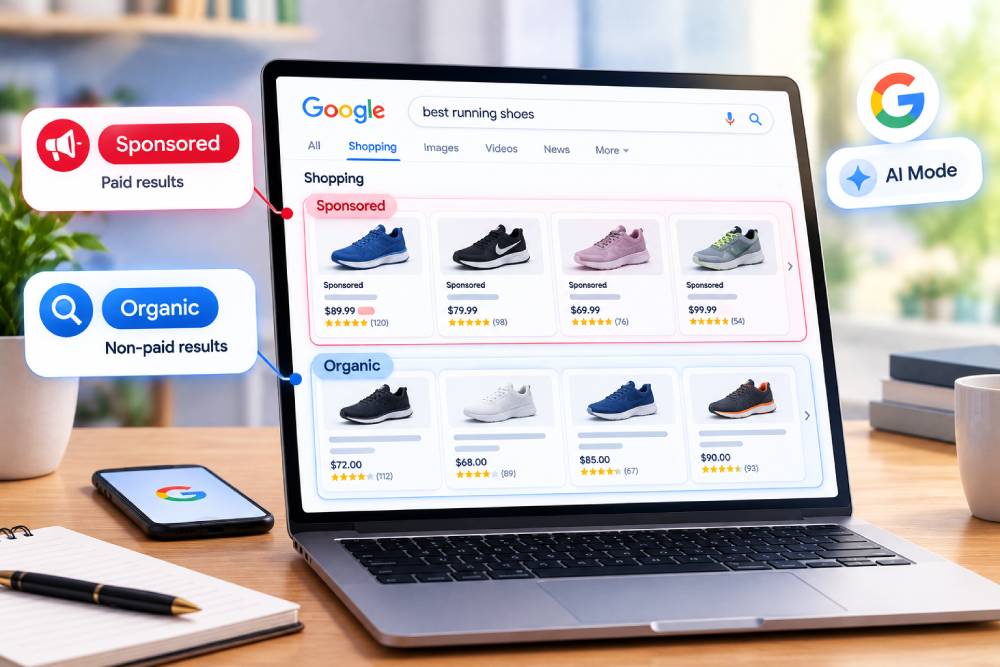
A report from Search Engine Land titled “Google AI Mode Tests Clearer Labels for Sponsored and Organic Shopping Results” highlights this issue. The reported test focuses on how sponsored and organic shopping results are identified within Google’s AI Mode experience.
Clear labeling matters because shoppers should be able to understand whether a product appears through advertising or through an organic discovery process. Additionally, transparent labeling helps users make more informed decisions. For advertisers, ecommerce businesses, and SEO professionals, changes in how shopping results are displayed may also influence visibility, customer trust, and marketing strategies. As a result, businesses may need to adapt their approaches to maintain a strong online presence.
Although interface tests do not necessarily become permanent features, they can still provide useful insights into the challenges of presenting advertising and organic information within AI-powered search. Moreover, these experiments help businesses understand how changes in search interfaces may affect user experience and product visibility.
In this guide, we will explore what sponsored and organic shopping results mean, why clear labels matter in AI Mode, how these developments may affect ecommerce marketing, and what businesses can do to prepare for changes in AI-driven product discovery.
1. What Is Google AI Mode?
Google AI Mode is an AI-powered search experience designed to help users explore questions through more conversational and interactive responses.
Traditional search often presents a list of links that users can open individually. AI-powered experiences can organize information into synthesized responses, helping people investigate complex questions and explore related topics.
For example, a shopper searching for a laptop for video editing may want to compare processor performance, memory, display quality, battery life, and price. Additionally, AI-powered search can help shoppers evaluate these features and identify products that best match their needs.
Rather than searching separately for every specification, the shopper may ask a series of related questions within an AI-powered interface. As a result, they can compare product features more conveniently and narrow down their choices based on their specific needs.
Depending on the query and the available search experience, Google may provide product-related information, links, shopping options, or other supporting details.
This creates new opportunities for businesses to reach consumers during the research and comparison stages of the buying journey. Additionally, businesses can showcase relevant product information, build customer trust, and help shoppers make informed purchasing decisions.
However, the presentation of product recommendations must also clearly distinguish sponsored placements from organic results. This way, shoppers can better understand how products are displayed and make informed decisions based on their preferences.
Important distinction: Google AI Mode is a search experience, not a replacement for every traditional Google Search feature. Its interface, availability, and functionality may vary as Google tests and develops new capabilities.
2. What Are Sponsored and Organic Shopping Results?
To understand the reported AI Mode test, it is important to distinguish sponsored shopping results from organic results.
Although both can help users discover products, they represent different methods of appearing in search experiences. Therefore, businesses should understand the distinction between paid placements and organic visibility to develop effective marketing strategies.
Sponsored Shopping Results
Sponsored shopping results are paid placements associated with advertising programs.
For example, a retailer may use Google Ads to promote products to people searching for relevant items. As a result, these paid placements can help businesses reach potential customers who are already interested in their products.
Depending on the campaign, eligibility, query, and available advertising format, those products may appear in shopping-related placements.
Advertisers generally pay according to the pricing model and conditions of their advertising campaigns. For example, some campaigns charge advertisers when users click on an ad, while others may use different billing methods depending on the campaign objectives.
Sponsored placements can help businesses reach potential customers who are actively researching or considering a purchase.
However, the presence of a sponsored product does not automatically mean that it is the best choice for every shopper. Therefore, consumers should compare product features, prices, and reviews before making a final purchase decision.
Users should evaluate price, specifications, reviews, availability, and their own requirements.
Organic Shopping Results
Organic results are not paid placements in the same sense as advertisements.
A product or website may receive organic visibility because search systems consider its information relevant to the user’s query and the available search experience. As a result, businesses can improve their chances of appearing in organic results by providing useful, relevant, and well-structured content that meets users’ needs.
Organic product discovery can be influenced by factors such as product information, website accessibility, and relevance. Additionally, other search-system considerations may affect how products appear in organic results.
Businesses cannot guarantee organic visibility simply by publishing product pages or adding structured data.
Organic search optimization is a long-term process that aims to make product information accessible, understandable, and useful to both shoppers and search engines. Therefore, businesses should focus on providing accurate product details, improving website accessibility, and creating helpful content to support better organic visibility.
Key Differences
| Feature | Sponsored shopping results | Organic shopping results |
|---|---|---|
| Placement type | Paid advertising | Non-paid search visibility |
| Advertising relationship | Connected to an advertising campaign | Not a paid placement by definition |
| Visibility | Depends on campaign setup, eligibility, and auction conditions where applicable | Depends on relevance, eligibility, and search-system selection |
| Primary business goal | Reach potential customers through advertising | Attract relevant visitors through organic discovery |
| Cost structure | Advertising costs may apply | No direct advertising charge for the organic placement itself |
| Optimization approach | Campaign targeting, bidding, product data, and advertising quality | Product content, technical SEO, relevance, and website quality |
Clear labels help users understand this distinction without having to investigate how every product placement was generated.
3. Why Is Google Testing Clearer Labels in AI Mode?
The Search Engine Land report focuses on a reported test involving clearer identification of sponsored and organic shopping results in Google AI Mode.
The broader issue is the growing importance of transparency in AI-assisted search.
In a traditional search results page, users may already recognize that certain placements are advertisements because of their position or labeling.
In a conversational interface, however, product information can appear alongside summaries, recommendations, explanations, and other content.
If paid and non-paid results are presented within a similar visual experience, users may need clearer cues to understand their differences.
Improving User Understanding
Clear labels can help shoppers recognize when a product placement is sponsored.
This allows users to interpret recommendations with a better understanding of the commercial context.
For example, someone comparing headphones may encounter several product suggestions. Knowing which suggestions are sponsored can help the shopper evaluate the results more thoughtfully.
Supporting Advertising Transparency
Advertising is a normal part of many search and ecommerce business models. The important issue is that paid placements should be distinguishable from organic results.
Labels help communicate the relationship between advertisers and displayed products.
The precise wording, placement, and visual treatment of these labels can influence how easily users recognize the distinction.
Building Trust in AI Search
AI-generated responses can combine different types of information in a single interface. Users therefore need understandable signals about where commercial content appears.
Clear advertising labels can support trust by helping people interpret product suggestions appropriately.
However, labels alone cannot guarantee trust. Accurate product information, useful recommendations, transparent pricing, and reliable shopping experiences also matter.
Important Context About the Reported Test
A test reported by an industry publication should not automatically be interpreted as a permanent Google policy change or a worldwide rollout.
Search interfaces can undergo experiments that appear only to selected users, queries, or devices.
Businesses should distinguish between a reported test, an officially announced feature, and a fully deployed change.
For the latest implementation details, consult Google’s official search and advertising documentation alongside the original industry report.
4. How AI-Powered Shopping Search May Change Product Discovery
AI-assisted shopping can make product research more conversational.
Instead of entering several short keywords, shoppers may describe their needs in greater detail.
For example, a user might ask for a lightweight laptop suitable for university, video editing, and travel within a particular budget.
An AI-powered search experience may help the user explore relevant specifications, compare options, and identify products worth researching further.
This creates several possible changes in the shopping journey.
More Detailed Product Comparisons
Consumers may ask follow-up questions about differences between products, including battery life, materials, compatibility, durability, and price.
Retailers should therefore provide accurate product information that helps customers understand what they are buying.
Greater Importance of Product Data
AI-powered discovery depends on the information available to search systems.
Incomplete or inconsistent product details may make it more difficult for users and search systems to understand a product’s characteristics.
Businesses should maintain accurate titles, descriptions, prices, availability, images, and product identifiers where applicable.
New Ways to Discover Brands
Shoppers may discover products through conversational questions rather than only through traditional category searches.
This creates opportunities for businesses whose products match specific customer requirements.
However, appearing in AI-generated responses is not guaranteed, and the precise selection process may vary by feature and query.
More Complex Attribution
A customer might discover a product through an AI-assisted search, visit the retailer’s website later, and eventually purchase through a different channel.
Traditional last-click reporting may not capture every influence on that decision.
Ecommerce businesses should therefore evaluate multiple performance indicators rather than relying on one traffic source or attribution model.
5. What Does This Mean for Ecommerce Businesses?
The reported test raises useful questions for retailers that depend on organic search, paid advertising, or a combination of both.
Although the long-term effects of an interface experiment cannot be assumed, businesses can take practical steps to improve their readiness for AI-assisted shopping.
5.1 Keep Product Information Accurate
Product information should match what customers actually receive.
Include relevant details such as:
- Product name and brand.
- Important specifications.
- Price and currency.
- Availability.
- Product images.
- Size, color, or other variants.
- Shipping and return information where relevant.
- Warranty details when applicable.
Accurate information supports a better shopping experience and helps businesses maintain consistency across their websites and product feeds.
5.2 Improve Product Page Quality
A product page should answer the questions that matter to a potential buyer.
Instead of relying on short, generic descriptions, explain the product’s features, intended uses, limitations, and relevant specifications.
For example, a laptop product page should not merely say that the device is powerful. It should provide useful details about the processor, memory, storage, display, ports, and other relevant specifications.
The goal is to help users make informed purchasing decisions.
5.3 Strengthen Technical SEO
Search engines need to access and understand relevant website content.
Retailers should review their websites for crawlability, indexation issues, broken links, duplicate pages, and incorrect canonical settings.
Product pages should be accessible to search engines when the business wants them to appear in organic search.
Technical SEO does not guarantee inclusion in AI Mode, but it supports the broader goal of making important website information discoverable.
5.4 Maintain Consistent Product Feeds
Businesses that use product feeds for advertising or eligible shopping experiences should keep their feed information consistent with the corresponding landing pages.
Differences in price, availability, product identifiers, or variant information can create confusion and operational problems.
Regular feed checks can help identify errors before they affect campaign performance or product discovery.
5.5 Measure Organic and Paid Performance Separately
Paid advertising and organic search serve related but different purposes.
Retailers should track their costs, traffic, and conversions separately wherever possible.
Useful metrics include organic impressions, organic clicks, advertising impressions, advertising clicks, conversion rates, revenue, and customer acquisition costs.
Separating these measurements helps businesses understand whether their results come from advertising, organic visibility, or other channels.
6. How SEO Professionals Can Prepare for AI Shopping Search
SEO professionals should continue focusing on established search optimization practices while monitoring changes in AI-powered discovery.
There is no reliable shortcut that guarantees a product will be included in an AI-generated response.
Instead, businesses should build strong foundations.
Optimize Product Titles Naturally
Product titles should accurately describe the item and include relevant identifying information.
For example, a title might include the product type, brand, model, and a key specification when appropriate.
Avoid stuffing product titles with repetitive keywords or promotional phrases that make them difficult to understand.
Write Helpful Product Descriptions
Descriptions should explain what makes the product relevant to its intended audience.
Include practical details and answer common questions where useful.
Avoid copying the same generic text across every product page, especially when doing so prevents customers from understanding meaningful differences between products.
Use Structured Data Correctly
Relevant product structured data can help search engines interpret information about products, including supported attributes such as price, availability, and reviews.
Implementation should follow Google’s current documentation and accurately reflect visible page content.
Structured data does not guarantee enhanced search appearances, shopping placements, or AI citations.
Improve Page Performance
A slow or difficult-to-use website can frustrate shoppers.
Review page loading, mobile usability, image sizes, layout stability, and checkout functionality.
Google’s Core Web Vitals provide useful measurements of loading performance, responsiveness, and visual stability.
Good page performance supports usability, although no single performance metric guarantees higher rankings.
Develop Useful Supporting Content
Product pages can be supported by relevant buying guides, comparisons, maintenance advice, and educational articles.
For example, an electronics retailer might publish a guide explaining how to choose a laptop for graphic design.
Such content can help users understand their options and navigate to suitable product categories.
Supporting articles should provide genuine value rather than existing only to repeat keywords or link to product pages.
7. Paid Advertising and Organic SEO: Why Businesses Need Both
The distinction between sponsored and organic results does not mean businesses must choose one strategy exclusively.
Paid advertising and SEO can support different stages of customer acquisition.
Benefits of Paid Advertising
Paid campaigns can help businesses promote selected products, test messaging, reach relevant audiences, and gather performance data.
Campaigns can also support time-sensitive promotions when the budget and targeting are appropriate.
However, advertising requires ongoing investment, and results depend on campaign quality, competition, pricing, and other factors.
Benefits of Organic SEO
Organic SEO can help businesses attract visitors through relevant searches without paying an advertising charge for each organic click.
Its benefits may accumulate over time as websites develop useful content, stronger technical foundations, and relevant search visibility.
However, SEO requires sustained effort, and rankings or traffic cannot be guaranteed.
A Combined Approach
An ecommerce business may use paid campaigns to promote selected products while investing in SEO to improve the long-term discoverability of its category and product pages.
Performance data from advertising may help identify products or messages that deserve further investigation.
Meanwhile, organic search data can reveal customer questions and opportunities for useful content.
Both channels should be evaluated according to business objectives rather than assumptions about which channel is always superior.
8. How Businesses Can Build Trust in AI-Driven Ecommerce
As shopping interfaces become more sophisticated, trust remains central to online purchasing.
Customers want to understand what a product offers, how much it costs, whether it is available, and what happens if they need to return it.
Businesses can strengthen trust through several practices.
Provide transparent pricing: Clearly communicate relevant prices, fees, and shipping costs.
Use accurate product images: Images should represent the actual product and its important characteristics.
Publish clear policies: Shipping, returns, refunds, privacy, and warranty information should be easy to find.
Display genuine reviews: Do not fabricate testimonials or misrepresent customer feedback.
Maintain secure transactions: Use appropriate security practices and supported payment systems.
Offer accessible support: Make it easy for customers to contact the business when they need assistance.
These practices are useful regardless of whether a shopper discovers a product through traditional search, an AI interface, an advertisement, or another channel.
9. Common Mistakes Ecommerce Businesses Should Avoid
Businesses preparing for AI-powered shopping search should avoid strategies based on speculation or guaranteed outcomes.
Assuming the Reported Test Is a Permanent Rollout
An interface experiment does not automatically establish that the same feature is available to every user.
Verify implementation details before changing marketing plans based on a reported test.
Treating AI Search as a Replacement for SEO
Traditional search optimization remains important for making website content discoverable and useful.
AI-powered interfaces introduce additional considerations, but they do not eliminate the need for accurate content, technical accessibility, and relevant product information.
Publishing Generic Product Descriptions
Descriptions that provide little useful information can make it harder for shoppers to compare products.
Focus on accurate specifications, meaningful differences, and customer questions.
Ignoring Product Feed Errors
Inconsistent pricing, missing identifiers, and inaccurate availability information can undermine the quality of product listings and advertising campaigns.
Regularly review product feeds and their corresponding landing pages.
Assuming AI Visibility Guarantees Sales
Even if a product receives visibility, customers may not purchase it.
Price, product suitability, competition, reviews, shipping, trust, and checkout usability can all influence the final decision.
Measuring Success Only Through Rankings
Rankings provide useful information, but ecommerce businesses should also measure qualified traffic, product engagement, conversions, revenue, and profitability.
The most useful strategy is to connect search visibility with actual business outcomes.
10. What Should Businesses Monitor Next?
Businesses should monitor developments in AI-powered shopping while continuing to follow established SEO and advertising practices.
Useful areas to review include:
- Changes in the presentation of sponsored and organic shopping results.
- Official Google announcements about AI Mode and shopping features.
- Updates to Google Ads policies and advertising formats.
- Changes to product data and merchant requirements.
- Organic search performance for product and category pages.
- Paid campaign performance and conversion rates.
- Customer behavior across different discovery channels.
- Product feed accuracy and website usability.
Use reliable sources and distinguish confirmed changes from experiments or industry commentary.
For Google-specific guidance, consult Google Search Central, the Google Ads Help Center, and the Google Merchant Center Help Center.
These resources can help businesses understand published requirements without relying entirely on speculation about individual interface tests.
Frequently Asked Questions
1. What is Google AI Mode?
Google AI Mode is an AI-powered search experience that helps users explore questions through conversational interactions and synthesized information. Its features and availability may evolve as Google develops the experience.
2. What are sponsored shopping results?
Sponsored shopping results are paid product placements associated with advertising programs. Their appearance depends on factors such as campaign eligibility, targeting, and the available advertising format.
3. What are organic shopping results?
Organic shopping results are non-paid results that may appear through search or shopping experiences. Their visibility depends on relevance, eligibility, and the search system’s selection processes.
4. Why are clearer labels for sponsored and organic results important?
Clear labels help users understand whether a product placement is sponsored or organic. This distinction supports transparency and allows shoppers to interpret commercial content more effectively.
5. Will AI Mode reduce organic traffic for ecommerce websites?
The effect may vary by query, industry, interface, and customer behavior. Businesses should monitor organic clicks, impressions, conversions, and other performance indicators instead of assuming that every AI feature will reduce traffic.
6. How can ecommerce websites improve visibility in AI search?
Businesses should maintain accurate product data, create useful product descriptions, improve technical SEO, implement appropriate structured data, and provide a reliable shopping experience. No specific method guarantees inclusion in AI-generated responses.
7. Should ecommerce businesses invest in SEO or paid advertising?
The decision depends on business goals, budget, competition, and customer acquisition requirements. Paid advertising can support targeted promotion, while SEO can build long-term organic visibility. Many businesses benefit from evaluating both channels together.
Conclusion
Google AI Mode’s reported test of clearer labels for sponsored and organic shopping results highlights an important issue in the development of AI-powered search: users need to understand the difference between advertising and non-paid product discovery.
For consumers, clear labels can make shopping experiences easier to interpret. For advertisers, they reinforce the importance of presenting products within transparent commercial environments. For ecommerce businesses and SEO professionals, the broader lesson is to prepare for evolving search interfaces without abandoning established optimization principles.
Businesses should continue improving product information, maintaining accurate feeds, strengthening technical SEO, and measuring both paid and organic performance. They should also follow official announcements to distinguish temporary experiments from confirmed product changes.
AI-powered shopping may create new opportunities for product discovery, but visibility alone does not guarantee customer trust or sales. Accurate information, transparent pricing, helpful content, and a reliable purchasing experience remain essential to sustainable ecommerce growth.