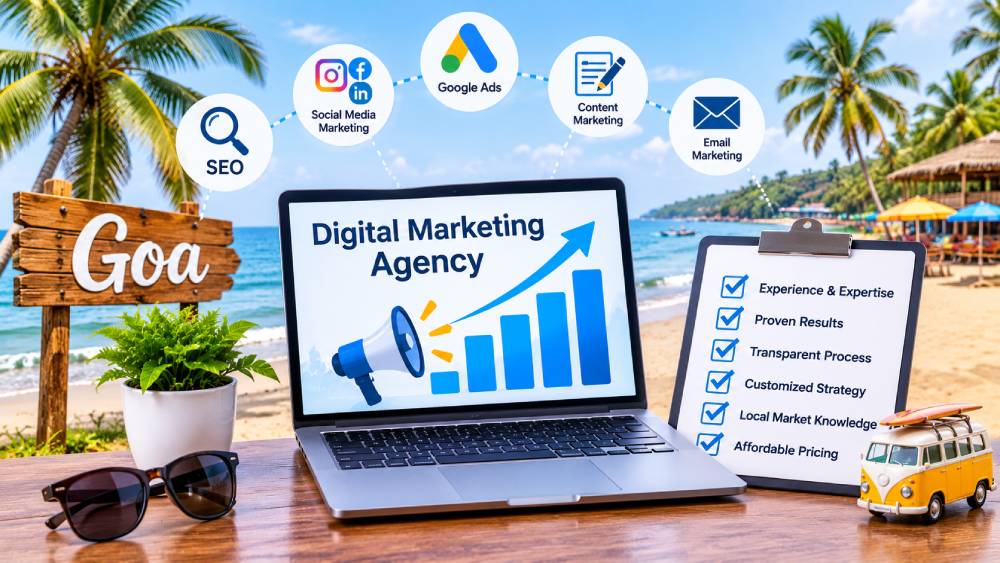
Running a business in Goa offers exciting opportunities, but reaching the right customers in a competitive digital environment requires more than simply having a website or social media account. Whether you operate a hotel, restaurant, travel company, real estate business, retail store, or startup, your potential customers are increasingly using online platforms to discover and compare businesses before making decisions.
This is why choosing the Best Digital Marketing Agency in Goa for Your Business can be an important step toward building a stronger online presence. A professional agency can help you reach relevant audiences, improve website visibility, generate enquiries, and develop marketing campaigns that support your business objectives.
However, selecting the right agency is not always straightforward. Different agencies offer different services, pricing structures, strategies, and levels of expertise. Some focus mainly on social media, while others specialize in SEO, paid advertising, content marketing, or complete digital marketing solutions.
Before investing your money, you need to understand what your business requires and how an agency can help you achieve those goals.
In this guide, we will explain how to evaluate a digital marketing agency in Goa, which services to look for, what questions to ask, and which mistakes to avoid before making your decision.
Why Businesses in Goa Need Digital Marketing
Goa has a diverse business environment that includes tourism, hospitality, restaurants, real estate, education, retail, healthcare, and professional services. Businesses in these industries often depend on online visibility to attract customers and generate enquiries.
For example, a hotel may want to reach travellers planning their next holiday, while a restaurant may want to attract people searching for dining options nearby. Similarly, a real estate company may need to connect with people interested in purchasing or renting properties.
Digital marketing helps businesses reach these audiences through different online channels.
Some important benefits include:
- Greater online visibility: SEO and other digital marketing activities can help customers discover your business online.
- Targeted audience reach: Advertising platforms allow businesses to target audiences based on relevant characteristics and interests.
- Better customer engagement: Social media and content marketing provide opportunities to communicate with potential customers.
- Lead generation: Well-planned campaigns can encourage visitors to enquire about products and services.
- Performance measurement: Analytics tools help businesses understand campaign performance and identify areas for improvement.
- Brand development: Consistent communication across digital platforms can help establish a recognizable brand identity.
For businesses in Goa, digital marketing can also support both local customer acquisition and wider audience targeting. A tourism company, for instance, may target travellers from different Indian cities or international markets, while a local service provider may focus on customers within specific areas.
1. Understand Your Business Goals Before Hiring an Agency
The first step in choosing a digital marketing agency is understanding what you want to achieve.
Without clear objectives, it becomes difficult to evaluate an agency’s strategy or measure whether its services are delivering value.
Different businesses have different marketing requirements.
For example:
| Business Type | Possible Digital Marketing Goal |
|---|---|
| Hotels and resorts | Increase direct bookings and enquiries |
| Restaurants and cafes | Attract local customers and improve brand awareness |
| Travel agencies | Generate tour and holiday package enquiries |
| Real estate companies | Generate qualified property enquiries |
| Ecommerce businesses | Increase online sales and product visibility |
| Educational institutions | Generate admission enquiries |
| Healthcare providers | Improve visibility for relevant services |
Before contacting an agency, identify your most important business objective.
Do you want more website visitors, qualified leads, online bookings, product sales, or brand awareness?
A professional agency should understand these priorities before recommending a marketing package. It should also explain which channels are suitable for your business instead of suggesting every available service.
2. Look for Relevant Industry Experience
Not every digital marketing strategy works equally well across all industries. A hotel, restaurant, real estate company, and software business have different audiences and customer journeys.
Therefore, consider an agency’s experience with businesses similar to yours.
For example, a digital marketing agency working with hotels and resorts should understand how travellers research destinations, compare accommodation options, and make booking decisions.
Similarly, an agency working with real estate businesses should understand lead generation, property-related search queries, landing pages, and audience targeting.
When evaluating industry experience, consider:
- Has the agency worked with businesses in your industry?
- Does it understand your target customers?
- Can it explain the challenges associated with marketing your products or services?
- Does it have relevant campaign examples?
- Can it explain what strategies were used and how performance was measured?
Ask for genuine case studies or examples where available. Look for clear explanations of the work completed rather than relying only on impressive traffic or ranking screenshots.
An agency should be transparent about its experience and avoid presenting another company’s results as its own.
3. Evaluate the Range of Digital Marketing Services
A good digital marketing agency should offer services that match your business requirements. You do not necessarily need every service, but the agency should understand how different channels can work together.
Here are some important services to consider.
Search Engine Optimization (SEO)
SEO helps improve a website’s visibility in organic search results.
It may include:
- Keyword research.
- On-page SEO.
- Technical SEO audits.
- Content optimization.
- Internal linking.
- Local SEO.
- Relevant link-building activities.
For example, a Goa-based hotel may want to attract people searching for accommodation in a particular area. SEO can help the hotel improve its visibility for relevant searches when supported by useful website content and a technically sound website.
Social Media Marketing
Social media marketing helps businesses communicate with their audiences through platforms such as Instagram, Facebook, and LinkedIn.
Depending on the business, activities may include:
- Content planning.
- Creative development.
- Reels and short-form videos.
- Social media page management.
- Community engagement.
- Campaign performance analysis.
For hospitality and tourism businesses, visually engaging content can help showcase properties, experiences, destinations, and services.
Pay-Per-Click Advertising (PPC)
PPC advertising allows businesses to promote their products and services through paid advertising platforms.
Common activities include:
- Google Ads campaign management.
- Search advertising.
- Display advertising.
- Remarketing.
- Campaign audience targeting.
- Conversion tracking.
For example, a travel company may use search ads to reach people actively looking for holiday packages. The agency should explain how it selects keywords, controls advertising costs, and measures conversions.
Content Marketing
Content marketing involves creating useful information that attracts and engages potential customers.
Examples include:
- Blog articles.
- Buying guides.
- Destination guides.
- Informational landing pages.
- Industry-related resources.
- Educational social media content.
A travel business in Goa, for instance, could publish useful content about local attractions, travel planning, and seasonal activities. Such content can help users discover the business while providing information relevant to their interests.
Website Design and Development
Your website is often one of the first places potential customers visit after discovering your business.
An agency offering website services may help with:
- Website design.
- Mobile responsiveness.
- Landing page development.
- Website speed improvements.
- Navigation and user experience.
- Conversion-focused page layouts.
A visually attractive website should also be easy to use, provide clear information, and guide visitors toward meaningful actions.
4. Check the Agency’s Local SEO Knowledge
Local SEO is particularly useful for businesses that want to attract customers in specific geographical areas.
In Goa, businesses such as restaurants, hotels, salons, healthcare providers, and local service companies may benefit from improving their visibility for location-related searches.
A capable digital marketing agency should understand:
Google Business Profile optimization: Maintaining accurate business information, categories, contact details, photos, and other relevant profile information.
Local keyword research: Identifying search terms that connect your services with relevant locations.
Location-specific website content: Creating useful pages that explain the services available in particular areas.
Customer reviews: Encouraging genuine customer feedback and responding professionally.
Local business information: Maintaining accurate and consistent business details across relevant online platforms.
For example, a restaurant may want to appear when people search for dining options in its service area. Local SEO can help improve its chances of being discovered for relevant searches.
However, local SEO should be based on genuine business locations and services. Creating multiple misleading location pages or fake business listings is not a sustainable strategy.
5. Review the Agency’s Website and Online Presence
Before hiring a digital marketing agency, examine its own website and online presence.
An agency’s website can provide useful information about its services, expertise, communication style, and approach to content.
Consider checking:
- Is the website professionally structured?
- Are its services explained clearly?
- Does it provide useful and relevant content?
- Is the website easy to navigate on mobile devices?
- Are its contact details accessible?
- Does it have genuine customer reviews or testimonials?
- Does it explain its experience and working process?
You can also examine its social media activity and published content.
However, remember that an agency’s own website performance does not tell the complete story of its capabilities. Use this information alongside case studies, discussions, and service proposals.
6. Ask About Its Strategy and Working Process
A reliable digital marketing agency should not recommend a campaign without first understanding your business.
It should follow a structured process that connects marketing activities with your goals.
A typical process may include:
Step 1: Business discovery
The agency learns about your products, services, target customers, competitors, and business objectives.
Step 2: Digital presence audit
It reviews your website, social media profiles, existing campaigns, and current online visibility.
Step 3: Competitor and audience research
It identifies relevant competitors, customer interests, and opportunities to reach your target audience.
Step 4: Strategy development
The agency recommends suitable channels, campaign priorities, content requirements, and performance indicators.
Step 5: Implementation
The agreed activities are carried out, such as SEO optimization, advertising campaigns, content creation, or social media management.
Step 6: Performance monitoring
The agency reviews results, identifies problems, and adjusts campaigns where necessary.
Ask the agency to explain its process before signing an agreement. A clear working approach makes it easier to understand what you are paying for and what responsibilities each party has.
7. Check Its Reporting and Performance Tracking Methods
Digital marketing should be measured through relevant performance indicators rather than assumptions.
Before hiring an agency, understand how it reports campaign performance and which tools it uses.
Common tools include:
- Google Analytics 4 for website traffic and user behaviour.
- Google Search Console for organic search performance.
- Google Ads for paid search campaign data.
- Meta Ads Manager for Facebook and Instagram advertising.
- SEO tools for keyword research, competitor analysis, and website audits.
The metrics you track should depend on your business goals.
| Performance Metric | What It Measures |
|---|---|
| Website traffic | Visitors arriving at your website |
| Organic clicks | Visitors coming from organic search |
| Search impressions | How often website pages appear in search results |
| Cost per lead | Advertising cost associated with generating a lead |
| Conversion rate | Percentage of visitors completing a desired action |
| Engagement rate | Audience interaction with social media content |
| Bookings and enquiries | Customer actions relevant to your business |
| Return on ad spend | Revenue generated relative to advertising spend |
For example, a hotel should not evaluate a campaign only by counting social media likes. It should also examine relevant enquiries, website visits, booking activity, and the quality of the traffic.
Ask whether the agency provides regular reports and explains what the numbers mean for your business.
8. Understand Pricing and What Is Included in the Package
Digital marketing pricing can vary depending on the services required, campaign complexity, content volume, advertising budget, and level of ongoing support.
Some agencies offer individual services, while others provide complete digital marketing packages.
Before choosing an agency, ask for a detailed breakdown of its pricing.
Check whether the package includes:
- SEO research and optimization.
- Social media content creation.
- Paid campaign management.
- Website maintenance or development.
- Blog and content writing.
- Creative design.
- Reporting and strategy meetings.
Also clarify whether advertising spend is included in the agency’s fee or charged separately.
For example, if you hire an agency to manage Google Ads, the management fee and the actual advertising budget may be separate expenses.
Do not select an agency only because it offers the lowest price. Compare the services, deliverables, expertise, communication, and reporting quality.
A transparent proposal should clearly explain what the agency will do, how often it will perform the work, and what is outside the agreed scope.
9. Evaluate Communication and Customer Support
Good communication is essential for a successful relationship between a business and its digital marketing agency.
Marketing campaigns require regular discussions, feedback, approvals, and performance reviews. If communication is inconsistent, even a well-planned strategy can become difficult to execute.
Before hiring an agency, understand:
- Who will manage your account?
- How frequently will you receive updates?
- How can you contact the team?
- How are campaign approvals handled?
- How are changes in business requirements communicated?
- Who will explain monthly performance reports?
You should feel comfortable asking questions and discussing concerns.
A professional agency should explain technical concepts in understandable language rather than using complicated terminology to avoid answering questions.
10. Check Transparency, Ownership, and Ethical Practices
Your website, advertising accounts, social media pages, and analytics data are valuable business assets.
Before signing an agreement, make sure your business retains appropriate ownership and administrative access.
A trustworthy agency should be transparent about its activities and responsibilities.
Check the following:
- You retain ownership of your website and domain.
- Your business has appropriate access to advertising accounts.
- Analytics and tracking accounts are accessible to your team.
- Campaign spending is clearly documented.
- SEO and link-building methods are explained.
- Reporting is based on genuine performance data.
- No guaranteed ranking or sales claims are used to pressure you.
Avoid agencies that refuse to explain their methods or demand unnecessary control over your digital assets.
Ethical practices and transparency are important for building a stable, long-term business relationship.
11. Questions to Ask Before Hiring a Digital Marketing Agency in Goa
Before finalizing an agency, ask questions that reveal its experience, strategy, and working style.
Here are some useful questions:
- Have you worked with businesses in my industry?
- Which digital marketing services would you recommend for my business?
- How will you identify my target audience?
- What will your initial marketing strategy include?
- How do you approach SEO and local search optimization?
- What is your process for managing paid advertising campaigns?
- Which performance metrics will you track?
- How frequently will I receive reports?
- Is the advertising budget included in your service fee?
- Will I retain ownership and access to my website and marketing accounts?
The answers should help you understand whether the agency has a practical strategy for your business.
Do not hesitate to ask for clarification if a proposal contains unfamiliar terms or unclear deliverables.
12. Common Mistakes to Avoid When Choosing a Digital Marketing Agency
Choosing an agency without proper evaluation can lead to wasted money, unclear expectations, and disappointing campaign performance.
Avoid these common mistakes:
Choosing only on the basis of price: A very low-cost package may not include the services your business actually requires.
Expecting instant results: SEO, brand development, and audience building take time. Paid advertising can generate visibility quickly, but results still depend on targeting, budget, and campaign quality.
Ignoring industry experience: An agency should understand your business model and the audience you want to reach.
Focusing only on social media followers: A large follower count does not automatically generate sales, bookings, or qualified leads.
Accepting guaranteed rankings or sales: No agency can legitimately guarantee specific Google rankings or fixed business outcomes.
Ignoring reporting: Without proper tracking, it becomes difficult to understand which activities are working.
Not checking account ownership: Always maintain appropriate access to your website, advertising platforms, and analytics accounts.
Taking time to evaluate these factors can help you make a more informed decision.
Conclusion
Choosing the Best Digital Marketing Agency in Goa for Your Business requires more than comparing service packages or looking at attractive promotional claims. You need an agency that understands your industry, target audience, marketing objectives, and available resources.
Start by identifying your business goals and evaluating the agency’s experience, service offerings, local SEO knowledge, reporting methods, pricing, and communication process.
Whether you run a hotel, restaurant, travel company, real estate business, ecommerce store, or startup, your digital marketing strategy should be designed around the customers you want to reach and the results that matter to your business.
Most importantly, choose a partner that values transparency, realistic expectations, and consistent improvement. A well-planned digital marketing strategy can help your business strengthen its online presence, reach relevant audiences, and create opportunities for sustainable growth.
Frequently Asked Questions (FAQs)
1. How do I choose the best digital marketing agency in Goa?
Evaluate the agency’s industry experience, services, previous work, local SEO knowledge, pricing, communication, and reporting process. Choose an agency that understands your business goals and offers a clear strategy.
2. What services does a digital marketing agency in Goa provide?
Services may include SEO, social media marketing, Google Ads, Meta Ads, content marketing, website design and development, local SEO, and performance tracking.
3. How much does a digital marketing agency in Goa charge?
Pricing depends on the services required, campaign scope, competition, content needs, and advertising budget. Request a detailed proposal to understand the service fees and additional expenses.
4. Is digital marketing important for small businesses in Goa?
Yes. Digital marketing can help small businesses improve online visibility, reach relevant customers, promote their services, and generate enquiries. The right strategy depends on the business type and target audience.
5. How can digital marketing help hotels and restaurants in Goa?
Digital marketing can help hotels and restaurants improve search visibility, showcase their services, engage with potential customers, promote offers, and generate enquiries or direct bookings.
6. How long does it take to see results from digital marketing?
The timeline depends on the marketing channel. Paid advertising can generate visibility soon after campaigns launch, while SEO and organic audience development generally require consistent work over time.
7. Should I hire a full-service digital marketing agency or a specialized agency?
A full-service agency may be suitable if your business needs support across several channels. A specialized agency may be a better option if you have a specific requirement, such as SEO or paid advertising. Choose according to your objectives and resources.
8. How can I measure the performance of a digital marketing agency?
Track relevant indicators such as website traffic, organic clicks, leads, conversion rates, bookings, advertising costs, and revenue. The right metrics depend on your business goals and campaign type.