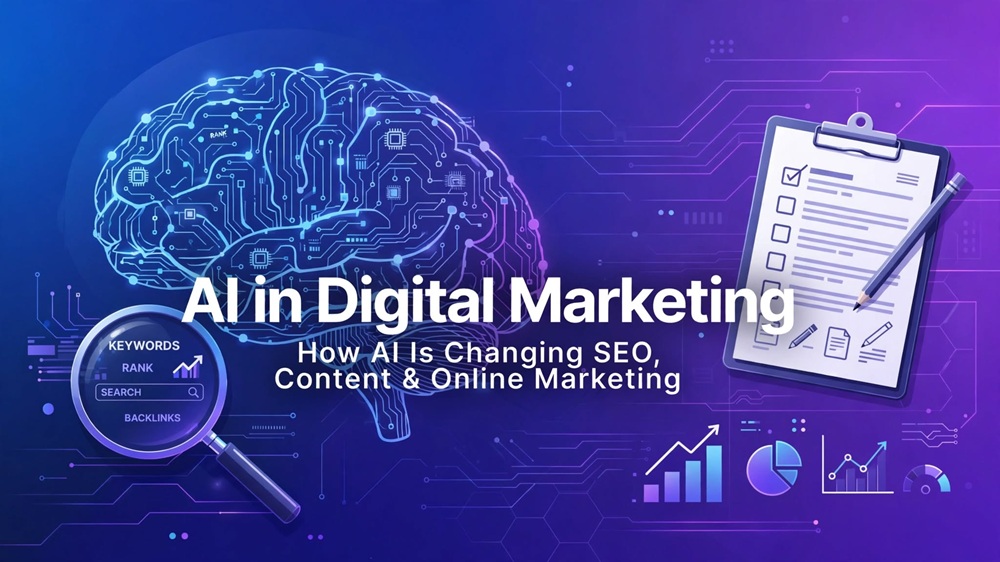
Artificial intelligence is no longer a futuristic concept reserved for technology companies. It has become part of everyday digital marketing—from keyword research and content creation to customer segmentation, advertising optimization, analytics, personalization, and search.
For businesses, the important question is no longer whether AI should be used in marketing. The more practical question is how AI can be integrated without sacrificing accuracy, originality, brand identity, or customer trust.
This is particularly important because search itself is changing. Google now provides generative AI experiences such as AI Overviews and AI Mode, while traditional SEO fundamentals continue to influence how websites are discovered and represented in these experiences. Google states that there are no special technical requirements or “AI SEO hacks” required for these features; foundational SEO and high-quality, people-first content remain important. [Reference Source: Google Search Central]
For marketers, this creates a new opportunity: combine human expertise + first-party data + SEO + AI-assisted workflows to produce marketing that is faster, more relevant, and more useful.
What Is AI in Digital Marketing?
AI in digital marketing refers to using artificial intelligence technologies to analyze data, identify patterns, automate repetitive tasks, generate or assist with content, personalize customer experiences, and support marketing decisions.
Traditional digital marketing depends heavily on manual research and execution. A marketer might manually analyze search queries, create audience segments, write ad variations, review campaign data, prepare reports, and identify content opportunities.
AI can assist with many of these activities.
However, AI should not simply be viewed as a content-writing machine.
A modern AI-enabled marketing workflow can involve:
- Search and keyword research
- Content research and outlining
- Content personalization
- SEO analysis
- Customer segmentation
- Predictive analytics
- Advertising optimization
- Conversational marketing
- Chatbots and virtual assistants
- Marketing automation
- Social media analysis
- Conversion-rate analysis
- Reporting and data interpretation
The key distinction is assistance versus replacement.
AI can process large volumes of information quickly, but human marketers still need to define objectives, verify information, understand customers, make strategic decisions, protect brand reputation, and evaluate the quality of the final output.
Salesforce’s India marketing research reported that 81% of marketers in India had adopted AI, while also highlighting data quality and disconnected customer data as significant challenges. [Reference Source: Salesforce, 2026]
This demonstrates an important principle: adopting AI is only one part of an effective marketing strategy. The quality and usability of the underlying data matter too.
How AI Is Changing Digital Marketing
1. AI Is Transforming SEO and Search Strategy
SEO has traditionally focused on understanding keywords, optimizing pages, building authority, improving technical performance, and matching search intent.
AI is expanding how marketers approach this process.
Instead of looking only at individual keywords, marketers can use AI-assisted analysis to identify:
- Search intent
- Related questions
- Topic relationships
- Content gaps
- Semantic entities
- User journey stages
- Existing content weaknesses
- Opportunities for supporting content
For example, instead of creating separate articles for dozens of variations of a keyword, an SEO strategist can identify the underlying topic and create a comprehensive resource that answers multiple relevant questions.
This aligns with Google’s current guidance. Google specifically warns against creating large quantities of pages primarily to manipulate rankings or generative AI responses. It recommends focusing on unique, useful, people-first content instead. [Reference Source: Google Search Central]
AI and Generative Search
The growth of AI-powered search has also introduced terms such as:
- Generative Engine Optimization (GEO)
- Answer Engine Optimization (AEO)
- AI search optimization
But marketers should not treat these as replacements for SEO.
Google’s guidance explicitly states that existing SEO best practices remain relevant for generative AI search experiences. AI systems can use relevant pages from Google’s Search index to formulate responses and provide links to supporting sources. [Reference Source: Google Search Central]
A Practical AI + SEO Workflow
A useful workflow can look like this:
Step 1: Identify the business objective.
Step 2: Research the target audience and search behavior.
Step 3: Analyze existing rankings and competing content.
Step 4: Use AI to cluster related topics and questions.
Step 5: Build a content architecture around the main topic.
Step 6: Create original content using human expertise, research, examples, and evidence.
Step 7: Optimize titles, headings, internal links, entities, images, and structured data where appropriate.
Step 8: Review the content for factual accuracy and originality.
Step 9: Publish and monitor performance.
Step 10: Improve the page using actual search and user data.
The objective is not to “write for AI.” The objective is to create content that is genuinely useful to people and technically accessible to search systems.
2. AI Is Changing Content Marketing
Content marketing is one of the areas where AI has created the biggest productivity gains.
AI can help marketers move from a blank page to a structured content workflow much faster.
It can assist with:
- Topic ideation
- Content briefs
- Keyword clustering
- Outlines
- FAQ identification
- Content repurposing
- Social media variations
- Email drafts
- Video scripts
- Metadata
- Content summaries
- Content audits
But there is an important limitation.
AI-generated content is not automatically high-quality content
Publishing large volumes of automatically generated articles without meaningful human input can create quality and originality problems.
Google’s guidance says generative AI can be useful for research and adding structure to original content, but generating many pages without adding value can violate its scaled content abuse policies. [Reference Source: Google Search Central]
Therefore, a stronger workflow is:
AI research → Human expertise → Original insights → Fact checking → Editorial review → SEO optimization → Publication
For example, an AI tool may generate ten possible blog structures for a healthcare marketing topic. A subject-matter expert can then remove irrelevant sections, add real industry examples, verify claims, incorporate customer questions, and develop original recommendations.
The final article becomes more than AI-generated text.
It becomes expert-led content supported by AI-assisted research and production.
Building E-E-A-T Into AI-Assisted Content
Businesses should pay particular attention to:
Experience: Include practical examples, first-hand observations, original processes, screenshots, case studies, or lessons learned where appropriate.
Expertise: Make sure technically important information is reviewed by someone knowledgeable about the subject.
Authoritativeness: Support significant claims with reliable sources.
Trustworthiness: Clearly distinguish facts, analysis, opinions, and promotional statements.
AI can help accelerate production, but these qualities ultimately depend on the people and processes behind the content.
3. AI Is Making Digital Advertising More Data-Driven
Digital advertising generates huge amounts of data.
A campaign can contain multiple:
- Audiences
- Creatives
- Headlines
- Descriptions
- Landing pages
- Placements
- Search terms
- Devices
- Locations
- Conversion events
AI can help marketers analyze patterns across these datasets and identify opportunities that would take considerably longer to discover manually.
AI in Paid Search
AI-assisted advertising workflows can support:
- Search-term analysis
- Keyword categorization
- Ad-copy variations
- Audience analysis
- Landing-page recommendations
- Conversion analysis
- Campaign performance summaries
However, automation should not eliminate human oversight.
A campaign can have technically impressive automation while still pursuing the wrong business objective.
For example, optimizing purely for a low cost per lead may produce many inexpensive leads but fail to generate qualified customers.
The marketing team therefore needs to connect advertising data with actual business outcomes.
AI and Paid Social
AI can also support social advertising through:
- Creative ideation
- Audience insights
- Copy variations
- Performance analysis
- Personalization
- Automated optimization
The human role remains critical in defining brand positioning and evaluating whether the generated creative actually reflects the company’s identity.
4. AI Is Personalizing Customer Experiences
One of AI’s biggest opportunities in marketing is personalization.
Traditional personalization might use simple rules such as:
“Show this offer to visitors who previously viewed this product.”
AI can analyze broader combinations of behavioral and contextual signals to support more sophisticated personalization.
Potential applications include:
- Product recommendations
- Personalized emails
- Dynamic website experiences
- Conversational assistants
- Lead qualification
- Customer-support automation
- Content recommendations
- Follow-up messaging
For example, an education company could use an AI-assisted system to categorize visitors based on whether they are researching undergraduate programs, executive education, or professional certifications.
The website can then provide more relevant information to each audience.
But personalization also increases the importance of responsible data management.
Organizations should understand what data is being collected, why it is being used, who can access it, and how AI systems process it.
NIST’s Generative AI Profile highlights risks that can arise throughout the AI lifecycle, including design, deployment, operation, and evaluation. [Reference Source: NIST]
5. AI Is Changing Marketing Analytics
Marketing analytics traditionally requires marketers to examine dashboards and manually interpret trends.
AI can help turn large datasets into actionable questions and summaries.
For example:
Traditional approach:
Traffic increased 18%.
AI-assisted analytical approach:
Which landing pages generated the increase? Which queries contributed to it? Did the increase produce more conversions? Which channels changed during the same period?
This shift moves marketing analytics from simply reporting numbers toward understanding why those numbers changed.
AI + Google Search Data
SEO teams can use AI-assisted analysis to examine:
- Queries
- Impressions
- Clicks
- CTR
- Average position
- Landing pages
- Countries
- Devices
- Search appearance
- Date-wise changes
Google announced dedicated Search Console reporting for visibility from generative AI features in Search, including AI Overviews and AI Mode, with the rollout reaching websites worldwide by August 31, 2026. [Reference Source: Google Search Central]
This creates another useful workflow:
Search data → AI-assisted pattern detection → Human interpretation → SEO hypothesis → Implementation → Measurement
AI should help marketers ask better questions—not simply produce attractive reports.
Real-World Applications of AI in Digital Marketing
Consider a hypothetical B2B company in Noida that wants to generate leads through organic search.
Instead of publishing generic articles every week, its marketing team could use an AI-assisted workflow.
Example 1: SEO Content
The team identifies:
- Commercial keywords
- Informational queries
- Competitor content gaps
- Customer questions
- Industry-specific topics
AI helps organize these into topic clusters.
A human SEO strategist then creates the content strategy and briefs subject-matter experts.
The final content includes original examples, supporting evidence, FAQs, internal links, and conversion-focused calls to action.
Example 2: Local Marketing
A Digital Marketing agency in Noida could use AI to analyze local search themes, identify service-specific content opportunities, review landing-page performance, and generate draft variations for different business segments.
The agency should still validate local information, maintain accurate business details, and ensure that pages provide genuinely useful information rather than producing hundreds of near-identical city pages.
Example 3: Lead Qualification
A company receiving hundreds of website enquiries could use an AI-assisted system to categorize leads according to:
- Service requirement
- Company size
- Location
- Budget range
- Purchase intent
- Requested timeline
Sales teams can then prioritize follow-up according to predefined business rules.
The AI does the classification; humans remain responsible for important decisions and customer relationships.
Common AI Digital Marketing Mistakes – and How to Avoid Them
Mistake 1: Publishing AI Content Without Editing
Problem: Generic, repetitive, inaccurate content.
Solution: Add human expertise, original examples, verification, and editorial review.
Mistake 2: Creating Hundreds of Pages for Keywords
Problem: Large-scale content created mainly to manipulate search visibility.
Solution: Consolidate related queries into genuinely useful resources and create pages because users need them—not simply because a keyword exists. Google specifically advises against scaled content created primarily for search manipulation.
Mistake 3: Trusting AI Output Without Verification
AI can produce incorrect information, outdated claims, or fabricated references.
Solution: Verify important facts using authoritative primary sources.
Mistake 4: Ignoring Data Privacy and Governance
AI systems can introduce privacy, security, bias, and reliability concerns.
Solution: Establish clear rules for what data can be entered into AI systems, who can access it, and how outputs are reviewed. NIST’s AI Risk Management Framework provides a useful framework for thinking about trustworthy AI practices.
Mistake 5: Measuring AI Productivity Instead of Business Results
Generating 100 articles or 500 ad variations does not automatically mean marketing performance improved.
Measure outcomes such as:
- Qualified leads
- Revenue
- Conversion rate
- Customer acquisition cost
- Organic visibility
- Engagement
- Customer retention
The Future of AI in Digital Marketing
The next phase of AI marketing is likely to move beyond simple content generation toward AI-assisted decision-making, personalization, conversational experiences, and increasingly agentic workflows.
Search is also evolving. Google’s current guidance discusses emerging agentic experiences and emphasizes that strong technical foundations and useful content remain important.
For marketers, the strategic advantage will not simply come from having access to an AI tool.
It will come from combining:
AI + proprietary data + human expertise + strong SEO + creative thinking + responsible governance.
Conclusion: AI Should Augment Marketing, Not Replace Strategy
AI in digital marketing is changing how businesses research, create, advertise, personalize, analyze, and communicate.
But successful AI marketing is not about producing the largest amount of content or automating every possible task.
It is about using technology intelligently.
Businesses should use AI to reduce repetitive work, identify patterns, accelerate research, personalize experiences, and support better decisions-while humans remain responsible for strategy, creativity, accuracy, ethics, and customer understanding.
For businesses looking to implement an AI-powered SEO and digital marketing strategy, working with an experienced Digital Marketing agency in Noida can help connect AI tools with broader objectives such as organic growth, lead generation, paid advertising, content strategy, and conversion optimization.