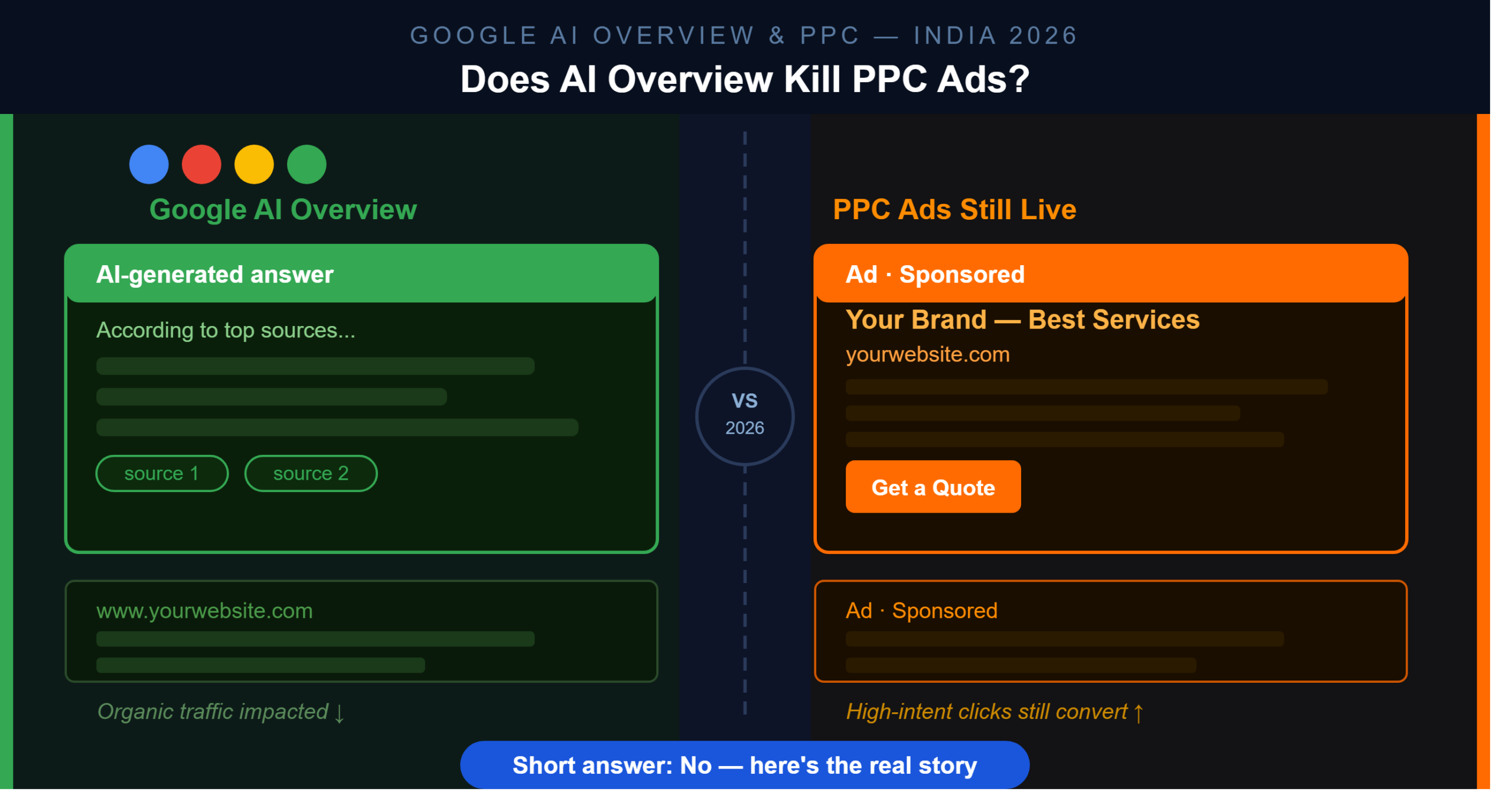
Google’s AI Overview — the AI-generated answer block that now appears above organic results on billions of searches — has triggered genuine panic among Indian advertisers. Traffic is dropping. Click-through rates are shifting. And business owners are asking a very reasonable question:
“If Google is answering questions directly, who’s going to click on my ads?”
The short answer: your ads are still running, still visible, and still working — but the game has changed. Here’s exactly what’s happening and what you must do about it.
First: What Exactly Is Google AI Overview?
Google AI Overview (formerly Search Generative Experience or SGE) is an AI-generated summary that appears at the very top of Google’s search results page for many queries. It synthesizes information from multiple sources and provides a direct answer — before any organic result or paid ad.
Launched globally in 2024 and now active across India in English, AI Overview appears for:
- Informational and research-style queries (“How does GST work for freelancers in India?”)
- How-to and comparison searches (“Which is better, WordPress or Shopify for Indian ecommerce?”)
- Some commercial queries (“Best CRM software for small businesses in India”)
Critically, AI Overview does NOT consistently appear for high-intent transactional searches — and that’s exactly where PPC lives.
The Reality: Where AI Overview Appears vs. Where PPC Ads Appear
The key misunderstanding driving advertiser panic is the assumption that AI Overview and Google Ads compete for the same searches. They largely don’t.
| Query Type | What Actually Appears on the Page |
| Informational | “How to improve website speed” → AI Overview shows, few ads |
| Research | “Best SEO strategies 2026” → AI Overview + some ads |
| Commercial Intent | “SEO agency Noida” → AI Overview sometimes, Ads prominent |
| Transactional | “Hire digital marketing agency Noida” → Ads dominate, no AI Overview |
| Local | “Web design company near me” → Local Ads + Maps Ads |
| 📊 Key Data Point Google’s own internal data (2025) showed that AI Overview pages still display ads on over 80% of commercial and transactional queries. The high-value clicks advertisers care about are still being monetized through PPC. |
What’s Actually Changing for Indian PPC Advertisers
While PPC is not dead, AI Overview has created real, measurable shifts that every Indian advertiser needs to adapt to:
1. Organic clicks for informational terms are declining
If your blog and SEO strategy relied on traffic from research-stage queries, you will see a drop. AI Overview satisfies those queries without a click. This affects content marketing more than it affects PPC.
2. The buyer journey is compressing
AI answers are accelerating how quickly users move from awareness to decision. Someone who used to spend a week researching “which PPC agency to hire” might now read an AI summary, decide in minutes, and immediately search for a specific agency. This means buyers are arriving at your transactional ads more ready to convert — which is actually good for PPC ROI.
3. Brand-name searches are becoming more important
When AI Overview recommends your business by name, users follow up with a branded search or direct visit. Brands that appear in AI answers will see branded search volume and branded PPC traffic increase. This creates a direct link between your AEO/GEO strategy and your PPC performance.
4. Quality Score pressures are increasing
As fewer users click from informational pages, Google’s ad auction is increasingly concentrated around high-intent searches. Landing page relevance and ad quality matter even more than before — because you’re competing for clicks from a more educated, more decisive audience.
The Opportunity Nobody Is Talking About: Ads Inside AI Overviews
Here’s the development most Indian advertisers have missed: Google has begun testing and rolling out Shopping Ads and Search Ads directly within the AI Overview block itself.
In early 2025, Google confirmed that ads labelled “Sponsored” now appear embedded within AI Overview summaries for commercial queries. For categories like e-commerce, travel, real estate, education, and insurance — where AI Overview is common and buyer intent is high — this represents an entirely new ad placement.
| 🚀 What This Means for Your Business If you are running Google Shopping Ads, Performance Max, or well-optimized Search Ads with high Quality Scores, you have a chance to appear inside the AI Overview block — at the very top of the page, embedded in a trusted AI answer. This is prime real estate that most Indian advertisers have not yet optimized for. |
How to Adapt Your PPC Strategy for the AI Overview Era
1. Shift budget toward high-intent, transactional keywords
Reduce spend on informational and research-stage terms (where AI Overview dominates and clicks are dropping). Double down on purchase-intent and hire-intent keywords where ads still dominate the results page.
2. Optimize for AI Overview ad placements
Improve your Quality Score across all campaigns — higher Quality Scores are more likely to trigger ad placement within AI Overview blocks. Focus on: tight keyword-ad-landing page alignment, high expected click-through rate, and superior landing page experience.
3. Run branded keyword campaigns
If your brand is being cited by AI Overview or AI assistants, users will search your brand name directly. Protect your brand with branded campaigns to capture this warm traffic at a low cost per click.
4. Use Performance Max with strong asset variety
Performance Max campaigns (Google’s AI-driven format) are the most likely to appear across AI-integrated placements including AI Overview. Provide Google with rich assets — multiple headlines, descriptions, images, and video — to maximize placement eligibility.
5. Embrace audience targeting over keyword targeting
As AI Overview handles more keyword-based queries, in-market audiences and custom intent audiences become more valuable than ever. Target users whose browsing behaviour indicates purchase intent, regardless of the exact search term they used.
6. Measure beyond clicks — track conversions and ROAS
Some advertisers are panicking over falling CTR without checking what’s happening to conversion rates. Often, fewer but more intent-qualified clicks result in better conversion rates and better return on ad spend. Review your ROAS, not just your traffic volume.
PPC Strategy: Before vs. After AI Overview
| Area | Before AI Overview |
| Primary keyword focus | Broad informational + commercial keywords |
| Content ads role | Driving awareness traffic via display |
| Measurement priority | CTR and impressions |
| Performance Max use | Optional or supplementary |
| Landing page focus | Information and engagement |
| Budget allocation | Spread across funnel stages |
Frequently Asked Questions
Should I pause my Google Ads because of AI Overview?
No. AI Overview primarily affects informational searches — not the transactional and commercial queries where PPC generates leads and sales. Pausing ads based on AI Overview panic would directly reduce your business pipeline. The right response is to adapt your keyword strategy, not abandon paid search.
Is my PPC traffic dropping because of AI Overview?
It depends on your keyword mix. If your campaigns include a significant number of informational or how-to keywords, you may see traffic decline. Review your search terms report in Google Ads and identify which terms now trigger AI Overview — then evaluate whether those terms were ever driving meaningful conversions.
Will Google eventually put more ads inside AI Overview?
Almost certainly yes. Google generates over 80% of its revenue from advertising. AI Overview is a product feature, not a threat to the ads business. Google is actively developing ad formats that integrate with AI-generated content. Advertisers who maintain strong Quality Scores and diverse creative assets will benefit first.
How does AI Overview affect my Google Ads budget in India?
For most Indian businesses focused on local services, lead generation, and e-commerce, the direct budget impact is minimal. The larger risk is an inefficient keyword strategy that wastes budget on terms where AI Overview has reduced the value of the click. A quarterly keyword audit should now be a standard practice.