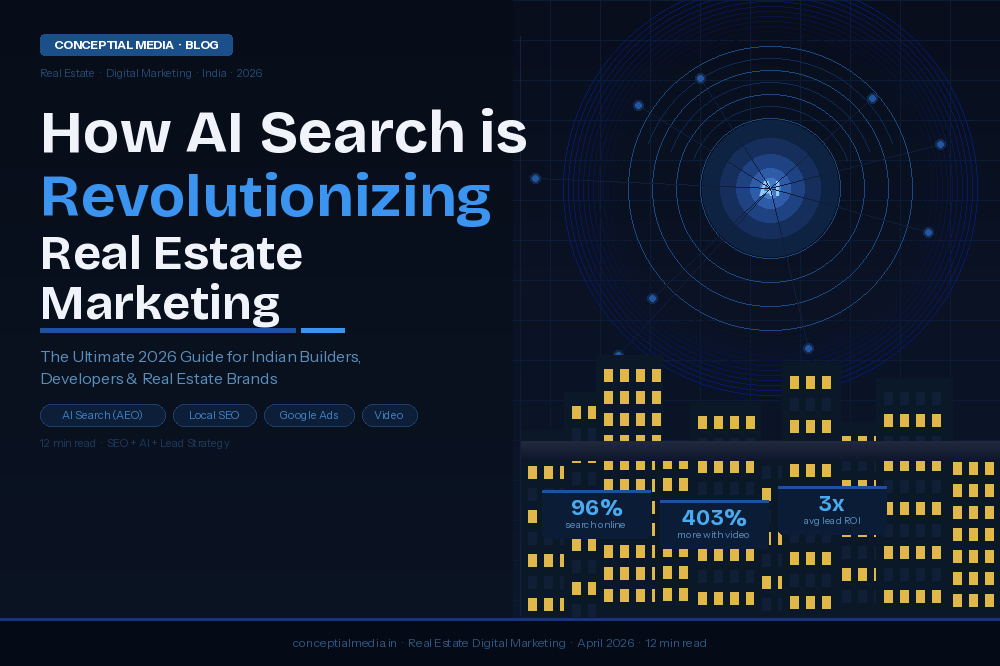
| 96% Buyers start search online | 403% More inquiries with video listings | 93% Use local search to find properties | 41x Rise in ‘agent near me’ searches since 2015 |
Why 2026 Is the Most Critical Year for Real Estate Digital Marketing in India
The Indian real estate market is undergoing a profound digital shift. A decade ago, a builder’s success depended on hoardings, newspaper ads, and broker networks. Today, a homebuyer in Noida spends 6 to 8 weeks researching properties online before making a single phone call. They search Google, scroll Instagram Reels of project walkthroughs, ask ChatGPT which builder has the best reputation in Gurgaon, and watch YouTube drone tours of their shortlisted projects.
This is the new buyer journey — and if your real estate brand is not present and visible at every single touchpoint, you are invisible to the very customers you are trying to reach. In 2026, digital marketing for real estate has evolved beyond running a few Facebook ads or having a basic website. The game has changed entirely. AI-powered search, short-form video dominance, hyper-local SEO, and Answer Engine Optimization (AEO) are now the frontlines of property marketing. Builders and developers who understand and act on these shifts will generate quality site visits at scale. Those who do not will watch their ad spend drain with diminishing returns.
1. The Rise of AI Search — The Biggest Change in Real Estate Marketing Since Google
The most significant shift happening right now in digital marketing — one that very few real estate brands in India have prepared for — is the rise of AI search engines. Platforms like ChatGPT, Google Gemini, and Perplexity are fundamentally changing how Indian homebuyers discover property information, builders, and agents.
Instead of clicking through ten blue links on Google, today’s buyer simply asks an AI assistant: ‘Which are the best 3 BHK projects under 80 lakhs in Greater Noida West?’ or ‘Who are the most trusted builders in Gurgaon?’ The AI responds with a curated, conversational answer — citing specific brands, projects, and sources it has learned to trust.
This is called Answer Engine Optimization (AEO) — optimizing your brand and content to be recommended by AI engines, not just ranked by search engines. And in 2026, it is one of the highest-leverage investments a real estate brand can make.
What does AI search mean for real estate brands in India?
- First-mover advantage: Very few Indian real estate brands are currently optimizing for AI citation. Getting in early means capturing a channel your competitors have not yet discovered.
- Brand authority over rankings: AI engines do not just look at keyword density — they look for consistent, authoritative brand mentions, structured content, and trusted signals across multiple platforms.
- FAQ and schema markup are now critical: AI engines source answers from structured Q&A content on your website. A well-organized FAQ page about your project or city can become a major source of AI citations.
- Reputation matters more than ever: AI engines pull from reviews, news mentions, and social signals to assess credibility. A builder with strong Google Reviews and consistent online presence will appear in AI answers far more often.
Short-Form Video is Now the Most Powerful Real Estate Lead Generation Tool
If you had to choose only one marketing channel for your real estate project in 2026, it should be short-form video. The data is impossible to ignore — real estate listings that include video content receive 403% more enquiries than those without. Video content on social media is shared 12 times more than text and image posts combined.
But here is the critical insight most Indian developers miss: it is not just about making videos — it is about making the right kind of videos on the right platforms.
The most effective real estate video formats in 2026
- 60-second project reels (Instagram & YouTube Shorts): A cinematic 60-second walkthrough of your project — featuring the lobby, sample flat, amenities, and location context — is the single highest-converting video format for Indian real estate right now.
- Drone footage of location and surroundings: Nothing communicates scale, location advantage, and project grandeur like aerial drone shots. Buyers who see drone footage are significantly more likely to book a site visit.
- ‘Day in the life’ neighbourhood videos: Show buyers what their daily life would look like — the nearby metro station, the school, the market, the park. These hyper-local videos build emotional connection and answer buyer concerns before they arise.
- Builder or agent face-to-camera trust videos: In 2026, authenticity sells. A 90-second direct-to-camera video from the project director or sales head builds trust faster than any brochure. Indian buyers increasingly want to ‘know’ the builder before they invest.
- Virtual 3D walkthroughs (for NRI and out-of-city buyers): 360-degree virtual tours using platforms like Matterport allow NRI buyers in Dubai, the UK, or Canada to walk through your project from their living room. Projects with 3D tours receive 87% more views than standard listings.
| What NOT to do with real estate video Avoid overproduced, overly corporate videos that feel like TV ads from 2010. Indian buyers in 2026 respond to authenticity, not perfection. A slightly informal walkthrough filmed by a knowledgeable salesperson often outperforms an expensive produced video because it feels real and trustworthy. | Platform strategy for real estate video Instagram Reels for awareness and lead ads. YouTube for longer walkthroughs and SEO. WhatsApp Status for retargeting warm leads. Facebook for older demographic homebuyers above 35. LinkedIn for NRI investors and commercial real estate. |
3. Hyper-Local SEO — How to Dominate Google Search for Your Project’s Location
Over 93% of Indian homebuyers use local search to find properties and agents. Searches like ‘flats near Noida Sector 62 metro’, ‘affordable 2 BHK in Greater Noida West’, or ‘builder in South Delhi’ are made thousands of times every day. If your project page or website does not rank on the first page for these terms, you are missing a flood of high-intent, organic leads that cost you nothing per click.
Hyper-local SEO is the practice of optimizing your web presence for the specific localities, sectors, and micro-markets where your projects are located – rather than just broad city-level terms. It is one of the highest-ROI marketing activities available to Indian real estate brands.
Key hyper-local SEO strategies for Indian real estate
- Location-specific project pages: Every project needs its own dedicated page targeting its exact location — not just ‘Noida’ but ‘Sector 150, Noida Expressway’. Include the landmark, connectivity, and micro-market context in your content.
- Google Business Profile optimization: Your Google Business Profile (formerly Google My Business) is the single most impactful free tool in local SEO. Keep it updated with recent photos, posts, project details, and ensure you have a steady stream of genuine buyer reviews.
- Long-tail keyword targeting: Over 50% of search queries now contain four or more words. Optimize for phrases like ‘3 BHK ready-to-move flats under 90 lakhs Gurgaon’ rather than just ‘3 BHK Gurgaon’. Long-tail terms have lower competition and significantly higher conversion rates.
- Local schema markup: Adding structured data (schema) to your project pages tells Google and AI engines exactly what your property is, where it is, its price range, and its amenities — dramatically increasing your chances of appearing in rich results and AI answers.
NAP consistency: Ensure your Name, Address, and Phone number are identical across your website, Google Business Profile, JustDial, IndiaMART, Housing.com, and every other directory you are listed in. Inconsistencies confuse Google and hurt your local rankings.
4. Google Ads for Real Estate – Beyond Basic Search Campaigns
Google Ads remains one of the most powerful and immediate tools for generating property leads in India. But in 2026, running a basic search campaign with broad match keywords and sending traffic to your homepage is a recipe for burning your budget with minimal returns. The real estate brands winning on Google Ads today are doing things very differently.
Advanced Google Ads strategies for Indian real estate brands
- Project-specific landing pages: Never send ad traffic to your homepage. Every campaign — and ideally every ad group — should have its own dedicated landing page with a single, clear call to action (CTA): ‘Book a site visit’, ‘Download brochure’, or ‘Talk to a property advisor’. Landing pages with a single CTA consistently outperform homepages by 300% or more in conversion rate.
- Call-only campaigns for mobile users: Over 72% of Indian property searches happen on mobile. Call-only campaigns allow buyers to call your sales team directly from a Google search ad — bypassing the landing page entirely. This is extraordinarily effective for senior buyers and those in lower-tier cities who prefer calling over form fills.
- Performance Max campaigns: Google’s Performance Max campaigns combine Search, Display, YouTube, Discover, Gmail, and Maps into a single AI-optimized campaign. For real estate brands with strong creative assets (project photos, video, headlines), Performance Max is capable of delivering leads at 30 to 50% lower cost than traditional search campaigns.
- WhatsApp click-to-chat integration: Indian buyers overwhelmingly prefer WhatsApp over contact forms. Integrating a WhatsApp click-to-chat button on your landing page — and configuring WhatsApp as a conversion event in Google Ads — dramatically increases lead capture rates.
- Remarketing to site visitors: Most real estate buyers visit your website 4 to 7 times before enquiring. A structured remarketing campaign — showing your project ads to everyone who visited your site in the last 30 days — keeps your project top of mind and re-engages warm prospects at minimal additional cost.
5. Social Media Marketing — Building Real Estate Brands That Buyers Trust
Social media is no longer just a promotional channel for real estate — it is a discovery engine, a trust-building platform, and increasingly a lead generation machine. In 2026, 82% of real estate businesses worldwide use social media for marketing, and the most successful Indian real estate brands on social have figured out a crucial truth: people do not want to be sold to, they want to be informed, inspired, and trusted.
6. The Real Estate Lead Funnel – From Click to Site Visit
Generating a lead is only the beginning. The average Indian real estate project receives hundreds of raw enquiries each month – but converts only a fraction into actual site visits, and fewer still into bookings. The difference between a project that converts 5% of leads and one that converts 20% is almost never the product – it is the lead nurturing system.
A high-performing real estate lead funnel in 2026 looks like this:
- Awareness: Buyer discovers your project through a Google search, YouTube Reel, Instagram ad, or AI engine recommendation.
- Interest: They land on a dedicated project landing page with a compelling headline, key USPs, video, floor plans, location map, and a single CTA.
- Lead capture: They fill a short form or click WhatsApp. The lead is instantly logged in your CRM and an automated WhatsApp message is sent within 60 seconds.
- Nurture sequence: Over the next 7 to 14 days, the lead receives a series of automated WhatsApp messages and emails – sharing the project video, a brochure, a price list, and a payment plan calculator.
- Retargeting: Google and Meta retargeting ads follow the lead across their digital life – showing project testimonials, limited-time offers, and site visit invitations.
- Conversion: A trained sales call or WhatsApp conversation converts the warm lead into a site visit booking – the critical gateway to closing.
7. Content Marketing & Blogging – Building Long-Term Organic Authority
The single highest-ROI, longest-lasting investment a real estate brand can make in digital marketing is publishing high-quality, genuinely useful content on their website. Blog articles, neighbourhood guides, buyer’s checklists, and market reports serve three critical functions simultaneously: they build trust with buyers, they attract organic Google search traffic, and they provide the factual, structured content that AI engines cite when answering buyer queries.
Google’s algorithm strongly rewards what it calls E-E-A-T content – content that demonstrates real Experience, genuine Expertise, true Authoritativeness, and strong Trustworthiness. A blog article written by a knowledgeable real estate professional that answers a buyer’s real questions will outrank a thin, keyword-stuffed article every single time.
High-performing real estate blog topics
- Neighbourhood guides: ‘Complete guide to living in Sector 150, Noida – schools, metro, hospitals, and property prices in 2026’
- Buyer’s guides: ‘First-time homebuyer checklist in India – 20 things to verify before you sign’
- RERA explainers: ‘How to check if a housing project is RERA-registered in Uttar Pradesh’
- Market reports: ‘Greater Noida West property market report Q1 2026 – price trends, new launches, and investment outlook’
- Comparison articles: ‘2 BHK vs 3 BHK – which is the better investment in Noida?’
- FAQ articles: ‘Top 15 questions Indian homebuyers ask before booking a flat’
- NRI guides: ‘Step-by-step guide for NRIs buying property in India’
8. Your Real Estate Digital Marketing Action Plan
The strategies covered in this article may feel overwhelming if you try to implement them all at once. The key is to prioritise based on your current situation, budget, and most pressing lead generation challenges. Here is a practical 90-day action plan to get started:
Days 1 to 30 – Foundation
- Week 1: Audit your Google Business Profile. Ensure it is fully filled, has recent project photos, and has a response to every review. This alone can generate enquiries within days.
- Week 2: Create a dedicated landing page for your top-priority project – with a video, key USPs, floor plan, location map, WhatsApp CTA, and a simple lead form.
- Week 3: Set up a WhatsApp Business API integration and a basic CRM so every lead is captured, tagged, and followed up within 60 seconds.
- Week 4: Launch a targeted Google Search campaign for your project’s location-specific keywords, directing traffic to your new landing page.
Days 31 to 60 – Growth
- Week 5-6: Produce 3 to 5 short-form Reels for Instagram – a project walkthrough, a drone shot, a construction update, and a buyer testimonial. Post consistently and track engagement.
- Week 7-8: Publish your first 2 blog articles targeting location-specific long-tail keywords. Optimize them with FAQ schema markup so they are AI-citation ready.
Days 61 to 90 – Scale
- Month 3: Activate Google and Meta remarketing campaigns targeting your landing page visitors. Launch a Performance Max campaign if you have strong creative assets. Review lead-to-site-visit conversion data and optimize your nurture sequences based on what is working.
The Real Estate Brands That Win Online Will Be the Ones That Start Now
Indian real estate is one of the most competitive digital marketing battlegrounds in the country. Buyers are more informed, more discerning, and more digital than ever. They research across Google, Instagram, YouTube, and increasingly through AI assistants before they ever speak to a salesperson.
The builders, developers, and brokers who build strong digital foundations today – through local SEO, AI-ready content, compelling video, and intelligent lead nurturing – will have a decisive, compounding advantage over those who are still relying on portals, hoardings, and cold calling.
The technology and strategies outlined in this guide are not aspirational – they are being deployed right now by the fastest-growing real estate brands in India. The question is not whether to embrace them. The question is whether you do it before or after your competitors do.