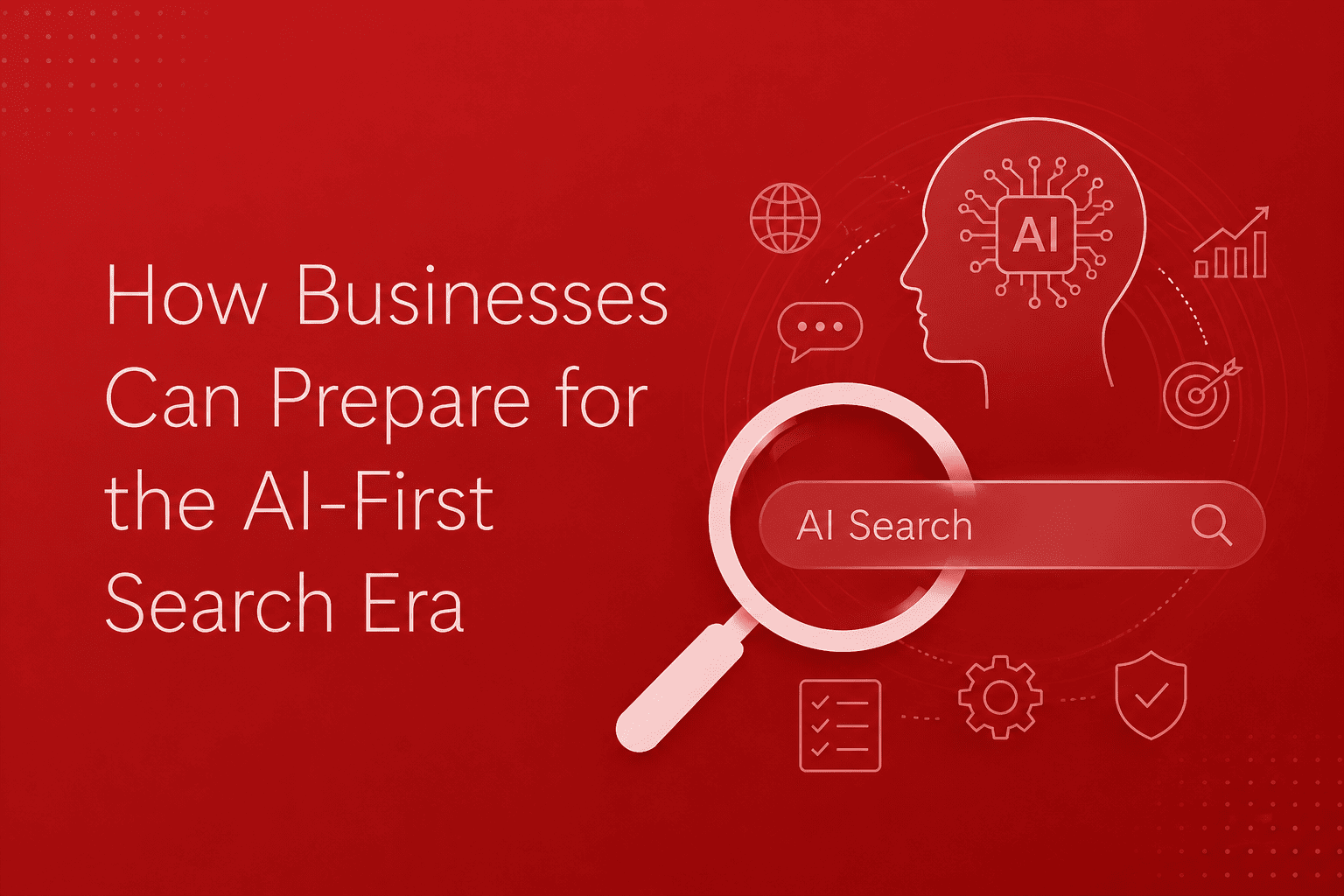
A practical checklist for staying visible as search splits across traditional results, AI Overviews and AI chat tools
Search no longer means a single results page. A customer researching your business today might see a traditional list of blue links, an AI-generated summary sitting above them, or an entirely separate answer inside ChatGPT, Gemini or Perplexity, with no traditional search results involved at all. Google’s own May 2026 guidance made this explicit: AI Overviews and AI Mode are not a temporary feature layered on top of search, they are simply what search looks like now, and businesses that treat them as an afterthought are already losing visibility they may not even realise they had.
The businesses handling this transition well are not the ones chasing every new AI feature individually. They are the ones building a foundation that performs across all three surfaces at once, because the underlying qualities that earn visibility, genuine expertise, clear structure and demonstrable authority, are largely the same regardless of which surface a customer’s question lands on.
Why This Requires a Real Strategy Shift, Not Just a New Tactic
The old SEO model optimised for a single outcome: ranking high enough on one results page to earn a click. The AI-first model has to account for at least three different outcomes at once, being cited inside an AI Overview, being recommended inside a standalone AI chat tool, and still ranking well in traditional results for the queries that have not shifted to AI summaries at all. Treating these as three separate projects wastes effort; treating them as three surfaces built on the same underlying foundation is what actually works.
A Practical Checklist for AI-First Readiness
1. Audit Which of Your Key Queries Already Trigger AI Answers
Before changing anything, find out where you currently stand. Search your most important customer-facing queries directly and note which ones return an AI Overview, which return AI Mode, and which still show a traditional results page. This single audit tells you where the risk and opportunity are actually concentrated, rather than applying the same strategy uniformly across content that faces very different realities.
2. Structure Content Around Direct, Clearly Answered Questions
AI systems consistently favour content that answers a specific question plainly and early, rather than requiring the reader to piece an answer together from several paragraphs of context. Restructuring key pages so the core answer appears clearly near the top, followed by supporting detail, measurably improves the odds of being cited or referenced by an AI system.
3. Build Genuine Topical Authority, Not Isolated Pages
A single well-written page rarely earns a stable citation anymore. AI systems increasingly favour sources that demonstrate sustained, consistent expertise across a topic over time, which means a cluster of genuinely useful, connected content on a subject outperforms a single standalone article, even if that single article was well optimised.
4. Publish Original Data, Research or Perspective
Content that only restates widely available information gives an AI system little reason to cite your business specifically over any other source saying the same thing. Original research, real case studies with specific numbers, and genuine first-hand expertise remain some of the most reliable ways to be the source an AI system actually chooses to name.
5. Implement Structured Data as a Standard Practice
Schema markup helps AI systems parse and trust exactly what a page is about, and by 2026 this has moved from an advanced technical tactic to a baseline expectation. Product, FAQ, article and organisation schema, kept accurate and current, meaningfully improve how reliably AI systems can extract and cite your content correctly.
6. Track AI Citation and Visibility as Its Own Metric
Traditional rank tracking no longer tells the full story. Rising impressions alongside falling clicks in Search Console is often a direct sign of AI Overview exposure rather than declining relevance, and several SEO platforms now offer dedicated AI citation tracking. Treating this as a distinct, ongoing metric, rather than an occasional check, is what separates businesses adapting quickly from those reacting after the fact.
7. Keep Core Business Information Consistent Everywhere
AI systems draw on a wide range of sources to build confidence in an answer, including your website, directory listings, reviews and social profiles. Inconsistent information across these sources, an outdated address, a discontinued service still listed, undermines the authority signals AI systems rely on, in much the same way inconsistent NAP data undermines traditional local SEO.
What Not to Overreact To
Not every business needs to overhaul its entire content strategy overnight. E-commerce and clearly transactional queries remain far less affected by AI Overviews than informational content, since completing a purchase still generally requires an actual site visit. The right response is proportional: informational and advice-driven content deserves urgent restructuring, while transactional pages can generally continue with a steady, ongoing improvement approach rather than a rushed overhaul.
Getting Started
Start with the audit. Knowing which of your important queries already show an AI Overview or AI Mode result tells you exactly where to focus first, rather than guessing. From there, prioritise restructuring your highest-traffic informational content around clear, direct answers, and treat structured data and consistent business information as fixed, ongoing maintenance rather than a one-time project. The businesses that treat AI-first search as a foundation to build rather than a feature to chase are the ones showing up across every surface a customer might actually use.
Frequently Asked Questions
Do small businesses need to worry about AI-first search as much as large enterprises?
Yes, in some ways more so. Smaller businesses with clearly defined local or niche expertise are well positioned to earn strong topical authority signals, since they are not competing against the same volume of content as a large, broad-topic enterprise site.
How is preparing for AI Mode different from preparing for AI Overviews?
AI Overviews sit as a layer on top of traditional search results, while AI Mode functions more like a separate, conversational search surface with its own citation behaviour. Both reward the same underlying qualities, structure, authority and clarity, but should be monitored and tracked as genuinely distinct surfaces.
Does investing in AI-first search mean traditional SEO no longer matters?
No. Strong technical and content SEO remains the foundation that AI visibility is built on. Google’s own guidance in 2026 has been explicit that there is no separate discipline that replaces solid SEO fundamentals, only an extension of what those fundamentals now need to support.
How long does it typically take to see results from these changes?
Structural and technical fixes, like schema implementation and content restructuring, can begin showing impressions or citation changes within weeks. Building genuine topical authority through sustained content investment typically takes several months to show its full effect.