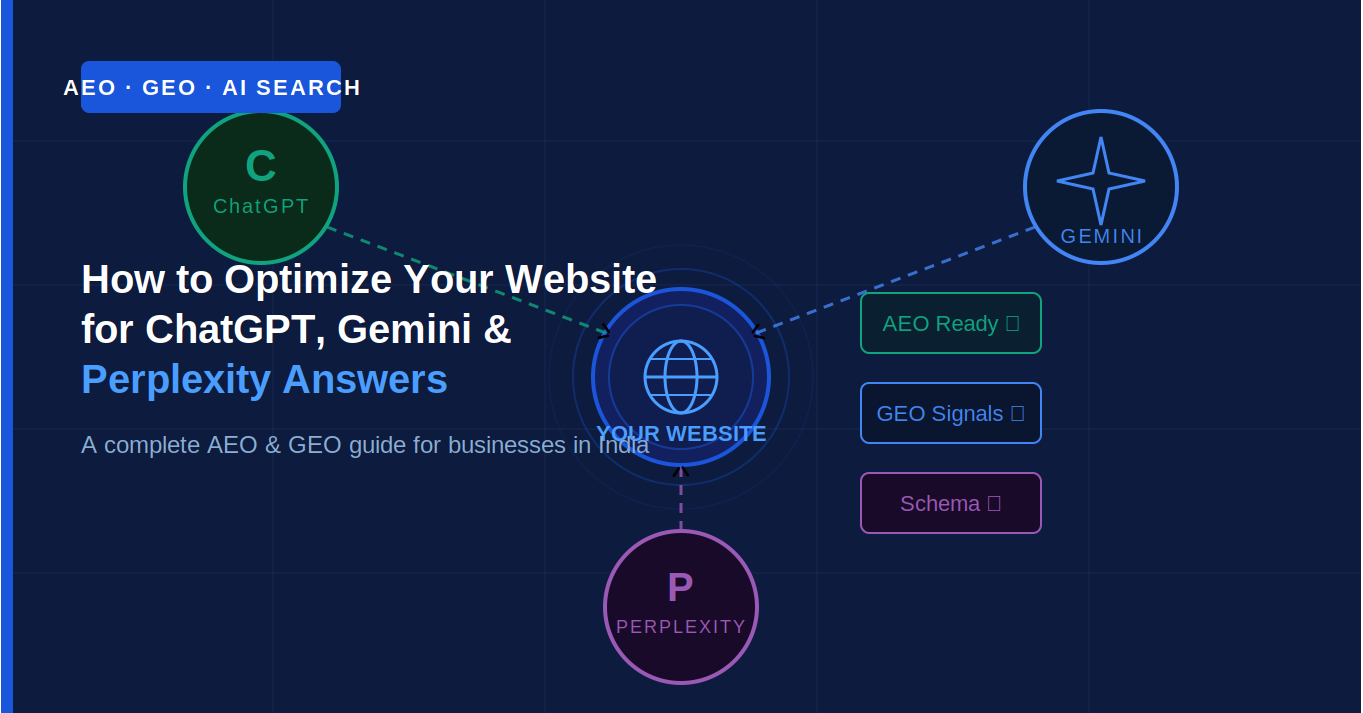
Three years ago, Google was the only game in town. Today, millions of people get their answers directly from ChatGPT, Google Gemini, and Perplexity – without ever visiting a website.
For businesses in India, this shift is both a threat and a massive opportunity. If your brand shows up when an AI answers a buyer’s question, you get the sale. If it doesn’t, your competitor does.
This guide explains exactly how to optimize your website so AI engines cite, recommend, and feature your business in their answers.
Why AI Search Is Different from Traditional SEO
Traditional SEO is about ranking your webpage on Google’s results page. AI search optimization — called AEO (Answer Engine Optimization) and GEO (Generative Engine Optimization) — is about becoming the source that AI engines trust and quote.
Here’s what makes these AI platforms unique:
| AI Platform | How It Sources Information |
| ChatGPT | Trains on web data + Bing index. Answers conversationally. Cites sources in GPT-4o. |
| Google Gemini | Tightly integrated with Google Search index and Knowledge Graph. Powers AI Overviews. |
| Perplexity AI | Real-time web crawling. Cites multiple sources visibly. Heavily used for research queries. |
All three AI engines share one fundamental behaviour: they pull from sources they consider authoritative, well-structured, and relevant. Your job is to be that source.
Step 1: Structure Your Content to Answer Specific Questions
AI engines are answer machines. They look for content that directly and clearly answers a question — not content that dances around the topic hoping to rank for a vague keyword.
What to do:
- Write dedicated FAQ sections on every important service and product page.
- Structure headings as literal questions: “What is AEO?” not just “About AEO”.
- Provide a clear, one-to-two sentence direct answer immediately below each question.
- Follow the direct answer with supporting detail — AI engines use the summary and the context.
Step 2: Implement Schema Markup (Structured Data)
Schema markup is code you add to your website that tells search engines and AI platforms exactly what your content means — not just what it says.
For AEO and GEO, the following schema types are critical:
| Schema Type | Why It Matters for AI Search |
| FAQ Schema | Makes your Q&A content machine-readable. AI engines extract it directly. |
| Organization Schema | Establishes your business identity — name, location, contact, services. |
| LocalBusiness Schema | Critical for Delhi NCR businesses targeting local AI queries. |
| Article / BlogPosting Schema | Signals editorial authority. AI engines weigh this for factual content. |
| HowTo Schema | For process-oriented content — step-by-step guides get featured heavily. |
| Product / Service Schema | For ecommerce and service businesses — includes pricing and availability. |
| ⚡ Technical Note Use JSON-LD format (Google’s preferred method) embedded in the <head> of each page. Validate using Google’s Rich Results Test before publishing. Incorrect schema is worse than no schema — it confuses AI crawlers. |
Step 3: Build E-E-A-T Signals (Experience, Expertise, Authoritativeness, Trustworthiness)
Google introduced E-E-A-T as a quality framework for human reviewers. AI engines now use the same signals — digital trust markers — to decide which sources to cite.
How to Build E-E-A-T for AI Visibility:
- Author bios: Every blog post and article should have a named author with credentials, a photo, and a link to their LinkedIn or professional profile.
- About page depth: Detail your team, years of experience, client count, and case studies with real results.
- Awards and recognition: Mention certifications (Google Partner, Meta Blueprint), industry awards, and press mentions.
- Client testimonials with names and companies: Anonymous reviews carry zero E-E-A-T weight.
- Consistent NAP (Name, Address, Phone): Especially critical for businesses in Noida and Delhi NCR to appear in local AI queries.
- Backlinks from authoritative Indian publications: Economic Times, YourStory, Inc42, or industry-specific sites in your niche.
Step 4: Write for Conversational, Long-Tail Queries
People ask AI engines questions the way they would ask a knowledgeable friend — in full sentences, with context. Traditional SEO trained us to target short keywords. AI optimization requires writing for natural language questions.
Compare these two approaches:
| Old Approach | AI-Optimized Approach |
| Old SEO Keyword | AI Search Query (What People Actually Ask) |
| “SEO agency Noida” | “Which digital marketing agency in Noida is best for a real estate startup with a ₹50,000 monthly budget?” |
| “PPC India” | “Is Google Ads worth it for a new e-commerce store in India competing with Meesho?” |
| “website development” | “How long does it take to build a Shopify store and what will it cost in India?” |
Create content that answers these longer, more specific questions. A single well-written guide answering “How to run Google Ads for real estate in India with a small budget” will be cited by AI engines far more than a generic “Google Ads Guide”.
Step 5: Optimize Your Technical Foundation for AI Crawlers
AI platforms send crawlers to your website, just like Google does. If your technical setup blocks, slows, or confuses these crawlers, your content will never be seen — let alone cited.
Technical Checklist for AI Crawlability:
- robots.txt: Ensure you have NOT blocked GPTBot (OpenAI’s crawler), Googlebot-Extended, or PerplexityBot. Check your robots.txt file today.
- Page speed: AI crawlers de-prioritize slow pages. Target a Core Web Vitals LCP under 2.5 seconds.
- Mobile-first design: Over 75% of Indian internet users browse on mobile. AI engines factor this in.
- Clean URL structure: Descriptive URLs like /services/seo-services-noida/ signal relevance clearly.
- XML sitemap: Submit an updated sitemap to Google Search Console regularly.
- HTTPS: Non-secure sites are not cited by any major AI engine.
| 🔍 Check Right Now Visit your website’s robots.txt file (yourwebsite.com/robots.txt) and confirm you don’t have ‘User-agent: GPTBot / Disallow: /’ — this single line blocks ChatGPT from ever reading your website. |
Step 6: Build Brand Presence Across Multiple Platforms
AI engines don’t just read your website – they cross-reference your brand across the entire web. A business that appears consistently across multiple high-authority platforms is treated as more credible and therefore more citable.
Key platforms to establish and maintain:
- Google Business Profile: The most important local signal for Gemini AI Overviews in India.
- Wikipedia (if eligible): The highest-authority source any AI engine uses.
- LinkedIn company page: Especially important for B2B businesses and for ChatGPT’s business queries.
- YouTube channel: AI engines increasingly cite video content and transcripts.
- Industry directories: Justdial, Sulekha, Clutch, G2 (for SaaS/tech), TripAdvisor (for travel).
- Press mentions: A single article in YourStory or Economic Times can dramatically increase AI citation frequency.
- Podcast appearances and guest blogs: AI engines treat these as third-party authority signals.
Step 7: Use Conceptial Media’s AEO & GEO Framework
At Conceptial Media, we’ve developed a proprietary AEO + GEO optimization process for businesses in India that combines all six steps above into a systematic, measurable programme:
| Phase | What We Do |
| AI Audit | We analyse how your brand currently appears (or doesn’t appear) in ChatGPT, Gemini, and Perplexity responses for your key buyer queries. |
| Content Mapping | We identify every high-intent question your potential customers are asking AI engines and map it to new or existing content. |
| Schema Implementation | We implement and validate all relevant schema types across your website. |
| Authority Building | We build citations on platforms that AI engines use as reference sources. |
| Monthly Tracking | We monitor your AI citation frequency and adjust strategy based on what’s working. |
Frequently Asked Questions
Does optimizing for AI search hurt my traditional Google rankings?
No. AEO and GEO optimization is built on the same foundations as strong SEO – quality content, technical health, and authority. Improving these factors helps you in both traditional search and AI search simultaneously.
How long does it take to appear in ChatGPT or Gemini answers?
ChatGPT’s training data updates periodically, so new content may take 3–6 months to appear. Gemini and Perplexity crawl in near-real-time, so well-optimized content can appear within days to weeks.
Can small businesses in India compete with large brands in AI search?
Yes – and in some ways more easily than in traditional SEO. AI engines favour the most directly relevant and clearly structured answer, not just the biggest domain. A local business with an excellent, specific FAQ page can outcompete a national brand for a hyper-local query.
Is AEO different for Hindi and regional language queries?
Yes. As voice search and regional AI usage grows in India, creating content in Hindi and other regional languages creates an untapped advantage. Gemini in particular handles Hinglish and Hindi queries well.