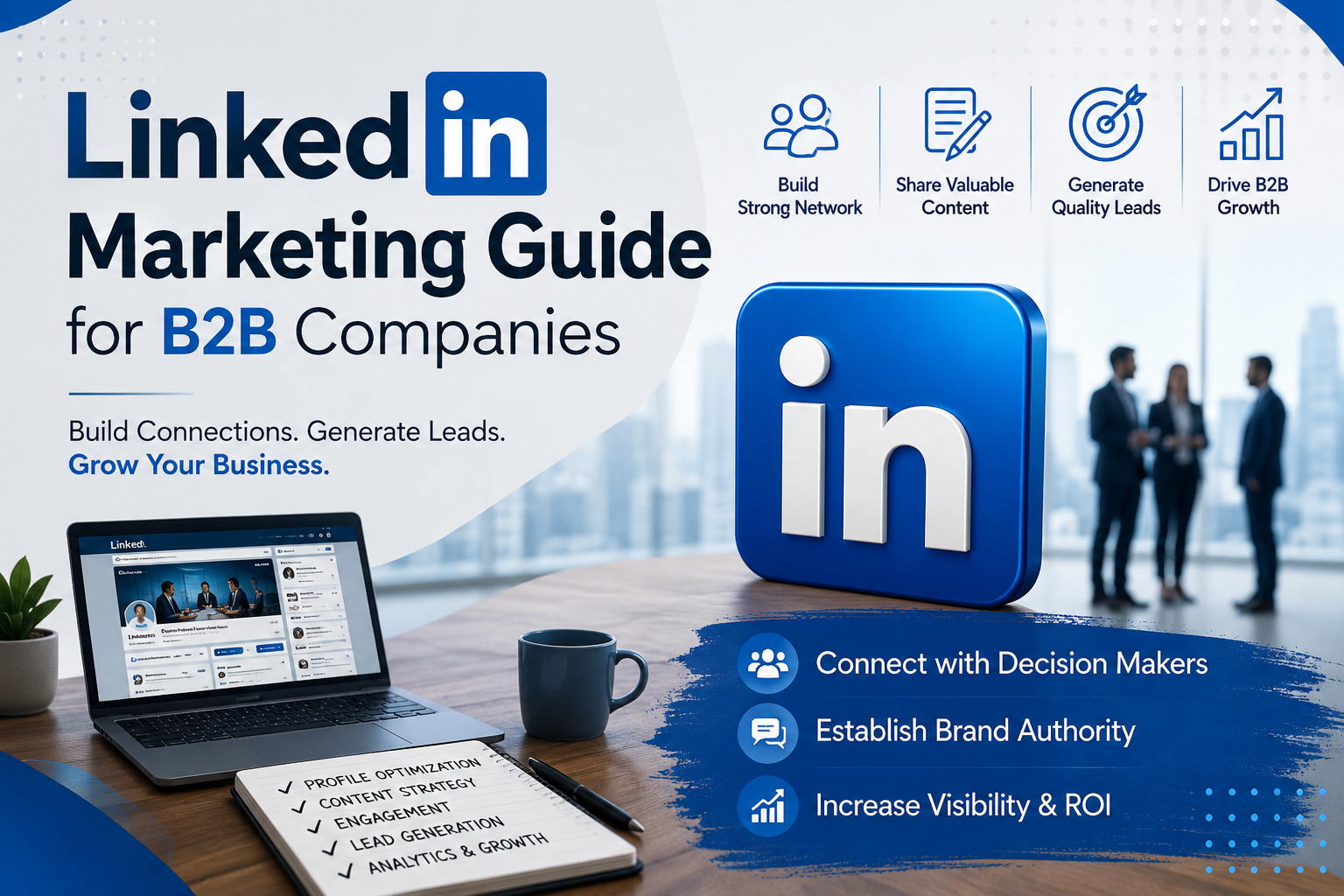
For most B2B companies, LinkedIn isn’t just another channel on the social media checklist, it’s where the actual buyers live. Decision-makers, procurement teams, and technical evaluators spend their working hours on the platform, which makes it one of the few places where B2B marketing and B2B selling genuinely overlap. Yet a lot of company pages still post like it’s 2015: quarterly award announcements, the occasional stock photo, and a résumé of a page that nobody outside the marketing team actually reads. This guide walks through what a modern LinkedIn strategy looks like for a B2B company that wants the platform to actually contribute to pipeline.
1. Start With the Foundations: Company Page and Employee Profiles
Before any content strategy matters, the basics need to be in order. Your company page should have a clear, benefit-driven tagline, not just your legal name and industry category, along with a banner image that communicates what you actually do at a glance. The About section should be written for a prospect skimming in ten seconds, not for an internal audience already familiar with your positioning.
Just as important, and often ignored, are the personal profiles of your founders, salespeople, and subject-matter experts. On LinkedIn, content from individual employees consistently reaches further and earns more engagement than content from the company page itself, because the algorithm favors person-to-person interaction over brand broadcasting. A B2B company with five to ten active employee voices will usually outperform a company page posting alone, no matter how large the follower count is.
2. Build a Content Strategy Around Buyer Problems, Not Product Features
The biggest mistake B2B marketers make on LinkedIn is treating it like a brochure feed. Posts that only talk about product launches, features, or company milestones tend to get ignored, because they’re written from the company’s point of view rather than the buyer’s. Content that performs well on LinkedIn usually does one of three things: it teaches something the audience didn’t know, it shares a specific result or case study with real numbers, or it takes a clear point of view on an industry debate.
A useful way to structure this is around a simple content mix. Roughly a third of your posts can be educational, breaking down a concept your buyers struggle with. Another third can be proof-driven, sharing customer outcomes, data, or behind-the-scenes process. The remaining third can be opinion or narrative content, where a founder or team member shares a genuine perspective, a lesson learned, or a prediction about where the industry is headed. This mix keeps the page from feeling like either a classroom or an advertisement.
3. Use Formats That Actually Get Distribution
LinkedIn’s algorithm has consistently rewarded certain formats over others. Native documents, the swipeable PDF carousels, tend to perform strongly because they keep people on the platform longer. Short, well-formatted text posts that open with a strong first line, since LinkedIn truncates posts after a couple of lines, also do well when the hook earns the click to expand. Native video, uploaded directly rather than linked from YouTube, generally outperforms link posts, because LinkedIn deprioritizes content that sends users off-platform.
External links to blog posts or gated content still have a place, but they’re better suited to the comments section or a follow-up post than the primary call to action in the first line. If the goal of a specific post is traffic to a landing page, expect lower reach in exchange for higher-intent clicks, and plan your content calendar with that trade-off in mind rather than expecting every post to both reach widely and convert directly.
4. Treat Employee Advocacy as a Real Program, Not an Afterthought
Asking employees to “like and share” a company post occasionally is not an advocacy program. A functioning one gives employees genuinely useful, ready-to-adapt content, makes it easy for them to add their own voice rather than just reposting verbatim, and recognizes the people who consistently show up. Sales teams in particular benefit from this, since a prospect is far more likely to engage with a salesperson’s thoughtful post than with a cold outreach message, and warm inbound conversations that start in the comments section often convert better than colder channels.
It also helps to be selective. Not every employee needs to become a LinkedIn creator, and pushing reluctant employees to post regularly usually produces low-effort content that does more harm than good. Focus advocacy efforts on the handful of people, usually leadership, sales, and a few subject-matter experts, who are naturally inclined to share and already have something worth saying.
5. Use LinkedIn Ads to Support, Not Replace, Organic Effort
LinkedIn’s advertising platform is powerful for B2B specifically because of its targeting options: job title, seniority, company size, industry, and even named account lists through Matched Audiences. That precision comes at a real cost, since LinkedIn’s cost-per-click tends to run considerably higher than most other platforms, so ad spend needs to be deployed deliberately rather than spread thin.
- Retargeting website visitors with a relevant offer usually delivers the strongest return, since the audience already knows your brand.
- Sponsoring your best-performing organic posts, rather than building ads from scratch, tends to outperform generic ad creative.
- Account-based marketing campaigns targeting a defined list of target companies work well for high-ACV B2B sales cycles.
- Lead gen forms, which pre-fill with the user’s LinkedIn profile data, generally produce higher form-completion rates than sending traffic to an external landing page.
The organic content you’re already publishing makes paid spend more effective, since prospects who’ve seen your name organically convert at a noticeably better rate than cold audiences meeting your brand for the first time in an ad.
6. Measure What Actually Predicts Pipeline
Follower count and impressions are the easiest metrics to track and the least useful for proving business impact. A more meaningful set of metrics includes engagement rate relative to reach, since it signals whether the algorithm is rewarding your content; profile views and connection requests following specific posts, which often precede inbound interest; and, most importantly, tracking how many sales conversations or demo requests can be traced back to LinkedIn as a touchpoint, even if it wasn’t the only one in the buyer’s journey.
Most B2B sales cycles involve multiple touchpoints before a deal closes, so LinkedIn’s contribution is often underestimated by last-click attribution models. Asking new leads directly where they first heard of your company, alongside whatever analytics your CRM captures, usually paints a more accurate picture than platform analytics alone.
Putting It Together
A LinkedIn strategy that works for B2B companies isn’t about posting more, it’s about posting content that buyers actually want to engage with, distributed through the people your audience already trusts. Get the company page fundamentals right, build a content mix that solves real problems instead of pitching features, activate a small group of genuine employee advocates, and use paid spend to amplify what’s already working rather than to compensate for weak organic content. Done consistently over a few quarters, LinkedIn stops being a box-ticking channel and starts becoming a real, measurable part of the pipeline.