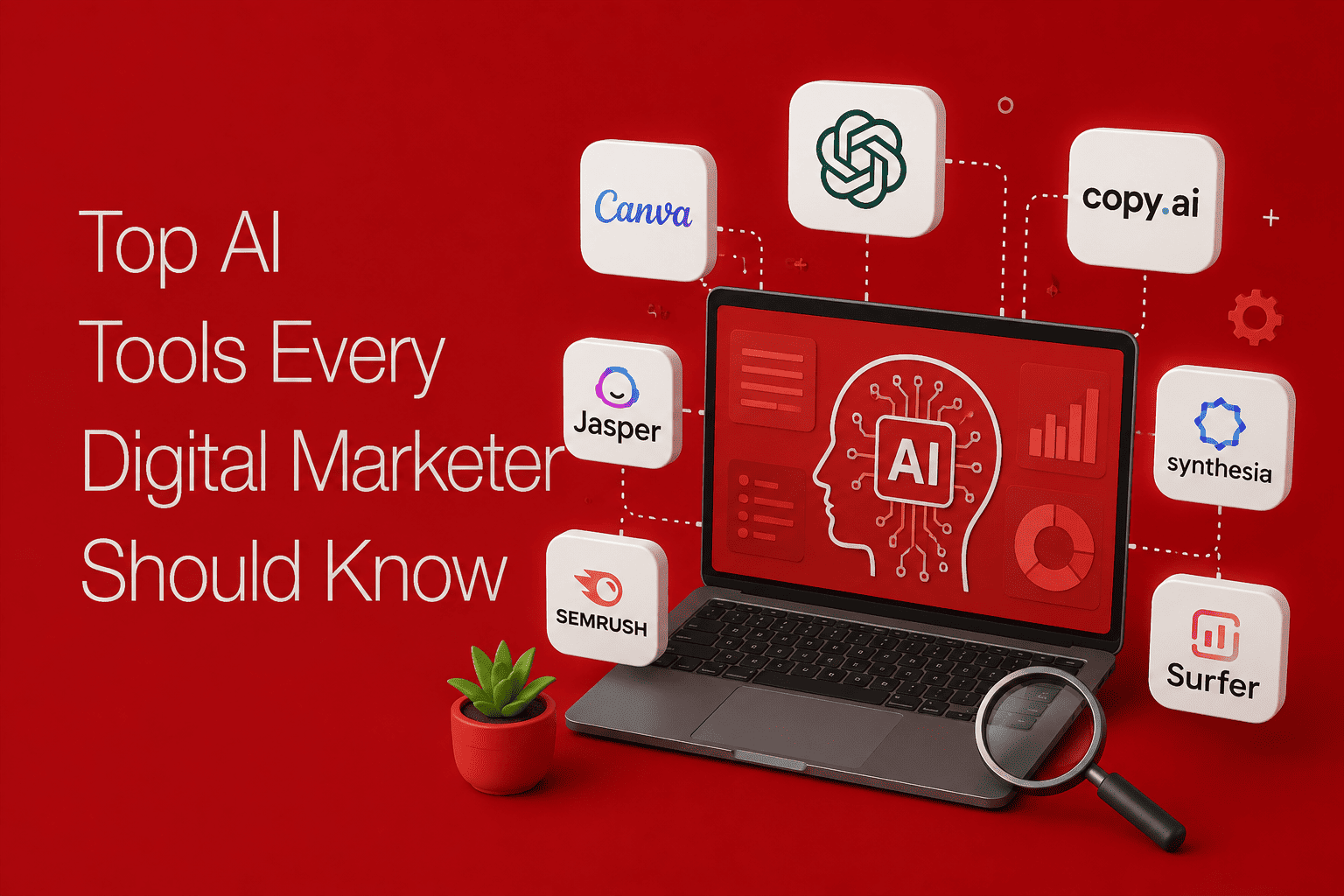
A practical, category-by-category guide to the AI tools actually earning a place in marketers’ workflows in 2026
The AI tools conversation in marketing has moved past novelty. In 2026, the question is no longer whether to use AI, but which tools actually earn a permanent place in the workflow versus which ones were interesting for a week and then quietly abandoned. Search itself has changed too, with AI-generated answers and chat-based search sitting alongside traditional results, which means the tools marketers rely on now need to help them show up in both.
Rather than list every AI product with a marketing use case, this guide organises the tools that are genuinely sticking around by the job they actually do, since the right tool depends far more on the task at hand than on which one is trending this month.
AI Assistants for Strategy, Research and Writing
General-purpose AI assistants have become the default starting point for a huge range of marketing tasks, from first drafts to campaign brainstorming to analysing a competitor’s positioning.
ChatGPT
Still the most widely used general AI assistant in marketing, valued for its flexibility across blog posts, ad copy, content calendars and campaign planning within a single tool rather than switching between several.
Claude
Increasingly favoured by marketers working with long documents, research materials and reports, and for writing that needs to sound genuinely human rather than obviously AI-generated, which matters more as audiences become more attuned to AI phrasing.
Perplexity
A research-focused AI tool that combines real-time web information with AI synthesis, useful for marketers who need quick, sourced answers on a competitor, a trend or a market rather than a purely generative response.
AI Tools for SEO and Content Strategy
SEO tools have absorbed AI most naturally, since the job has always involved processing large amounts of data to find patterns a human would take far longer to spot.
Semrush
A long-standing SEO platform that has built AI features directly into keyword research, competitor tracking and, more recently, tracking visibility inside AI-generated search answers, reflecting how much search itself has shifted.
Surfer SEO
Combines AI-assisted content creation with SEO-focused optimisation, helping marketers research topics, structure content and improve pages based on real search intent rather than treating writing and SEO as separate steps.
Ahrefs
Widely used alongside Semrush for spotting content gaps and search intent patterns faster than manual research, particularly valuable for content teams planning a topic cluster rather than a single article.
AI Tools for Content and Creative Production
This category has expanded the fastest, moving well beyond simple text generation into full creative production across formats.
Jasper
Built specifically for scaling content production across a marketing team, useful when the challenge is consistent output across multiple channels rather than a single piece of writing.
Canva AI
Brought AI-assisted design directly into one of the most widely used graphic design tools already in a marketer’s stack, lowering the barrier for non-designers to produce genuinely usable visual content.
AdCreative.ai
Focused specifically on advertising creative, generating multiple concept variations for a campaign so performance marketers can test different visual and messaging directions before refining the strongest ones manually.
AI Tools for Social Media and Multi-Channel Management
Sprout Social
A social media management platform that has built AI into scheduling, engagement and reporting, useful for teams managing a genuinely high volume of content and interaction across multiple platforms.
Reply.io
An AI-assisted outreach tool built for multi-channel sequences, particularly useful for marketers and sales teams running coordinated outbound campaigns across email and other channels at once.
AI Tools for Advertising and Campaign Optimisation
Albert.ai
Applies AI across the entire digital advertising workflow, from media buying to creative optimisation to cross-channel campaign management, best suited to brands with significant ad spend who want continuous, automated optimisation rather than manual adjustment.
AI Tools for Analytics and Unified Reporting
Improvado
A marketing analytics platform built to unify data across multiple channels and tools into a single view, addressing one of the most persistent problems in marketing: data scattered across too many disconnected platforms to analyse properly.
Choosing the Right Tools Instead of Chasing All of Them
The marketers getting genuine value from AI in 2026 are not the ones using the most tools; they are the ones who picked a small number that map directly onto their actual workflow gaps and used them consistently. A content team drowning in SEO research benefits far more from Surfer or Semrush than from adding a fourth writing assistant, while a lean team without a dedicated designer gets more immediate value from Canva AI than from an enterprise ad-optimisation platform they will barely use.
Getting Started
Start by identifying the one or two tasks eating the most time in your current workflow, whether that is content production, SEO research, ad creative or reporting, and choose one tool from the relevant category above rather than trying to adopt several at once. Once that tool is genuinely embedded in the workflow, expanding into an adjacent category becomes a much easier decision to make well.
Frequently Asked Questions
Do I need a paid AI tool, or are free versions enough?
Free versions of tools like ChatGPT and Canva AI are genuinely useful for individual marketers or very small teams. Paid tiers generally become worthwhile once a team needs collaboration features, higher usage limits or the more advanced automation that free plans typically restrict.
Will AI tools replace the need for a marketing strategist?
No. AI tools handle repetitive, data-heavy work well, like first drafts, keyword tracking and reporting, but the strategic judgment behind what to say, to whom, and why still comes from a person, and that combination is what actually moves results.
How is AI changing SEO specifically?
Search increasingly includes AI-generated summaries and answers alongside traditional results, which means visibility now depends on showing up in both. Several SEO tools have already added features specifically to track a brand’s presence inside AI-generated answers.
What’s the biggest mistake marketers make when adopting AI tools?
Adopting too many tools at once without embedding any of them properly into an actual workflow. A single well-integrated tool used consistently delivers more value than five tools tried briefly and abandoned.