New benchmark data suggests a rising Shopping ad CTR isn’t necessarily good news
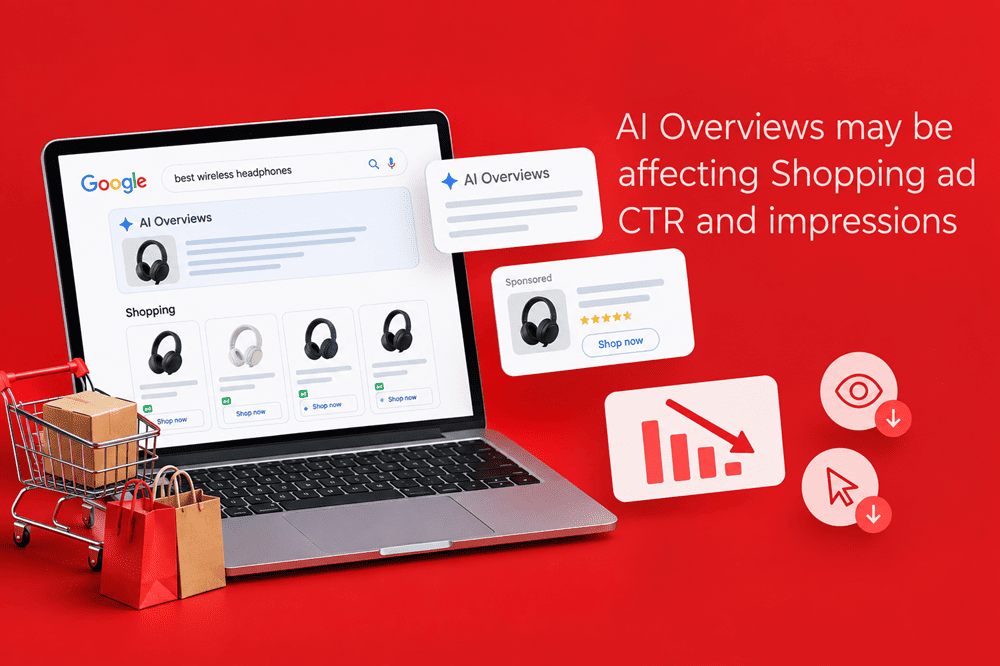
A rising click-through rate usually reads as good news in any paid search account, but new benchmark data published in September 2026 suggests that for Shopping ads specifically, the opposite interpretation may be closer to the truth. Mike Ryan, head of ecommerce at Smarter Ecommerce, analysed thousands of Shopping and Performance Max campaigns across hundreds of advertiser accounts, covering roughly 175 billion impressions, and found a consistent pattern: Shopping ad impressions are falling while click-through rates climb. His reading is that this is not two separate trends but one event seen from two angles, and AI Overviews may be the reason behind it.
This piece breaks down what the data actually shows, why the pattern might be connected to how Google is currently serving AI Overviews, and what it means for how advertisers should actually be reading their own Shopping campaign metrics right now.
What the Data Actually Shows
According to the benchmark analysis, median Shopping ad impressions per advertiser account fell from roughly 1.85 million in mid-2025 to about 1.4 million in mid-2026, a meaningful year-over-year decline. Over the same period, median Shopping click-through rate rose from 1.20 percent to nearly 1.55 percent, an increase of roughly 20 percent. A separate dataset from Optmyzr measured a closely aligned 17 percent year-over-year CTR increase, which is part of what prompted Ryan to dig deeper into what was actually driving the shift.
The “Crocodile Effect” and Why Shopping Ads Look Different
Ryan frames this using a pattern he calls the SEO “crocodile effect,” where publishers gain impressions from AI Overviews but lose clicks, since the AI-generated summary answers the query directly and reduces the need to click through. Shopping ads, in his analysis, appear to be experiencing the inverse: fewer impressions, but a higher click-through rate on the impressions that remain. His interpretation is that Google may be showing Shopping ads on a narrower set of higher-intent queries while serving AI Overviews on the lower-intent searches that Shopping ads used to also appear against, which would explain why CTR is rising even as total ad exposure shrinks.
An Important Caveat: Correlation, Not Confirmed Causation
It is worth being precise about what this data does and does not establish. The analysis is a twelve-month correlation and does not isolate AI Overviews specifically from other auction and algorithm changes happening over the same period, and Google has not confirmed this causal explanation. The pattern is genuinely consistent and drawn from a very large dataset, but advertisers should treat the AI Overviews explanation as the most plausible current reading of the data, not as an established, confirmed fact.
Why This Matters More Than It Might First Appear
A rising CTR is the kind of metric that typically gets celebrated in a performance report without a second look, but this data suggests that celebration might be premature. If Shopping ads are simply being shown less often rather than performing meaningfully better, a team optimising purely around CTR could end up making decisions based on where ads are being placed rather than genuine gains in ad quality or relevance. This mirrors a broader pattern already well documented in organic search: stable or even improving surface-level metrics can mask a real decline in overall reach once AI-generated answers enter the picture.
How This Fits the Broader AI Overviews Picture
This Shopping-specific finding sits alongside a wider, well-established body of research on how AI Overviews affect paid search generally. Separate research from Seer Interactive, tracking billions of impressions across dozens of brands, has found that when an AI Overview appears alongside a paid query, click-through rate can fall dramatically compared to the same query without an AI Overview present. Ecommerce and local service advertisers, however, have generally shown more stability in this broader research than educational or lead-generation-focused accounts, particularly when campaigns are built around strong shopping feeds and clearly high-intent product searches, which may help explain why Shopping ads specifically show a different pattern from paid search generally.
What Advertisers Should Actually Do With This
1. Track Impression Volume Alongside CTR, Not CTR Alone
Since a rising CTR can reflect a shrinking, more selective set of impressions rather than genuinely improved performance, reviewing impression volume trends alongside click-through rate gives a far more honest picture of whether a Shopping campaign is actually reaching fewer total potential customers.
2. Watch Total Click and Conversion Volume, Not Just Rate Metrics
A percentage-based metric like CTR can look healthy while the underlying click and conversion volume genuinely declines, so reviewing absolute numbers alongside rates protects against drawing the wrong conclusion from a single improving ratio.
3. Segment Performance by Query Intent Where Possible
Since the theory behind this pattern suggests Google may be routing lower-intent queries toward AI Overviews and reserving Shopping ad placement for higher-intent searches, reviewing performance specifically by intent level, where campaign structure allows it, can reveal whether this shift is genuinely happening within a specific account.
4. Treat Historical Benchmarks With More Caution Right Now
Given how much the underlying distribution of impressions appears to be shifting, comparing current performance against a benchmark from even twelve months ago carries more uncertainty than it would in a more stable search environment, making recent, rolling comparisons generally more reliable than long-term historical ones for the time being.
Getting Started
The instinct to treat a rising Shopping ad CTR as unambiguous good news is understandable, but this benchmark data is a genuine reason to look one level deeper before drawing that conclusion. Reviewing impression volume, total clicks and conversion numbers alongside CTR, rather than trusting CTR as a standalone success metric, is the most practical way to tell whether a Shopping campaign is genuinely improving or simply being shown to fewer, more selectively filtered searches.
Frequently Asked Questions
Is it confirmed that AI Overviews are causing the Shopping ad impression decline?
Not definitively. The analysis is a twelve-month correlation across a very large dataset, and while the pattern is consistent and the AI Overviews explanation is plausible, Google has not confirmed this causal reading, and other auction or algorithm changes have not been fully ruled out.
How large was the dataset behind this finding?
The analysis covered thousands of Shopping and Performance Max campaigns across hundreds of advertiser accounts, totaling roughly 175 billion impressions, published by Mike Ryan of Smarter Ecommerce in September 2026.
Does this mean Shopping ads are becoming less effective overall?
Not necessarily less effective, but potentially less far-reaching. The theory suggests ads may be concentrating on higher-intent queries, which could mean stronger conversion quality on the traffic that remains, even as total impression and reach volume declines.
Are all types of advertisers affected equally by AI Overviews and paid search changes?
No. Broader research suggests ecommerce and local service advertisers relying on high-intent product searches tend to show more stability than accounts dependent on educational or research-stage traffic, such as many SaaS, B2B and lead-generation campaigns.
What is the single most important metric change advertisers should make because of this data?
Reviewing impression volume and absolute click and conversion numbers alongside CTR, rather than treating CTR as a standalone indicator of campaign health, is the most immediately actionable change this data supports.