
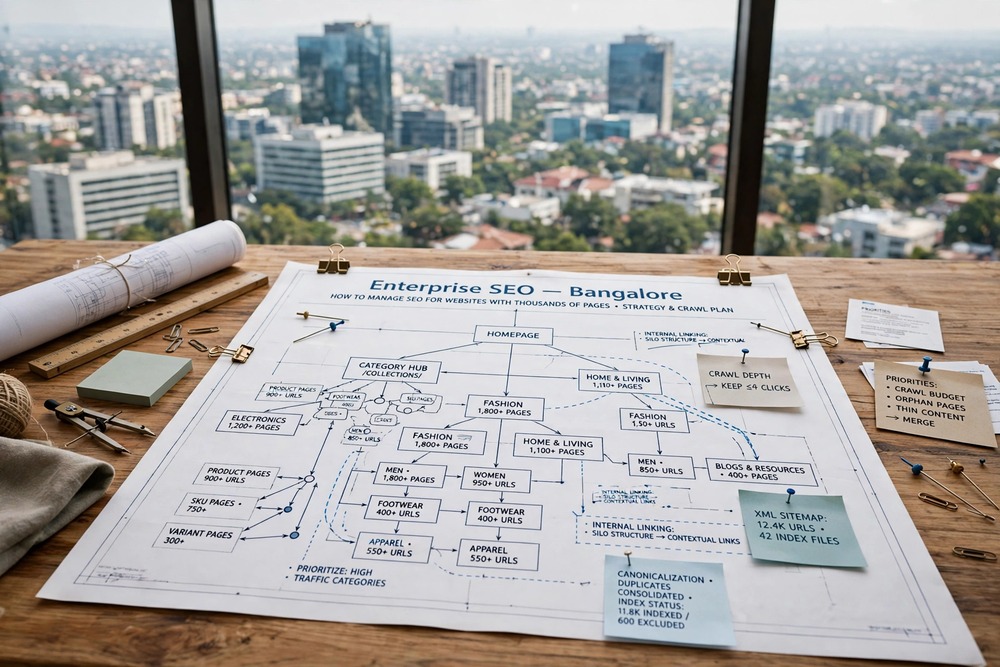
Managing SEO for a website with thousands of pages requires a structured strategy, consistent monitoring and strong technical foundations. Unlike smaller websites, enterprise websites often contain extensive product catalogues, multiple service pages, location-specific landing pages, blog sections and other dynamic URLs. Optimizing each page manually is rarely practical, making scalability an essential part of enterprise search engine optimization.
Large websites also face challenges such as duplicate content, inefficient internal linking, crawl inefficiencies, indexing problems and inconsistent on-page optimization. Without proper management, valuable pages may struggle to appear in search results, while low-value URLs consume resources that could be better directed towards important content.
An experienced Enterprise SEO Company Bangalore can help organizations develop scalable SEO systems that support large websites, improve organic visibility and maintain consistent search performance. The objective is not simply to optimize more pages but to ensure that every important URL serves a clear purpose and provides value to users.
This guide explains how businesses can manage SEO for websites with thousands of pages through technical improvements, content governance, automation, structured data and performance measurement.
What Is Enterprise SEO?
Enterprise SEO refers to the process of planning, implementing and managing search engine optimization for large, complex websites. It involves coordinating technical SEO, content optimization, website architecture, internal linking, analytics and ongoing performance monitoring.
Enterprise SEO is particularly relevant for:
- Large ecommerce websites with extensive product catalogues.
- Online marketplaces with thousands of product and category pages.
- Multilocation businesses with location-specific landing pages.
- Financial and healthcare organizations with large information portals.
- SaaS companies offering multiple products, features and solutions.
- Educational institutions managing extensive course and resource pages.
Unlike traditional SEO projects, enterprise SEO often requires collaboration between developers, content teams, marketing departments, product managers and business stakeholders.
The main objective is to create repeatable optimization processes that can be applied across thousands of URLs without compromising content quality or user experience.
Why Managing SEO for Thousands of Pages Is Challenging
Large websites offer significant opportunities to target different search queries. However, their size also introduces technical and operational challenges.
1. Duplicate and Similar Content
Large websites frequently generate similar pages through product variations, category filters, location templates and dynamic URL parameters.
For example, an ecommerce website may create separate URLs for different product colours, sizes or sorting options. If these pages provide little unique value, they may create unnecessary duplication.
Search engines may struggle to identify which version should be indexed and shown in search results.
2. Crawl and Indexing Problems
Search engines use automated crawlers to discover and process website pages. Large websites may contain millions of URLs, including pages that are not useful for organic search.
Examples include:
- Internal search result pages.
- Duplicate category filters.
- Expired product URLs.
- Tracking parameter variations.
- Empty or thin-content pages.
- Unnecessary pagination URLs.
A poorly managed URL structure can make crawling less efficient and delay the discovery of important pages.
3. Inconsistent On-Page SEO
When thousands of pages are created using different templates or publishing processes, SEO elements may become inconsistent.
Some pages may have missing title tags, poorly written meta descriptions, duplicated headings or incomplete image alt text.
Manual optimization alone becomes difficult at this scale.
4. Complex Internal Linking
Large websites often have deep navigation structures. Important pages may receive very few internal links, while less valuable pages become unnecessarily prominent.
This can make it harder for users and search engines to discover important content.
5. Coordination Between Teams
Enterprise SEO is not limited to the marketing department. Developers may control technical changes, content teams manage publishing, and product teams influence website architecture.
Without clear ownership and communication, important SEO improvements may be delayed or implemented incorrectly.
1. Build a Complete Website Audit and URL Inventory
The first step in managing SEO for thousands of pages is understanding the website’s existing structure.
A comprehensive SEO audit should identify all important URLs, their technical status and their organic search performance.
Start by collecting URL information through:
- XML sitemaps.
- Website crawls.
- Google Search Console.
- Google Analytics 4.
- Server logs, where available.
- CMS or product database exports.
Once the URLs have been collected, organize them into meaningful groups.
For example:
| Page category | Examples | SEO priority |
|---|---|---|
| Homepage | Main website homepage | High |
| Category pages | Product and service categories | High |
| Product pages | Individual product listings | Based on demand and value |
| Location pages | City-specific landing pages | Based on local relevance |
| Blog articles | Informational content | Based on search intent |
| Utility pages | Login, cart and account pages | Usually not organic landing priorities |
The next step is to identify technical issues such as broken links, redirect chains, duplicate titles, missing metadata and non-indexable pages.
This inventory provides a foundation for prioritizing SEO work instead of treating every URL equally.
2. Create a Scalable Website Architecture
Website architecture determines how pages are organized and connected. A logical structure makes navigation easier for users and helps search engines discover important content.
For example, an ecommerce website may use a structure such as:
- Homepage
- Main product categories
- Subcategories
- Individual product pages
- Supporting buying guides and informational articles
A service-based enterprise website may organize pages around services, industries, solutions and locations.
Use Clear URL Structures
URLs should be descriptive, consistent and easy to understand.
For example:
example.com/services/enterprise-seo/
example.com/products/electronics/laptops/
Avoid unnecessarily complicated URLs containing excessive parameters or random identifiers when cleaner alternatives are available.
Maintain Logical Navigation
Important pages should be accessible through relevant navigation menus, category pages or contextual internal links.
However, there is no universal rule that every page must be reachable within a fixed number of clicks. The focus should be on logical navigation and ensuring that important content is discoverable.
Avoid Unnecessary URL Variations
Filters, sorting options and tracking parameters can generate multiple URLs with similar content.
Businesses should decide which URL variations deserve to be crawled and indexed. Appropriate canonicalization, parameter handling and internal linking can help maintain a cleaner website structure.
3. Develop a Scalable Keyword Research Strategy
Keyword research becomes more complex when a website contains thousands of pages.
Instead of assigning keywords individually without considering relationships, enterprise businesses should organize keywords into topic groups and map them to appropriate page types.
Group Keywords by Search Intent
Search intent helps determine the type of page required for a query.
Common search intents include:
Informational intent: Users want answers or guidance.
Example: How to choose enterprise SEO software.
Commercial investigation: Users compare products, services or providers.
Example: Best enterprise SEO solutions for large websites.
Transactional intent: Users are ready to purchase or take action.
Example: Enterprise SEO consulting services.
Navigational intent: Users want to find a specific website or brand.
Example: A company’s official product page.
Create a Keyword-to-URL Mapping System
Assign primary keyword themes to relevant pages and use supporting terms naturally.
This helps reduce keyword cannibalization, where multiple pages unintentionally compete for similar search queries.
For enterprise websites, keyword mapping should be maintained in a central document or SEO management system so that content teams can follow consistent guidelines.
4. Automate On-Page SEO Without Sacrificing Quality
Optimizing title tags, meta descriptions, headings and image alt text manually across thousands of pages can consume significant time.
Automation can help businesses apply consistent SEO rules through CMS templates, content management workflows and approved development processes.
However, automation should support quality rather than generate repetitive or misleading content.
Optimize Title Tags
Every important page should have a descriptive title that accurately represents its content.
For example:
- Enterprise SEO Services for Large Websites
- Commercial Kitchen Equipment Buying Guide
- Enterprise Software Solutions for Growing Businesses
Avoid generating thousands of titles that differ only by a city or product identifier when the underlying pages provide no meaningful distinction.
Write Relevant Meta Descriptions
Meta descriptions should explain what users can expect from a page. They should be unique and relevant wherever practical.
Search engines may generate their own snippets, so writing a meta description does not guarantee that the exact text will appear in search results.
Maintain Proper Heading Structure
Use headings to organize content logically. A page should have a clear main heading followed by relevant supporting sections.
Template-based pages should not repeat generic headings that fail to describe their actual content.
Optimize Image Alt Text
Descriptive alt text helps explain meaningful images to users who rely on screen readers and provides search engines with additional context.
Avoid automatically inserting the same keyword into every image. Decorative images should generally use empty alt attributes where appropriate.
5. Manage Crawl Efficiency and Indexing
Crawl management is a major consideration for large websites.
Google does not allocate a fixed crawl budget equally across every website. Crawl capacity and demand depend on several factors, including site health, popularity, update frequency and server performance.
The goal should be to make important pages easy to discover while reducing unnecessary crawling.
Review XML Sitemaps
XML sitemaps help search engines discover important URLs.
For enterprise websites:
- Include canonical URLs that should be indexed.
- Exclude redirected and non-canonical URLs.
- Remove broken and irrelevant URLs.
- Keep sitemap files within search engine limits.
- Use separate sitemaps for different page types when useful.
- Update sitemap entries when important pages change.
Submitting a sitemap does not guarantee indexing, but it helps communicate the website’s preferred URL inventory.
Use Robots.txt Carefully
The robots.txt file can control crawler access to specific URL paths.
However, blocking a URL through robots.txt does not necessarily prevent that URL from appearing in search results. Search engines may discover blocked URLs through external links.
Use robots.txt strategically and avoid blocking important resources required to understand page content.
Apply Canonical Tags Correctly
Canonical tags help indicate the preferred version of duplicate or substantially similar pages.
For example, if product sorting creates multiple URL variations with substantially identical content, a suitable canonical strategy may help consolidate signals.
Canonical tags are signals rather than absolute directives, so Google may select a different canonical URL when other signals suggest another version is more appropriate.
Monitor Indexing Reports
Google Search Console provides information about indexing and crawling issues.
Review relevant URL groups to identify:
- Pages excluded by noindex directives.
- Duplicate pages with different canonical selections.
- Pages discovered but not indexed.
- Pages crawled but not indexed.
- Server errors.
- Redirect-related issues.
Investigate these patterns instead of assuming every unindexed page represents a technical failure.
6. Improve Internal Linking Across Large Websites
Internal linking helps users navigate related content and allows search engines to discover important pages.
For large websites, internal links should follow a clear structure rather than being added randomly.
Connect Related Pages
Link category pages to relevant products, service pages to supporting resources and informational articles to related commercial pages where appropriate.
For example, an article about enterprise technical SEO may link to a relevant enterprise SEO service page.
Use Descriptive Anchor Text
Anchor text should explain the destination page.
Instead of repeatedly using generic phrases such as “click here”, use meaningful descriptions such as “enterprise technical SEO services”.
Identify Orphan Pages
Orphan pages are URLs that lack internal links from other pages on the website.
They may still be discovered through sitemaps or external links, but important pages should generally have relevant internal links.
Use website crawling tools to identify orphan URLs and determine whether they should receive internal links, be consolidated or removed.
7. Maintain High Content Quality at Scale
Publishing thousands of pages does not automatically improve organic visibility.
Search engines aim to provide useful and relevant results. Large websites must therefore ensure that their content offers genuine value rather than simply targeting variations of the same keyword.
Avoid Thin and Repetitive Content
Pages that contain very little original information may provide limited value to visitors.
For example, creating hundreds of city landing pages with identical paragraphs and only changing the city name is unlikely to provide a useful experience.
Location pages should contain genuinely relevant information, such as local services, availability, business details or other meaningful distinctions.
Establish Content Governance
Enterprise businesses should create documented editorial guidelines covering:
- Content accuracy.
- Brand terminology.
- Keyword targeting.
- Heading structure.
- Internal linking.
- Image usage.
- Fact-checking.
- Content updates.
- Review and approval responsibilities.
Review Existing Content Regularly
Not every older page needs to be rewritten.
Classify content into four groups:
- Keep: Useful, accurate and performing pages.
- Update: Pages that contain outdated or incomplete information.
- Consolidate: Multiple pages covering substantially similar topics.
- Remove or redirect: Pages that no longer serve a useful purpose, after evaluating backlinks, traffic and user requirements.
Content removal should be handled carefully. Deleting pages without reviewing their purpose and existing signals can cause unnecessary traffic losses.
8. Strengthen Technical SEO and Website Performance
Large websites need reliable technical infrastructure to deliver a consistent experience.
Technical SEO should be integrated into the development process rather than treated as a one-time activity.
Important areas include:
Mobile-Friendly Website Design
Enterprise websites should provide consistent navigation, readable content and functional checkout or enquiry forms across mobile devices.
Core Web Vitals
Google uses Core Web Vitals as part of its page experience evaluation.
The key metrics include:
- Largest Contentful Paint (LCP): Measures loading performance.
- Interaction to Next Paint (INP): Measures responsiveness.
- Cumulative Layout Shift (CLS): Measures visual stability.
Businesses should monitor these metrics using real-user data and investigate templates that consistently perform poorly.
Structured Data
Structured data helps search engines understand eligible content on a page.
Depending on the website, relevant schema types may include Organization, Product, BreadcrumbList, Article and LocalBusiness.
Use only schema that accurately represents visible page content and follow Google’s structured data policies. Structured data does not guarantee rich results.
Server Performance
Monitor server response times, availability, errors and resource usage.
Large websites should also ensure that important pages remain accessible during traffic spikes and content updates.
9. Use Automation and SEO Tools for Better Management
Enterprise SEO requires systems that can process large amounts of data efficiently.
Automation can reduce repetitive work and help teams identify issues earlier.
Useful tools include:
- Google Search Console: Monitor search performance, indexing and technical issues.
- Google Analytics 4: Understand website traffic and user behaviour.
- Screaming Frog SEO Spider: Crawl websites and identify technical SEO issues.
- Ahrefs: Research keywords, backlinks and competing websites.
- Semrush: Support keyword research, competitive analysis and site audits.
- Looker Studio: Build dashboards using connected data sources.
Tools should be selected according to website size, technical requirements and reporting needs.
Automation can also support:
- Duplicate title detection.
- Broken link monitoring.
- Missing metadata identification.
- XML sitemap validation.
- Redirect audits.
- Internal link analysis.
- Content update alerts.
However, automated recommendations should be reviewed before implementation. A tool cannot always understand the business importance or actual usefulness of a page.
10. Measure Enterprise SEO Performance with Meaningful KPIs
Enterprise SEO success should not be measured by keyword rankings alone.
Businesses need performance indicators that connect search visibility with meaningful outcomes.
Important KPIs include:
Organic clicks: Measures visits generated through organic search results.
Organic impressions: Shows how frequently pages appear in search results.
Organic conversions: Measures purchases, enquiries, registrations or other valuable actions from organic visitors.
Non-branded organic traffic: Helps evaluate visibility for searches beyond existing brand demand.
Indexed page trends: Helps monitor how search engines process important URL groups.
Technical issue resolution: Tracks progress in fixing crawl errors, broken links and other technical problems.
Revenue from organic search: Helps ecommerce and lead-generation businesses understand the commercial contribution of SEO.
Segment reporting by page type, product category, business location and search intent. This makes it easier to identify which parts of a large website need attention.
11. How an Enterprise SEO Company in Bangalore Can Help
Managing SEO for thousands of pages requires technical expertise, planning and coordination across multiple teams.
An experienced Enterprise SEO Company Bangalore can help organizations develop an approach suited to their website structure and business objectives.
Its responsibilities may include:
- Conducting comprehensive technical SEO audits.
- Developing scalable website architecture.
- Building keyword mapping and content strategies.
- Improving crawl efficiency and indexing.
- Implementing internal linking improvements.
- Establishing content quality guidelines.
- Monitoring Core Web Vitals.
- Supporting structured data implementation.
- Automating repetitive SEO monitoring tasks.
- Measuring organic traffic, leads and revenue.
A suitable SEO partner should also coordinate with internal developers and content teams, provide transparent reporting and prioritize recommendations based on business impact.
Businesses should evaluate an agency through its technical capabilities, reporting methodology, communication process and experience with websites of comparable complexity. No agency can guarantee specific rankings or indexing outcomes.
Common Enterprise SEO Mistakes Businesses Should Avoid
Even organizations with experienced marketing teams can encounter SEO problems when managing large websites.
Some common mistakes include:
- Creating thousands of pages without a clear search purpose.
- Publishing duplicate or low-value location pages.
- Ignoring canonicalization and URL parameter issues.
- Blocking important resources through robots.txt.
- Using automated content without quality checks.
- Neglecting internal links to valuable pages.
- Making major website changes without SEO testing.
- Ignoring mobile performance and Core Web Vitals.
- Measuring success only through keyword rankings.
- Deleting older URLs without evaluating their value.
A documented SEO process and regular technical reviews can help prevent many of these problems.
Frequently Asked Questions (FAQs)
1. What is enterprise SEO for large websites?
Enterprise SEO is the process of managing search engine optimization for large and complex websites with extensive pages, products, services or locations. It includes technical SEO, content management, website architecture, internal linking and performance monitoring.
2. How do you manage SEO for a website with thousands of pages?
Start with a complete URL inventory and technical audit. Organize pages into categories, create keyword mappings, improve website architecture, automate repetitive on-page checks and monitor indexing and performance through SEO tools.
3. Why is technical SEO important for enterprise websites?
Technical SEO helps search engines discover, crawl and understand website content. It also supports website performance, mobile usability, canonicalization and proper indexing of important pages.
4. Which tools are useful for enterprise SEO?
Google Search Console, Google Analytics 4, Screaming Frog, Ahrefs, Semrush and Looker Studio are useful tools. The right combination depends on website size, reporting needs and available resources.
5. How can businesses avoid duplicate content on large websites?
Businesses should review URL variations, use appropriate canonical tags, consolidate overlapping content and ensure that important pages provide distinct value. Automated duplicate-content audits can help identify potential issues.
6. How often should enterprise websites be audited?
Technical monitoring should be continuous for critical issues, while comprehensive SEO audits can be scheduled periodically and after major website changes. The frequency depends on website size, publishing activity and technical complexity.
7. Can an Enterprise SEO Company Bangalore manage international websites?
Yes. An experienced enterprise SEO team can support international SEO through language and regional targeting, appropriate URL structures, hreflang implementation where applicable, localized content and technical monitoring.
Conclusion
Managing SEO for websites with thousands of pages requires more than adding keywords and publishing content. Businesses need a scalable system that combines technical SEO, logical website architecture, effective internal linking, content governance and continuous performance monitoring.
From identifying indexing issues to improving page quality and automating repetitive tasks, every activity should support a clear business objective and provide value to website visitors.
Partnering with an experienced Enterprise SEO Company Bangalore can help organizations build a structured SEO strategy, coordinate technical improvements and manage large-scale organic search initiatives more effectively.
Ultimately, successful enterprise SEO is about managing website complexity without compromising content quality, technical reliability or user experience.