Google is no longer the only gatekeeper between your business and your next customer. In 2026, a growing share of research, comparison, and purchase-intent queries are being answered directly by large language models (LLMs) — ChatGPT, Gemini, Claude, Perplexity, and Google’s own AI Overviews. These systems don’t just index your website; they read it, interpret it, and decide whether it’s trustworthy enough to reference in the answer a user actually sees.
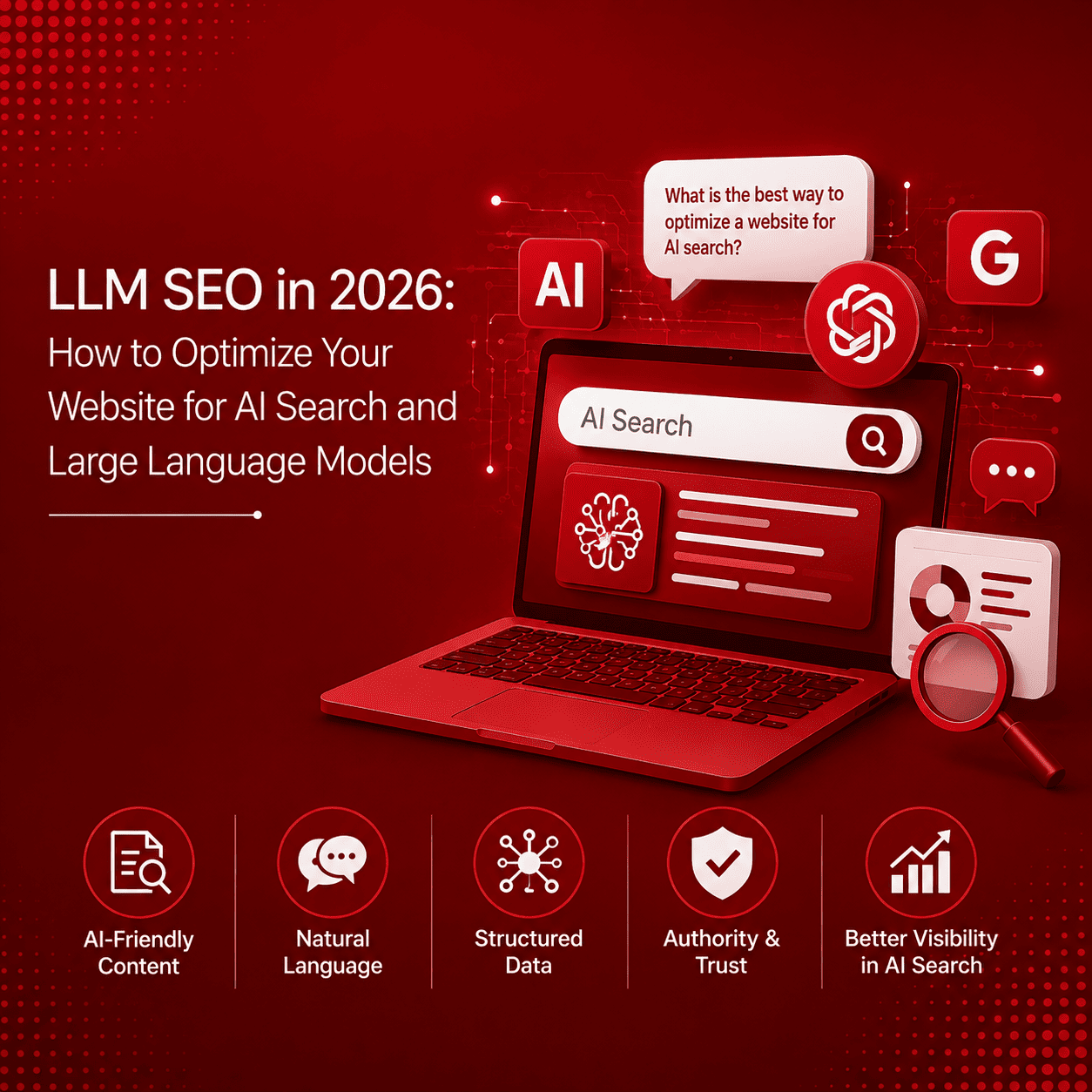
This is where LLM SEO comes in. LLM SEO is the practice of optimizing your website’s content, structure, and authority signals so AI models can accurately understand, retrieve, and cite your brand when generating answers. It builds on the fundamentals of traditional SEO but adds a new layer of requirements built specifically around how language models read and reason about content.
This guide breaks down what LLM SEO actually means in 2026, why it matters for your business, and the concrete steps you can take to make your website AI-search-ready.
What Is LLM SEO?
LLM SEO refers to optimizing digital content so it can be easily crawled, understood, and cited by large language models when they generate responses to user queries. Unlike traditional search engines that rank pages using backlinks and keyword signals, LLMs synthesize information from multiple sources into a single, direct answer — and they choose which sources to trust based on clarity, structure, and credibility.
In short: traditional SEO gets you found. LLM SEO gets you quoted.
Why LLM SEO Matters in 2026
- AI Overviews and chat-based assistants have become a default first stop for research and comparison queries, reducing traditional click-through to websites.
- Being cited by an LLM carries implicit trust — users arrive at your website already believing you’re a credible source, which improves conversion once they do click through.
- Voice assistants, in-app AI search, and browser-integrated AI tools are all powered by the same underlying LLM technology, multiplying the surfaces where LLM SEO impacts visibility.
- Brands that ignore LLM SEO risk becoming invisible in an entire, fast-growing category of search behavior — even while still ranking well in classic search results.
How LLMs Actually Read and Select Content
Understanding how language models process your website is the foundation of LLM SEO. Unlike traditional crawlers that primarily index keywords and links, LLMs attempt to comprehend meaning, context, and relationships between ideas. When deciding what to surface in an answer, they generally weigh:
- Directness — does the page state a clear answer to the likely question, rather than burying it under introductions and filler?
- Structure — are headings, lists, and tables used to clearly separate distinct pieces of information?
- Credibility — does the content show real expertise, sourcing, and authorship, rather than reading as generic or unverified?
- Consistency — does the information match what other trusted sources say about the same topic?
- Freshness — is the content current, or does it reflect outdated facts, prices, or statistics?
Step-by-Step: How to Optimize Your Website for LLM SEO
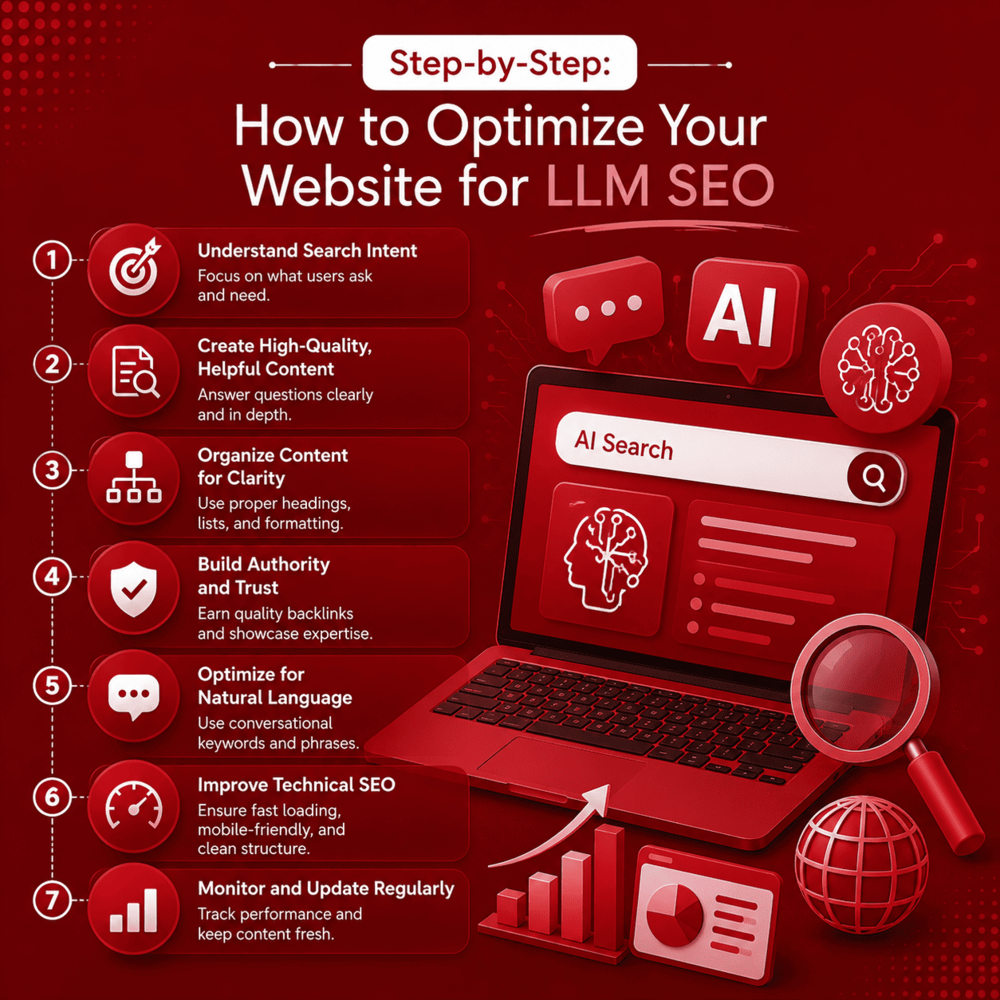
1. Restructure Content Around Direct Answers
Every important page should open with a clear, self-contained answer to its core question, ideally within the first few sentences. Follow this with supporting detail, examples, and nuance. This “answer-first” format matches how LLMs prefer to extract and summarize information for users.
2. Implement Structured Data and Schema Markup
Schema markup translates your content into a format machines can parse with confidence. Prioritize:
- FAQ schema for question-and-answer sections
- HowTo schema for step-by-step processes
- Article and Author schema to reinforce authorship and publishing details
- Product and Review schema for e-commerce and comparison content
3. Format for Machine Readability
Use descriptive H2/H3 headings, short paragraphs, bullet points, numbered steps, and comparison tables. LLMs favor content that can be cleanly broken into discrete, self-contained chunks rather than long, unstructured blocks of text.
4. Strengthen E-E-A-T Across Every Page
- Add detailed author bios that demonstrate real experience and subject-matter expertise.
- Cite verifiable data, original research, and credible external sources.
- Earn backlinks and mentions from reputable, topically relevant websites.
- Ensure every factual claim is accurate, current, and easy to independently verify.
5. Build Deep Topical Authority
LLMs assess how comprehensively a website covers a subject, not just the quality of a single page. Build interlinked content clusters — pillar pages supported by detailed subtopic articles — so your domain reads as a genuine authority rather than a single lucky match.
6. Extend Optimization Beyond Blog Content
LLMs increasingly pull from PDFs, whitepapers, video transcripts, and podcast transcripts, not just blog posts. Structure and transcribe every content format your brand publishes so nothing valuable is left unreadable to AI models.
7. Keep Content Fresh and Factually Consistent
Regularly audit and update statistics, pricing, product details, and industry data. LLMs are more likely to trust and cite sources that stay accurate over time and align with what other authoritative sites currently say.
8. Track Your AI Search Visibility
Manually test how your brand appears across ChatGPT, Gemini, Perplexity, and AI Overviews for your priority queries, and consider adopting emerging AI-visibility tracking tools. Treat this as a standing part of your SEO reporting alongside traditional keyword rank tracking.
LLM SEO Checklist
- Does the page answer its core question directly within the first few sentences?
- Is content broken into clearly labeled sections with headings, lists, and tables?
- Is relevant schema markup (FAQ, HowTo, Article, Product) implemented sitewide?
- Does every important page include a credible, credentialed author byline?
- Are claims backed by data, citations, or original research?
- Is content reviewed and refreshed on a regular schedule?
- Are non-text formats (PDFs, video, podcasts) also optimized and transcribed?
- Are you tracking citations and mentions across major AI search platforms?
Final Thoughts
LLM SEO isn’t a replacement for traditional search engine optimization — it’s the next evolution of it. The businesses that adapt early, structuring their content for both human readers and AI reasoning engines, will be the ones that stay visible as search continues its shift toward AI-generated answers.
2026 is the year this shift becomes mainstream. The sooner your website is built to be read, understood, and trusted by large language models, the sooner your brand becomes part of the answer — instead of a link nobody sees.
Want your website structured for AI-first search? Conceptial Media helps businesses build LLM SEO and AI-search-ready content strategies designed around how ChatGPT, Gemini, and Google’s AI Overviews actually select and cite sources.